
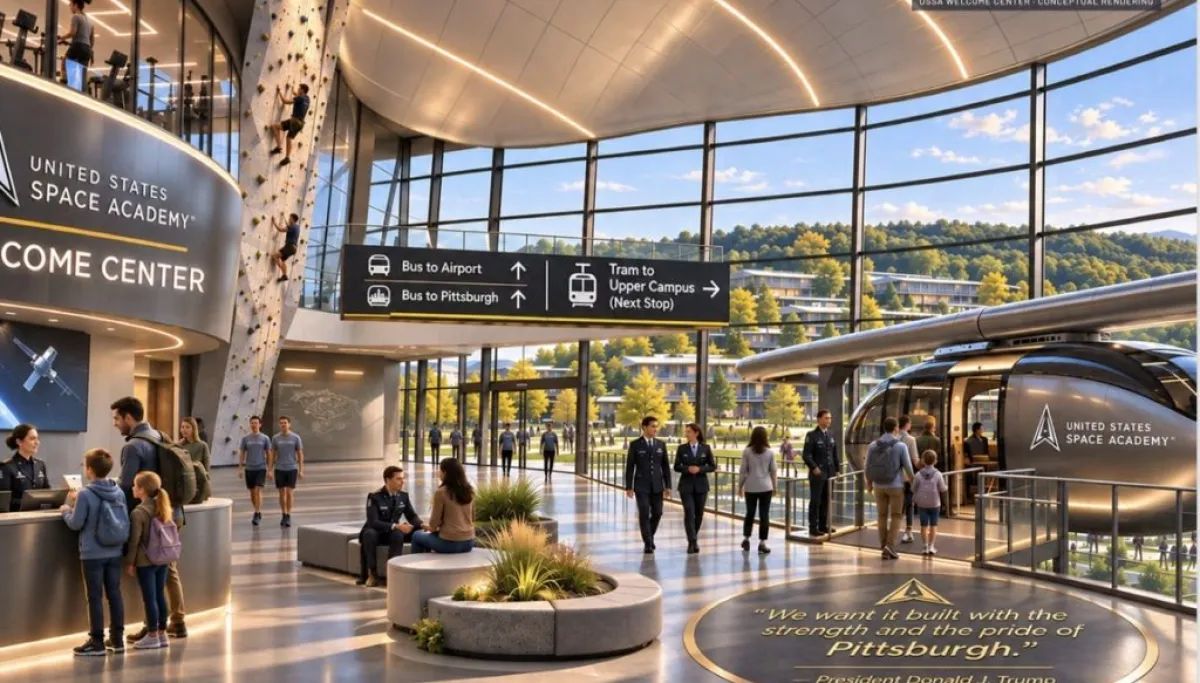
NORTH FAYETTE TOWNSHIP, Pennsylvania — Two years ago, the campus on McKee Road was the kind of place Western Pennsylvanians drove past without looking. Pittsburgh Technical College had closed its doors on Aug. 9, 2024, its classrooms dark and its dormitories empty.On Monday, Pennsylvania will tell the federal government it should become the first home of the United States Space Academy. President Donald Trump has repeatedly visited the region, from Irvin Works to Carnegie Mellon to Carlisle, marveling at its innovation, use of natural resources, and work ethic.“We’re bringing it back,” said Justine Kasznica, the Pittsburgh attorney who founded the Keystone Space Collaborative and sits on the executive committee that assembled the state’s bid. She called the old college “a turnkey, turn-on-the-light situation.” Under the proposal, about 300 cadets would arrive here in 2028 and live in three residence halls with a combined 461 beds, according to the bid’s 23-page brochure, a copy of which was reviewed for this story. In the fall of 2031, the cadets would relocate to Southfield, a 900-acre tract of airport land in Findlay Township, an eight-minute shuttle ride away. The site borders the southwest runway at Pittsburgh International Airport.What makes the bid unusual is not just the real estate. It is who signed on to it.A Democratic governor, a Republican senator, the entire congressional delegation, county and state lawmakers, all seven of Pennsylvania’s top research universities, the airport authority, and the region’s space companies spent six weeks on a single pitch just weeks after one of the state’s most bitter midterm elections.“It’s everybody rowing in the same direction, local, state, federal, Democrat, Republican,” Gov. Josh Shapiro (D-PA) said in an interview.“Pennsylvania has the talent, technology, and industrial strength to help America win the race for space dominance,” said Sen. Dave McCormick (R-PA), adding that bringing the academy to Pittsburgh would “train the next generation of leaders who will ensure America remains the world’s leader in space.”McCormick’s involvement was a condition from the start, Kasznica said. “I said, ‘I’m not doing this unless McCormick’s all in and is willing to go to the mat,'” she said. “He is. He’s a West Point graduate.”The competition began on Aug. 28, when President Donald Trump signed an executive order establishing the academy. NASA Administrator Jared Isaacman chairs the commission that will recommend a site. Each state gets one submission, led by an entity the governor designates.Texas, Florida, Alabama, Colorado and Ohio are expected to compete, and a recommendation is due around Christmas, according to people familiar with the process.Golf course: The 47° Championship Golf Course would be set into the wooded hills of the main campus, steps from the runway. Its holes are named for America’s great space missions, starting with Apollo. The academy would be mostly civilian, producing, as Kasznica put it, “astronauts, but it’s engineers and civil servants and business people and obviously Space Force cadets.”The bid’s case is that almost everything needed to put a rocket in space and to live and work there once it arrives is already made in Pennsylvania.The state is home to 556 firms in the space supply chain, according to a landscape analysis commissioned by the Keystone Space Collaborative, and $8.12 billion in federal space contracts were performed there between fiscal 2022 and May 2026, according to the brochure. Seventy-five Pennsylvania companies supply NASA’s Orion spacecraft.Most are not household names. AccuTrex Products, a veteran-owned shop in Canonsburg, has made precision shims and gaskets since 1980. In Oakdale, a short drive from McKee Road, American High Performance Seals counts space exploration among its markets. The best-known, Voyager Lunar Systems, which began as Astrobotic, builds lunar landers on Pittsburgh’s North Side. On Nov. 7, NASA selected Voyager for its next-generation lunar delivery program, which carries a $10 billion ceiling.In 1969, Westinghouse cameras sent the world its first live pictures from the moon, and Alcoa alloys flew in the Saturn V. Two years later, Pittsburgh-born James Irwin walked on the moon.The bid team chose a griffin as the academy’s mascot, a nod to Voyager’s lander. Its motto is Supra Caelum, Ultra Terminum: above the sky, beyond the limit.“If you’re in Southwest Pennsylvania, we see this as the proving grounds for space,” Kasznica said.Then there is the energy under the region’s feet. Pennsylvania is the nation’s second-largest natural gas producer, and the Marcellus Shale underlies about 60% of the state. Westinghouse, headquartered north of Pittsburgh, is at the center of a federal partnership to build at least $80 billion in new nuclear reactors, and it is designing a reactor concept for the lunar surface. A permanent human presence on the moon and Mars, the brochure argues, “will require reliable power, autonomous infrastructure and repeatable manufacturing. Pennsylvania supplies each today.”Penn State, the governor’s designated lead, did much of the heavy lifting. What tipped the university in, according to a Penn State official involved in the effort, was an early call on which Rick Siger, Shapiro’s economic development secretary, and McCormick’s office both made clear they were committed. Seeing a Republican senator and a Democratic governor look at the project the same way, the official said, gave the university reason to “lock arms and jump.”Its engineers drafted a curriculum in about a week, then asked Carnegie Mellon, Pitt, Penn, Temple, Drexel and Lehigh what was missing. Seven Penn State students designed the campus with the architecture firm NBBJ.“Penn State’s research enterprise and academic strengths position us to make a meaningful contribution to this initiative,” Penn State President Neeli Bendapudi said, adding that the universities are building “a rigorous, hands-on curriculum that prepares the next generation of astronauts, scientists, engineers, operators, entrepreneurs, and civil servants.”Cadets would build and fly a class satellite and prospect in a Pennsylvania mine standing in for a lunar cave, drawing on Penn State’s Applied Research Laboratory, Carnegie Mellon’s Robotics Institute, whose students built the Iris lunar rover, and Pitt’s Trivedi Institute for Space and Global Biomedicine.The campus is designed to be seen from the air. Passengers landing at Pittsburgh International would look down on what Kasznica called “a constellation of spheres”: an academic ring, a skytram, a chapel with twin spires and, in the wooded hills by the runway, the 47° Championship Golf Course, its holes named for America’s great space missions.Construction would run $910 million to $2.43 billion for 1,200 cadets, the brochure estimates. Until then, Kasznica said, McKee Road is ready: “I am the USSA from day one.”Western Pennsylvania has spent much of the past half-century being underestimated, sometimes by itself. The mills closed, the young people left, and the region rebuilt slowly around universities, hospitals, robotics, and the shale beneath its hills. It rarely announces itself.Trump has come to look more than once. In May 2025, at U.S. Steel’s Irvin Works in West Mifflin, he announced he would double tariffs on imported steel and told the workers, “We want it built with the strength and the pride of Pittsburgh.”Two months later, at Carnegie Mellon, he headlined McCormick’s Energy and Innovation Summit, saying, “We’re back in Pittsburgh to announce the largest package of investments in the history of the commonwealth of Pennsylvania.” This past July, at McCormick’s defense summit at the Army War College in Carlisle, he said, “Pennsylvania workers will build the ships, submarines, trucks, weapons and industries” that keep the country strong.The bid team noticed. In the brochure’s rendering of the academy’s welcome center, the line from the steel mill is set in gold on the lobby floor.Stadium and student life: The plan includes a stadium for 20,000 to 30,000 people, and the campus sits at the edge of the Allegheny Mountains, minutes from Pittsburgh’s three rivers. Shapiro was at both summits. At Carlisle, he and McCormick shared a panel called “Pennsylvania: Freedom’s Forge,” moderated by Bendapudi. The Penn State official described the relationship among the three as “mutual respect and game recognizes game.”Shapiro credits a formula of union labor, universities training workers, and every level of government pulling the same way. “Aerospace is the next big area of opportunity for us,” he said, and the academy would be “a real game changer.”There is a strategic argument, too, aimed squarely at Washington. NASA’s strongholds are Texas, Florida, Alabama and Colorado. Placing the academy elsewhere, Kasznica said, would be “diversifying and expanding NASA’s constituency.” The brochure is blunter: Pennsylvania built its space economy “without a major federal space anchor. The Academy will become that anchor.”The airport has nonstops to Orlando, Houston, and Washington. NASA’s Glenn Research Center is 105 miles away, and Pittsburgh is within 500 miles of nearly half the country’s population. The 911th Airlift Wing, which flies C-17s under Air Mobility Command, already shares the airfield.Kasznica recalled Isaacman telling her group’s conference in Pittsburgh last month, “You don’t need the federal government to tell you that you’re a space state.” The bid, she said, is the commonwealth’s answer.“We had six weeks to get this stuff done, and we mobilized the entire commonwealth,” she said. “For anyone who says that Pennsylvania does not move fast.”PITTSBURGH’S MOON SHOTNobody is predicting victory. The field is crowded, and the price tag must clear Congress. But on McKee Road, where the lights went out two years ago, the people who built the bid say they have proven what this place can do when everyone pulls together.“We may not win this one,” Kasznica said, “but we’re going to give it our very best shot.”
Pennsylvania bids for US Space Academy with ‘the strength and the pride of Pittsburgh’
Full Article
Original Source
Read the full article at Washingtonexaminer →KhanList aggregates and links to publicly available news content. We do not host full articles from third-party sources. Always verify important information with original sources.