
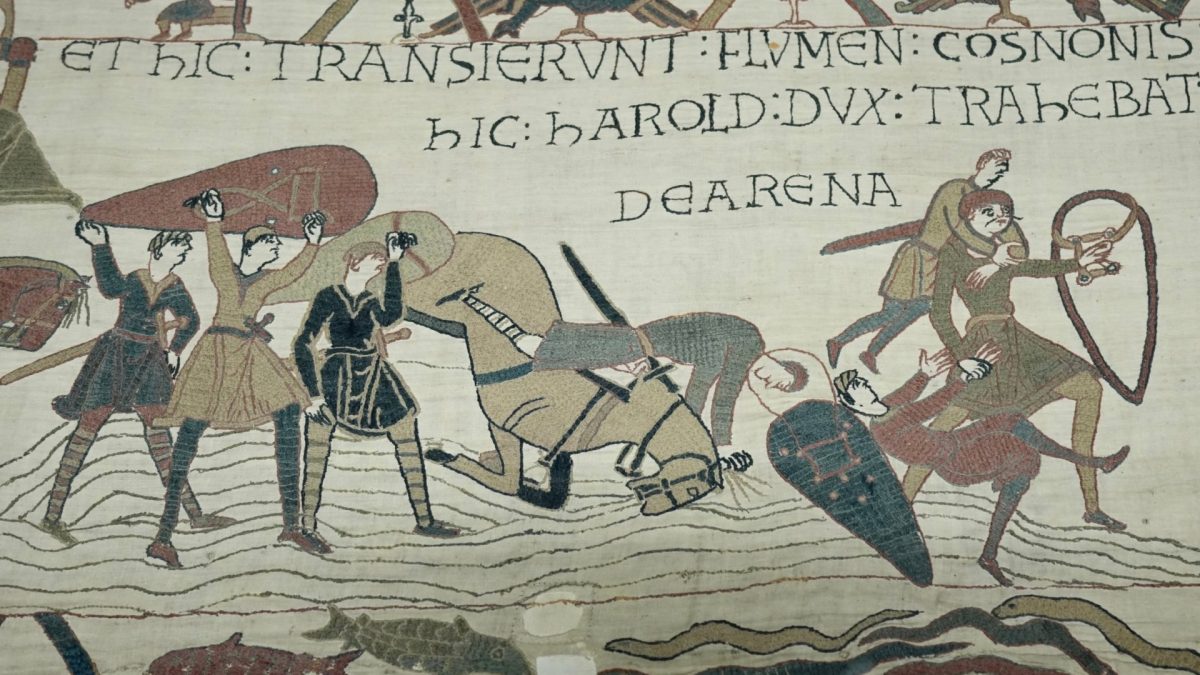
The death of King Harold, felled by an arrow through the eye at the Battle of Hastings, is the Bayeux Tapestry’s defining moment, marking the end of the Saxon era and the beginning of Britain’s fraught love-hate relationship with France, as William the Conqueror became the first Norman king of England. Now in Britain for the first time in almost 1,000 years, the 70-metre long, 50cm high Tapestry enjoys a cultural profile comparable to that of the Mona Lisa. Whether you’ve seen it in the flesh or in a school textbook, it is hard to forget its jaunty, characterful imagery spanning nine linen panels, and its idiosyncratic plant-derived palette of blues, greens, reds, browns and yellows. Beginning in 1065, it describes the events leading up to the Norman invasion and victory over King Harold at the Battle of Hastings on 14 October 1066 – including an inauspicious (for Harold) weeklong appearance by Halley’s Comet in April 1066 – in images stitched with wool and accompanied by brief Latin captions. Ranking as one of the world’s most recognisable artworks has its downsides. In 2014, Nigel Farage triggered a demand for Bayeux Tapestry ties when he wore one during a by-election campaign. Less controversially, it was adapted for a jokey Guinness advert in 1966, the 900th anniversary of the Battle of Hastings, when it also featured on a special set of postage stamps, and a Wedgwood mug. These commemorative trinkets were presumably small compensation for what would have been the ultimate prize that year – the loan of the tapestry itself. Following a previous, failed 1953 attempt to get France to lend it to us, plans to host it in London were revived in 1966. Opposition from the custodians at Bayeux, and British fears about the potential fallout that would result from any damage to the piece, put an end to the idea. The Bayeux Tapestry at the British Museum (Photo: Suzanne Plunkett/Reuters) The current year-long loan to the UK coincides with the closure for refurbishment of the Bayeux Museum, which when it reopens in autumn 2027 will present the tapestry raised at an angle, a slight adjustment to its display at the British Museum where it is laid flat in a single run. The old Bayeux Museum, which has been home to the masterpiece since 1983, did not have the space for this, and it was hung vertically in a U-shape, an arrangement understood to put excessive strain on the fabric. Despite its ubiquity, experts are uncertain of many key facts about the Bayeux Tapestry. And perhaps inevitably for an object of such age and significance, one or two persistent “facts” are altogether wrong – though if you’ve managed to get this far without knowing that it is not a tapestry, but an embroidery, you’ve clearly not been paying attention these past weeks. A big one is that the soldier with the arrow through his eye might not be Harold after all – the next one along, also in a bad way having been cut down by a Norman sword, could be a candidate. It’s even possible that both of these unfortunate men are Harold, though that would seem uncharacteristically gleeful for what is otherwise a notably restrained, even-handed record of the events leading up to the Norman Conquest. In the age of Putin and Trump, there’s something very novel about the idea of a military victory being heralded with anything less than grotesque jubilation – especially when the main protagonist came to be known as William “the Conqueror”. But the diplomatic tone of the Bayeux Tapestry, which emphasises Harold’s bravery and prowess as a warrior, reveals much about the circumstances of its creation immediately after the Conquest, and the political climate in those early years when the invasion was still a recent memory. Usually dated to the 1070s, Michael Lewis – curator of the British Museum show – explains that its political tact makes a date in the late 1060s a possibility. At this early stage the French were still hopeful that the English would acquiesce to Norman rule, though as time wore on, frequent English rebellions provoked brutal crackdowns. French ambassador Hélène Duchêne, British museum director Nicholas Cullinan and the museum’s chair George Osborne at Piccadilly Circus (Photo: Trustees of the British Museum) The French had good reason to be nervous – the English were accustomed to attack, and weeks before the Battle of Hastings, Harold had marched his army north to see off a Norwegian invasion. A missing section brings the Tapestry to an abrupt, yet open-ended close with the retreat of the English. Perhaps the intended ending would also have been open-ended, adding to the sense that the Tapestry was more a tool of persuasion than a monument to victory. The way its storytelling remains open to different interpretations lends weight to the idea that the Tapestry was intended to be seen by a variety of different audiences. As a textile it was portable, and could have toured from place to place, before arriving at the cathedral in Bayeux, the town where it has remained since the 15th century. For centuries the story went that it had been made in France under the direction of Queen Matilda, the wife of Duke William of Normandy (later William the Conqueror). But though today the Tapestry is still believed to have been commissioned by Bishop Odo of Bayeux, half-brother of William the Conqueror – and from 1067, Earl of Kent – the broad consensus is that it was made not in France but by nuns based at a convent near Canterbury, professional embroiderers famed for their high quality work. While the precise location of the workshops is subject to speculation, there is little doubt that the work was designed at Canterbury, since manuscripts from the monastic library have been identified as sources. We may never know who the designer was, but the sophistication of the Tapestry, which delivers its high-stakes narrative in terse captions and expressive imagery, is clearly the work of a consummate storyteller. Almost 1,000 years on, the Bayeux Tapestry has lost none of its political potency (Photo: Kin Cheung/AP) Read from left to right, the narrative is not entirely linear – one memorable moment sees two messengers on horseback dispatched by William to intercept Harold. Their hair flattened into go-faster stripes, they speed leftwards, back towards our last sighting of England’s king. The lower margin introduces a further aspect of the story. Sometimes, a fight breaks out between animals, amplifying a moment of tension in the main plot, while in a scene showing William’s men being swallowed by quicksand, the lower margin details the creatures lurking beneath, alongside a growing body count of stricken soldiers. Perhaps the margins offered an opportunity for the needlewomen to improvise, away from what was presumably a fairly rigid scheme for the main narrative. Certainly this is where you’ll find many of the Tapestry’s famous penises – which may be random comic irrelevances or a lewd and now unfathomable commentary on the story. The sense of meanings lost and reinterpreted over the centuries is brought into sharp focus at various points in the Tapestry’s history. In the 19th century Napoleon recruited it as part of a propaganda campaign, displaying it in Paris as a preliminary to an intended invasion of England. The Nazis were similarly interested in the Tapestry as a way of inserting Hitler’s planned invasion of Britain into his narrative of Aryan supremacy. The story of the Tapestry’s survival during the Second World War, when it was subject to a cat-and-mouse pursuit involving the Nazis, Bletchley Park codebreakers and the French Resistance, is hair-raising enough, and yet only a snippet of its survival story over 100 centuries. The risks involved in allowing it across the Channel seem tame in comparison, and yet anxieties about the loan – which went ahead despite a petition, and warnings from figures including David Hockney – remain. The loan could hardly have been planned with more care – dummy runs were carried out in advance of the Tapestry’s night-time arrival at the British Museum in a humidity-controlled, vibration-proof container last July, and the close collaboration between French and British partners shows that 1,000 years on, the Bayeux Tapestry has lost none of its political potency. ‘The Bayeux Tapestry’ is at the British Museum until 11 July 2027. The next ticket release is on 21 October.
Penises, Hitler and Canterbury nuns – the extraordinary history of the Bayeux tapestry
Full Article
Original Source
Read the full article at Inews →KhanList aggregates and links to publicly available news content. We do not host full articles from third-party sources. Always verify important information with original sources.