
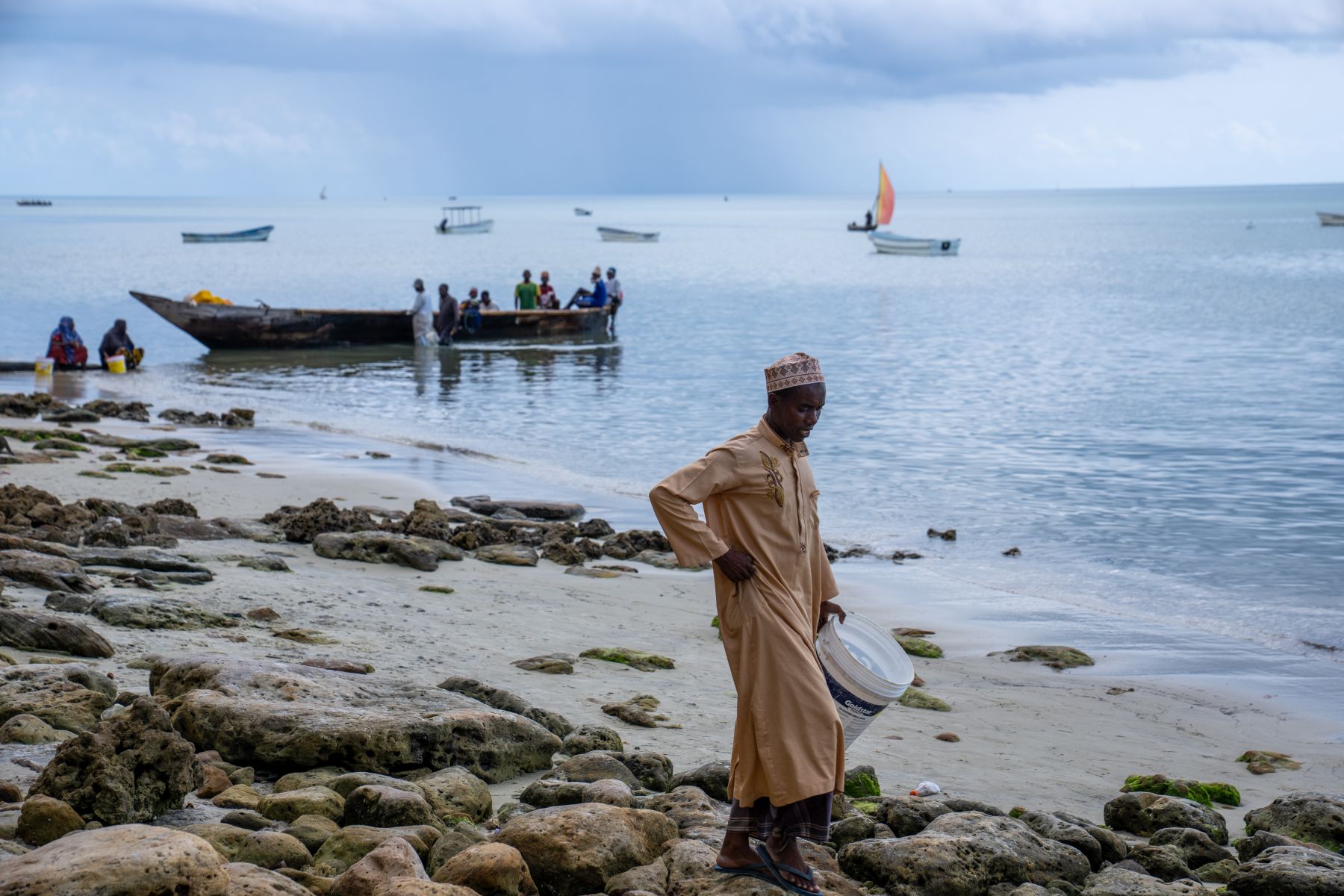
The east coast of Pemba Island was facing severe overfishing and illegal activity leading to declining fish populations and degrading ecosystems.In an extensive collaboration between more than 20 local communities, the Tanzanian government, and environmental NGOs, two new marine protected areas have been introduced in order to protect the ecosystem and those who rely on it.Pemba’s MPAs are providing a lesson on how we can use co-management, true collaboration and locally led solutions to achieve the 30×30 goal in a meaningful way. Omar Hamad Salim, like many other fishermen from Tumbe village, relies on the ocean for food, an income and a way of life. A number of years ago, he and his fellow fishers began returning from the sea with less and less. “Fishers would go to sea and return with very few fish, or sometimes none at all,” Salim says. “And this was not a temporary situation; the shortage had persisted for an extended period.” Salim is one of 12 elected members of the fisheries committee for the Tumbe shehia, or ward, on the north-eastern shore of Pemba Island, part of the semi-autonomous archipelago of Zanzibar. Shehia fishing committees elsewhere on Pemba’s east coast were also worried as their catches shrank. They decided that something had to change. Salim and a few others from Tumbe village conducted a more detailed assessment of what was actually happening, which they then presented to the rest of the village during a public meeting. Fishing committees on Pemba island’s east coast grew worried as their catches shrank. Image courtesy of Adrian Ponsard/WCS. The community had seen how the establishment of the Pemba Channel Conservation Area (PECCA) on the other side of the island in 2005 increased fish populations and improved livelihoods for fishers there. They wondered if new marine protected areas (MPAs) could do the same in the east. Some villagers were hesitant at first, recalls Salim, with fellow fishers wondering: “Where will we get school fees for our children? Where will we get food?” But, in time, he told Mongabay in a phone interview, the majority agreed that an MPA was needed. The community approached the Tanzanian government to propose the establishment of new MPAs. They found a receptive audience in government, which had a track record of embracing such conservation efforts. Some villagers were concerned that creating new protected areas would deprive them of their livelihoods. Image courtesy of Adrian Ponsard/WCS. Collaborating for change The community’s approach to government was the start of a collaboration between more than 20 local communities and the Tanzanian Department of Blue Economy and Fisheries, which in 2022 reached out to non-government organizations including the Wildlife Conservation Society (WCS); Blue Alliance, an international NGO focused on ocean conservation; and Mwambao, a Tanzanian group focused on marine ecosystems. Mwambao was already working with fisheries committees elsewhere in Pemba to strengthen management and protection of marine ecosystems and diversify livelihoods. These NGOs went directly back to the fishers on the east coast and worked with them to conduct baseline assessments of ecosystem conditions, outline the boundaries of two MPAs and how these new protected areas should be managed With the 17th meeting of the Conference of the Parties (COP17) to the U.N. Convention on Biological Diversity underway, the Kunming-Montreal Global Biodiversity Framework and particularly the 30 by 30 target, which calls for the protection of 30% of our land and water by 2030 (just four years away), is under the spotlight. Pemba is quietly showing us what it can look like to turn a paper promise into real and effective change. The Tanzanian government announced the new MPAs at the U.N. Ocean Conference in Nice, France in June 2025. A year later, in June 2026, the areas were officially gazetted. The North-East and South-East conservation areas cumulatively cover 1,300 square kilometers (502 square miles) and protect highly biodiverse waters filled with coral reefs, mangroves, seagrass and numerous threatened species such as the reef manta ray (Mobula alfredi) and commercially valuable species such as yellowfin tuna (Thunnus albacares). The fisheries committee’s members work with Blue Alliance and WCS staff to monitor the water to enforce no-take zones, such as Fundo or Njau, and seasonal closures of certain areas, often during spawning periods. They also ensure no one makes use of prohibited gear such as spear guns. “We also stopped seaweed farming in areas where it was not permitted. This practice was causing environmental damage because people were constantly walking through these areas and trampling the vegetation until it was destroyed, leaving bare sand. Another important step we took was to establish village by-laws to help us enforce the agreed rules and take action against those who violate them,” said Salim Salim describes measures that have been put in place to protect the area, alongside the no-take zones and temporary closures: “Other measures proposed by the community and supported by our leaders included banning harmful fishing practices, particularly the use of kokoro (a type of fishing net with small mesh sizes that favors juvenile fish and damages coral reefs), which poses a threat to fish breeding grounds; fishing with guns; the use of destructive fishing nets; and the use of non-biodegradable fishing nets,” he told Mongabay. Women now make up around 30% of the membership of fishery committees. Image courtesy of Adrian Ponsard/WCS. Salim and other members of the fisheries committee also deal with a large part of the administration side of running the MPA. “My day starts at 8 a.m. and ends at 1 p.m. Among the things I do are: Coordinating committee activities, receiving complaints, hearing cases, attending meetings, processing fishing license applications and providing advice to people who come to the office seeking guidance.” Pemba’s marine conservation areas, both new and old, are designed to allow economic activities such as fishing to continue. In contrast to what the IUCN, the global wildlife conservation authority, calls “strict nature reserves” where human presence and activity are strictly limited, these MPAs belong to a class of protected areas in which conservation, sustainable use of natural resources, and social benefits can be mutually beneficial if properly managed. Abdulrahman Ali Abdalla, the country manager at North Pemba for Blue Alliance, explains that since the MPAs were established, regulation of fishing has increased. When asked what makes Pemba’s MPAs work so well day-to-day, Abdalla is unequivocal: “The system of co-management.” He says that Blue Alliance prioritizes inclusion of a broad range of the community. The involvement of women and youth in patrolling and regulating the MPAs is intended to put them at the forefront in an area, he says, often discriminates against them. Women make up around 30% of fishery committees’ members and growing numbers are becoming involved in aquaculture projects and fillet processing. The new North-East and South-East conservation areas extend over 1,300 km2, protecting waters filled with coral reefs, seagrass and numerous threatened species. Image courtesy of Adrian Ponsard/WCS. But is it working? Hard evidence on ecosystem recovery will take time to gather, according to Makame Omar Makame, the head of the Tanzanian Department of Blue Economy and Fisheries. “The good thing is we have baseline information now,” he told Mongabay. “It is too early to tell but in the near future, we will see how things have changed.” Blue Alliance’s Abdalla says that since the new MPAs were established, patrols have increased by more than 50% — and illegal activity has dropped by around 45%, allowing for future ecosystem recovery. Abdalla says that while most community members understand the long-term benefits of the MPAs from the example of PECCA nearby, and accept the conservation measures, the temporary closures and no-take zones remain a tough pill for some community members to swallow. Fishers can no longer rely on fishing as their sole source of income year-round. The diversification of livelihoods has become critically important, and many opportunities are being explored. While North-East and South-East Pemba MPAs were only formally established in July, conservation projects already underway have produced results in the areas they cover. “My life has improved because my income has increased,” Salim told Mongabay. “Increased catches mean higher income and improved quality of life. The mangrove trees we planted provide fresh air and a cool breeze, and crabs can be seen moving among the mangrove forests.” Blue Alliance is actively working to build Pemba’s broader blue economy. Abdalla mentions their link to Samaki Bluu, a Pemba-based business that buys and processes high-quality fish from villagers, selling it locally and internationally for premium prices. This boosts fishers’ earnings. Abdalla tells Mongabay the NGO is also looking at introducing sea cucumber farming and seaweed drying enterprises. A study of older marine protected areas, set up by the Tanzanian government in the 1990s in response to faltering fisheries, shows how MPAs helped villagers nearby to diversify their income and improve their living standards. This was largely based around tourism which is particularly rampant on Unguja, a nearby island. Abdalla and Makame both say that eco-tourism is something the government and NGOs are pushing for Pemba’s new MPAs. Pemba’s marine conservation areas are designed to allow economic activities such as fishing to continue. Image courtesy of Adrian Ponsard/WCS. For villagers in Tumbe to seize any of these new opportunities, they will need to learn new skills. Abdalla says that through training and education programs facilitated by Mwambao, Blue Alliance and WCS, community members are building new transferable skills and learning more about conservation and preserving the ecosystems they rely on. “This position has also increased my confidence, skills, experience and knowledge in leadership. It has allowed me to travel to different places and learn from others,” Salim says. But, Abdalla says, some of the training and education around the MPAs has flowed in the other direction: “They (the local villagers) have their own way of knowledge and sometimes more expertise,” he said, “so by involving them, we get a lot of information, which might not be written anywhere else. More knowledge and skills on conservation, but also in how we can help them support their livelihoods.” One direct example of how local knowledge has been harnessed is to help identify spawning aggregation sites which can then be prioritized as no-take zones. The newly-created MPAs in Pemba offer something of a blueprint for other marine conservation efforts. “Community participation also contributes to the success of conservation initiatives, because people are more willing to protect and support activities they have helped to plan, than those imposed on them after decisions have already been made,” Salim says. Banner image: At the beach, Pemba Island. Image courtesy of Adrian Ponsard/WCS. Finance and Indigenous rights top Africans’ agenda as biodiversity summit opens in Yerevan At Yerevan’s COP17 biodiversity summit, a steep climb ahead for ‘30 by 30’ target Not MPAs but OECMs: Can a new designation help conserve the ocean? Feedback: Use this form to send a message to the author of this post. If you want to post a public comment, you can do that at the bottom of the page. Credits Topics
Pemba’s new marine protected areas show the power of collaboration to meet 30×30 goal
Full Article
Original Source
Read the full article at News →KhanList aggregates and links to publicly available news content. We do not host full articles from third-party sources. Always verify important information with original sources.