
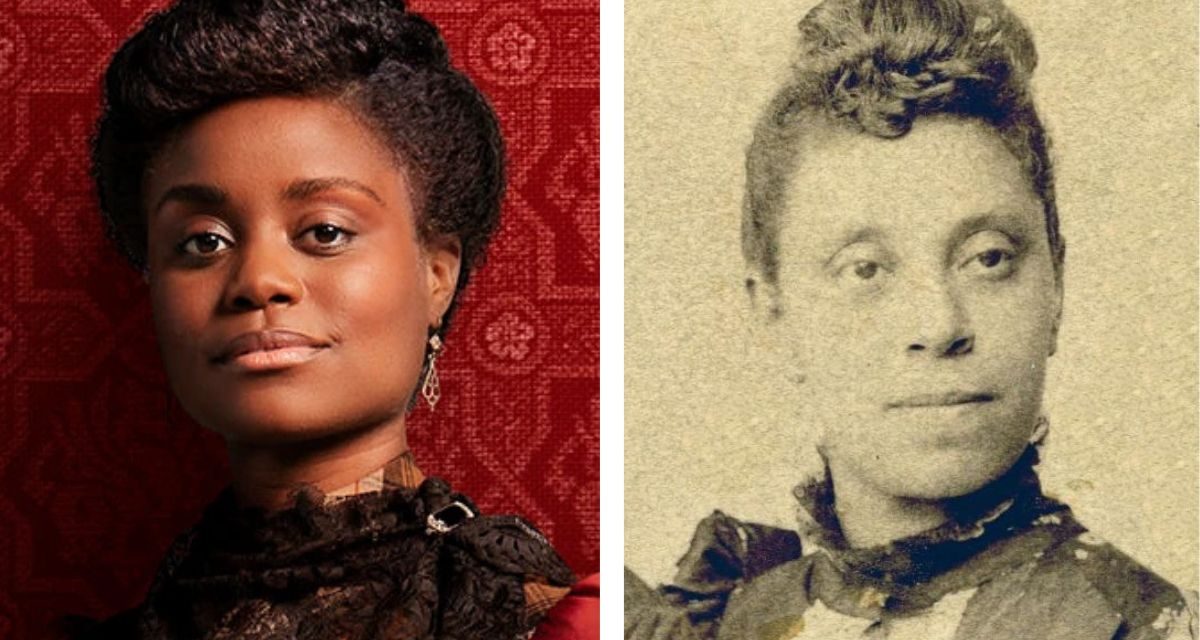
Peggy Scott (played by Denée Benton) has spent much of The Gilded Age figuring out what kind of writer she wants to be. As a Black woman in the early 1900s…the journey hasn’t been an easy one. When a white newspaper offers to publish her work, Peggy discovers that the editor wants her to use a pen name and change her Black protagonist to a white character. This prompts Peggy to write for a Black newspaper instead. Now in Season 4, that question has become even more important as her literary career takes off and she prepares to marry Dr. William Kirkland (played by Jordan Donica). Her ambitions have put her at odds with people who have their own ideas about what her future should look like. This storyline might be fictional, but the world Peggy was navigating was very real Erica Armstrong Dunbar, the show’s historical consultant and co-executive producer, has explained that Peggy is a composite character inspired by several Black women of the era who were creating professional opportunities for themselves, including journalists Ida B. Wells and Gertrude Bustill Mossell, as well as novelist Julia C. Collins. Mossell is a particularly fascinating person to discover. Gertrude Mossell’s writing ambitions also took her into the Black press Born in Philadelphia in 1855, Mossell came from a prominent Black family with a strong tradition of education and civic involvement. Though her mother died when she was very young, her father encouraged Mossell and her sister to read. By the time she was a teenager, she was already writing. Her commencement speech on “influence,” arguably her first work of note, was published in the Christian Recorder after she graduated. As an adult, Mossell worked as a teacher before becoming a journalist in the early 1870s. She eventually wrote for numerous Black newspapers and periodicals, as well as publications serving predominantly white audiences. Then, in 1885, she took on a new role at the New York Freeman, a Black-owned weekly newspaper published in New York City from 1884 to 1887. Founded and edited by journalist and activist T. Thomas Fortune, the paper covered politics, education, civil rights, and other issues affecting Black Americans. It also gave Black writers a place to address their communities directly and shape the conversation around their lives and ambitions. Mossell became the writer behind “Our Woman’s Department,” a column devoted to the interests of Black women, including education, women’s rights, and the challenges facing Black girls and women. We can still read some of what Mossell wrote. In one surviving column, she explained that the department would focus on the “success, progress or needs” of Black women. She encouraged readers to engage with debates about women’s rights and education and invited them to contribute material that could benefit other women. Like Peggy, Mossell wasn’t simply trying to find a place to publish her work. She was helping create a space where Black women’s experiences and accomplishments could be discussed on their own terms. Mossell continued that work beyond her newspaper columns In 1894, she published The Work of the Afro-American Woman, a book documenting the accomplishments of Black women in areas including literature, education, suffrage, temperance, and abolition. She was also active outside journalism. After marrying physician Nathaniel F. Mossell, she helped raise $30,000 for the Frederick Douglass Memorial Hospital and Training School in Philadelphia. She also organized a local branch of the National Afro-American Council. The Gilded Age creators drew on several women when creating the resilient and ambitious Peggy, but Mossell, in particular, shows why Peggy’s ambitions were completely historically plausible.
Peggy Scott’s writing career on ‘The Gilded Age’ echoes a Black journalist who made her own rules
Full Article
Original Source
Read the full article at Upworthy →KhanList aggregates and links to publicly available news content. We do not host full articles from third-party sources. Always verify important information with original sources.