
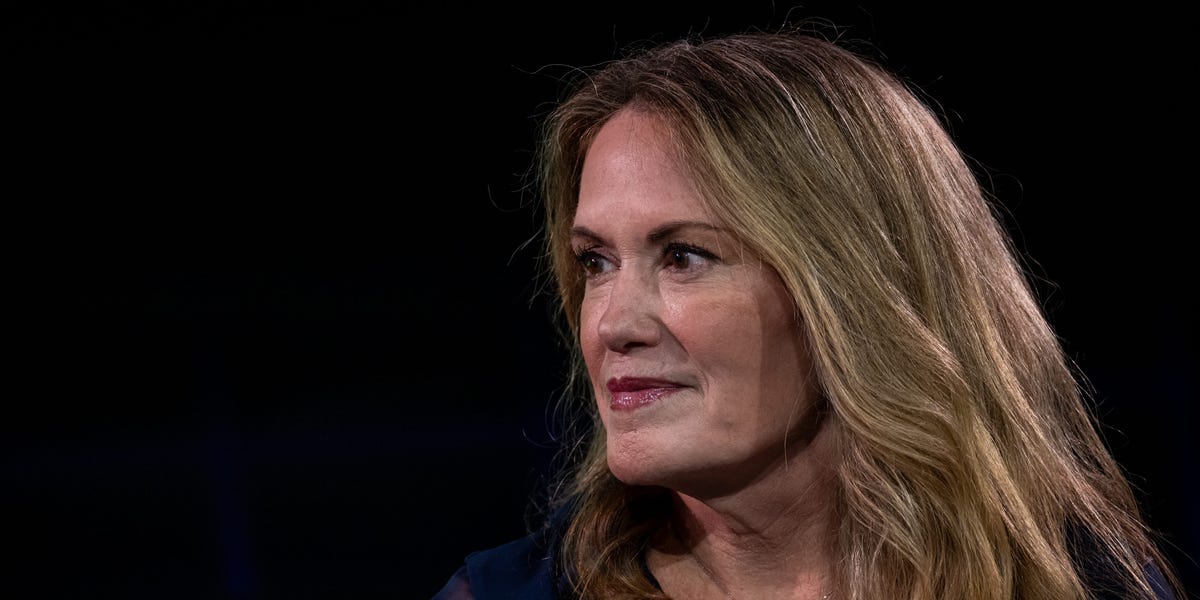
Agility Robotics CEO Peggy Johnson David Paul Morris/Bloomberg via Getty Images When Peggy Johnson began her career as an engineer in 1985, personal computers were only beginning to make their way into homes, the World Wide Web had yet to be invented, and humanoid robots were largely the stuff of science fiction.Four decades later, Johnson, 65, has taken the first humanoid robotics company public in the US.On Thursday, Johnson took Oregon-based Agility Robotics public through a merger with a special-purpose acquisition company that raised about $465 million. The money will help Agility ramp up production and deployment of Digit, its two-legged robot designed to perform tasks in warehouses and factories. Amid market volatility following the midterm elections, Agility shares, trading under the ticker AGLT, closed Friday at $9.90, down nearly 14% from their Thursday close. For Johnson, the listing marks a major milestone in a career that has taken her from Qualcomm to the upper echelons of Microsoft, where she served as CEO Satya Nadella's chief dealmaker, and then to the helm of augmented reality startup Magic Leap.Now, she is tasked with her most formidable challenge yet — turning humanoid robots into a profitable business."I do like taking early-stage technology and pulling it through to commercialization," Johnson told Business Insider. Agility Robotics CEO Peggy Johnson at the 2026 World Economic Forum in Davos. Krisztian Bocsi/Bloomberg via Getty Images Despite billions pouring into humanoid robotics, experts and investors remain divided over whether robots need to look like humans, and the technology has yet to prove itself at scale. Agility generated just $1.8 million in revenue last year while recording a $138.1 million net loss, according to regulatory filings.Still, Agility has a head start on its rivals. Its robots operate across nine customer facilities, including those of Amazon, Toyota, and the logistics company GXO. The company has disclosed more than $300 million in orders for 1,000 robots from a single customer with financial ties to the company.But competition is intensifying. Rivals including Figure AI, recently valued at $39 billion, and Apptronik, valued at roughly $5.5 billion, have attracted significant investor backing and are testing their robots with customers. Elon Musk has staked Tesla's future on Optimus, which Tesla has begun producing at its Fremont factory.Johnson is betting Agility's experience putting robots to work will give it an edge."This is a real business problem right now, and we can fill that need that companies have for automation," she said.From dealmaker to CEOJohnson grew up in a crowded Los Angeles home filled with bunk beds. Her father died when she was young, and she was raised in a blended family of 15 children. Her parents encouraged them to attend college but expected them to pay their own way.Johnson worked odd jobs to put herself through San Diego State University and graduated with an electrical engineering degree. After starting her career at industrial giant General Electric, she joined Qualcomm, then a fledgling wireless technology company, in 1989. A self-described introvert, Johnson initially found it challenging to work in the male-dominated engineering world. "I did struggle to have my voice heard," she said.But she found her footing, rising through engineering, sales, and business development over 24 years to become executive vice president of global market development. Along the way, she led the division that launched BREW, an early mobile app platform that enabled more than $1 billion in app sales. Agility's Digit 5 humanoid Agility Robotics Former colleagues told Business Insider that Johnson was known as an avid runner and a relentless dealmaker who cultivated relationships across the wireless industry. Paul Jacobs, Qualcomm's former CEO, singled out two deals that cemented her reputation: a 2002 agreement with Nextel involving walkie-talkie-style cellphone technology and a $1.925 billion sale of wireless spectrum to AT&T in 2010. "Those two deals caused Peggy's star to shine very brightly," Jacobs said.Johnson's reputation eventually caught the attention of Satya Nadella, who had just taken over as Microsoft's CEO. In 2014, he recruited her to lead the company's business development efforts. During her six years there, she helped steer Microsoft's $26.2 billion acquisition of LinkedIn and launched M12, its venture capital arm, to forge closer ties with emerging Silicon Valley startups.Nagraj Kashyap, who worked under Johnson at Qualcomm and Microsoft, recalled a boss who gave employees considerable freedom. "She gave me air cover to let me do my job the way I saw fit," he said. "Her motto was to hire good people, and then let them thrive and execute."But Johnson had long wanted to run a company herself. "I kept thinking, I just need a little bit more experience here, a little more experience there," she said. When the pandemic arrived, she decided to take the plunge. Johnson was CEO of augmented reality startup Magic Leap from 2020 to 2023. Alexander Tamargo/Getty Images for Vox Media In 2020, Johnson became CEO of Magic Leap, the augmented reality startup that had struggled to turn its futuristic technology into a viable business. Johnson continued the company's pivot toward enterprise customers and oversaw the launch of a new headset.But as enthusiasm for the metaverse waned, Agility came knocking. Founded in 2015 as an Oregon State University spinout, the startup had spent nearly a decade developing robots. Johnson saw technology ready for commercialization."I saw a working robot that could actually do real work and could deliver value to a real customer," Johnson told Business Insider.Johnson's big testTwo years into the job, Johnson now has to convince public market investors that Agility's technology can deliver a return.Agility's regulatory filings underscore the challenge ahead. The company estimates that its new Digit 5 robot will initially cost $150,000 in materials alone, but projects that figure will fall to $75,000 at an annual production rate of 1,000 robots and $30,000 at 10,000. Its financial model also assumes the robots will last five years and recoup their costs in roughly 18 months under a robot-as-a-service model — projections that hinge on Agility dramatically scaling production and bringing down costs."There's a lot of challenges when it comes to solving unit economics," Michelle Sun, a robotics analyst who writes the Substack Core Matter, previously told Business Insider. Agility's Digit 5 humanoid Agility Robotics Johnson's immediate focus is on making Digit more useful to industrial customers by expanding the range of tasks it can perform. Agility recently opened a 60,000-square-foot engineering facility in Fremont, California, to teach its robots new skills. The company says it has accumulated 65,000 hours of commercial operating data, with each new deployment providing information to improve its technology.While Johnson envisions humanoids eventually entering people's homes, she doesn't expect that to happen within the next five years.For now, she's betting that labor shortages will drive demand from factories and warehouses. She points to a Deloitte study estimating that 1.9 million US manufacturing jobs could go unfilled by 2033. Agility has 30 qualified prospective customers in its pipeline, she said."They can't find people," Johnson said. "It is definitely existential for these companies and we can help solve the problem."Have a tip? Contact Rya Jetha via email at rjetha@businessinsider.com or Signal at rjetha.07. Use a personal email address and a nonwork device; here's our guide to sharing information securely. Robotics Microsoft Tesla More Wall Street Elon Musk Most popular Business Insider tells the stories you want to know about the world of business, technology, and finance Business Insider tells the stories you want to know about the world of business, technology, and finance Business Insider tells the stories you want to know about the world of business, technology, and finance Business Insider tells the stories you want to know about the world of business, technology, and finance Business Insider tells the stories you want to know about the world of business, technology, and finance Business Insider tells the stories you want to know about the world of business, technology, and finance Rya is a senior reporter at Business Insider covering robotics and physical AI. She writes about factory automation, humanoid robots, and the race to collect the real-world data needed to bring AI into the physical world. She previously worked at The San Francisco Standard, where she reported on tech culture and autonomous vehicles. She has a bachelor’s degree from Pomona College and a master’s from the University of Cambridge. Rya lives in San Francisco. Contact her at rjetha@businessinsider.com or on Signal at rjetha.07. Use a personal email address, a nonwork WiFi network, and a nonwork device. Here's our guide to sharing information securely.
Peggy Johnson took humanoid robots to Wall Street. Now she has to make them profitable.
Full Article
Original Source
Read the full article at Businessinsider →KhanList aggregates and links to publicly available news content. We do not host full articles from third-party sources. Always verify important information with original sources.