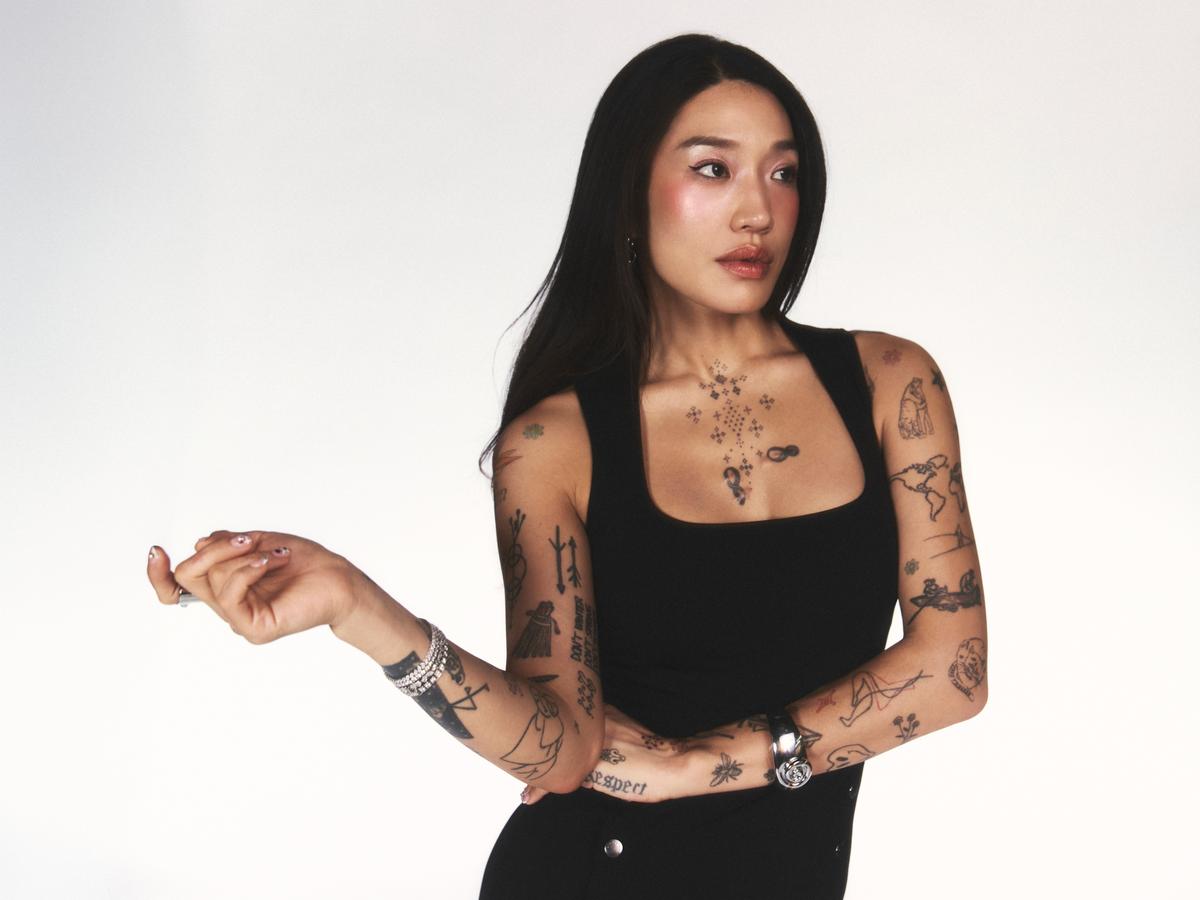
London is melting. The early July heatwave has emptied Tube carriages, packed out parks and pub gardens, and made a strong case for air conditioning engineers to be bumped to key worker status. Sitting next to me on the sofa at her record label’s Notting Hill HQ — brow free of sweat, long hair deadly straight, a patchwork of fineline tattoos emerging from the rolled-up sleeves of her lace top — Peggy Gou is unfazed. “Let’s enjoy it! It’s not going to last for long,” she says to counter my very British weather complaint. “I’m always chasing the sun.” Not even the intermittent air-con in the room can get dance music’s leading lady down. “I have a good feeling about summer,” she tells me, her own just beginning after a slew of festival appearances in Barcelona, Porto and Copenhagen and her 35th birthday celebrations the week before. She usually spends the day in Ibiza, but this year settled on London (where she’s lived since 2024), specifically Mayfair’s Maison Estelle. “I had a little private dinner, went downstairs for a boogie, and ended up at The Box at 4am. The rest is history.” For the South Korean-born DJ, producer, labelhead and fashion designer, this time of year is an important one. “Life is stressful, and I feel like summer heals people,” she says. “That’s the feeling I want them to experience when they hear my music. I like to create songs that make people feel positive. I want them to feel as if they’re on holiday.” “I like to create songs that make people feel positive. I want them to feel as if they’re on holiday.” Three years ago, she did exactly that. Thanks to an earworm chorus, a 1990s Balearic house grove and a decent helping of TikTok hysteria, her sunny track (It Goes Like) Nanana reached the UK top five. Now a staple of festivals and al fresco pre-drinks, the song catapulted Gou into a different stratosphere of fame, one beyond the ears of her usual fanbase of house, techno and disco clubbers. “It was surreal seeing kids and older people singing my song,” she remembers. “I’ve never had a hit like that before.”An ex-clubrat herself, in the decade since she started producing, Gou has racked up as many achievements as her arms used to collect nightclub wristbands. One year in, she became the first Korean DJ to play Berlin’s techno temple Berghain. She has nearly nine million monthly listeners on Spotify, counts Kylie Minogue and Lenny Kravitz as her collaborators, and shortly after releasing her debut album I Hear You in 2024, became the first female DJ to headline Glastonbury’s Park Stage. But before she was Peggy Gou, she was Kim Min-ji. Born to traditional Korean parents in Incheon, the self-confessed “wildchild” didn’t share the same academic focus as her parents or peers. Instead, she played piano and danced to the 1980s and 1990s K-pop blaring from her Walkman. Disappointed with her school grades, her parents sent their 14-year-old daughter to London to learn English and to obtain her GCSEs and A-levels. Far from the Ibizan beach clubs she frequents with Maya Jama or the fashion week front rows she perches on with Chappell Roan, Gou spent her teen years gallivanting around Croydon. “I had to toughen up to live there, you know. I came from Korea, I couldn’t speak any English,” she says over the beep of her handheld fan. “I could’ve easily been bullied or not accepted.” Peggy Gou performs after the match on day two of LIV Golf Hong KongGetty ImagesIf anyone finds her old picture in Croydon, she jokes that she’ll “pay them to get rid of it” (although I can sense she’s being deadly serious). Even from 5,000 miles away, she still managed to anger her parents, lying to the various guardians she lived with about her underage nights out at Tiger Tiger (a rite of passage for any Londoner) and drinking at school discos. “My parents would call the next day and try to ground me, but I said, ‘If you don’t let me go, I’ll do everything I can to get out.’”Thankfully, these WKD-stained dancefloors weren’t her only experiences of London nightlife. After a brief stint back in Korea — where she picked up the basics of beat-matching from her first love — she returned to study at the London College of Fashion. It’s here she discovered a clubbing scene that at the time, her home country lacked. It also triggered an insatiable appetite for house music.“I was going everywhere,” she remembers, listing Cirque Le Soir, Fabric, Corsica Studios and Plastic People as her go-tos. “My joy was watching who was going where every weekend.” She started collecting records from Soho’s Phonica Records — discovering the likes of Kraftwerk and disco maverick Patrick Cowley, her “forever icon” — and under the tutelage of her dancefloor acquaintances, began DJing at The Book Club in Shoreditch.“It taught me so much about making mistakes,” she says of the weekly residency. “I used to focus on who wasn’t dancing, but then I realised I should be focusing on who was, even if there were only two of them. All of these experiences in London made me who I am today.”“All of these experiences in London made me who I am today”Something I learn quickly is that Gou is not afraid of change. I ask her opinion on the state of nightlife today, especially as so many of the city’s venues she spent her formative years exploring now cease to exist. “I was very sad when Plastic People closed, that club meant so much to me as a student. I was amazed by the sound system and every DJ playing there was cool… But I see it as when one thing closes, something else will open. There’s always something new, and you know, change is also necessary.” Her own path took a turn at 21. She quit her graduate job as a London correspondent for Harper’s Bazaar Korea, and set her sights on pursuing music in Berlin. It happened, but not without pushback from her family, especially her dad, a university professor who came from little money. “He was like, ‘Oh wow, what’s next? In a few years are you going to change again and be an artist or architect? How many times do we need to support you?’” Despite their reluctance to provide the financial support she needed to obtain a visa, she made her parents a promise. “I said to them, ‘If I can’t make it in Berlin, I’ll be whatever you want me to be and I’ll pay back everything.’” Thankfully, she didn’t need to. “I make jokes to him now: ‘Dad, if I was still listening to you, I would never have been Peggy Gou. I would be a doctor somewhere in Korea.’” Peggy Gou at the 2026 Cannes Film FestivalGettyI’ll admit I was slightly nervous to interview Gou. Chatter in some corners of the internet paints her as rude and egotistical. Elsewhere, her talent has been questioned and her success attributed to her looks and aspirational social media presence (she has nearly five million Instagram followers). Both are sexist criticisms women in the industry have long faced. But in person, she’s headstrong, funny and oozes a sense of confidence which I gather is all-too-often mistaken for arrogance. “I feel like I’m having a catch-up with an old friend,” she jokes as we practically share a sofa cushion. When we agree she high-fives and fist-bumps, and when we don’t a few minutes later, she isn’t afraid to say it.In spite of her globe-trotting lifestyle (one minute she’s in Mykonos, the next Las Vegas), her Korean values remain entrenched in her psyche. It’s why she grounds herself in alone time and exercise away from the turntables (“We love to take care of ourselves — I joke that Koreans never die”) and explains her reluctance to share details on future music (“In Korea we say people’s minds change 12 times a day, so I’d rather show than tell”).Her tough skin started to form as an adolescent in south London, but it fully hardened after a decade living in Berlin, where she arrived to find a scene dominated by white men. Did she feel welcome in the industry as a woman? “Definitely not.” What about as a Korean? “Definitely not! I get asked these questions a lot, and I always say I don’t want to talk about it because I don’t want to look like I’m complaining.” Peggy Gou at Gunnersbury ParkMike MassaroBut she now opens up about her negative experiences, which mostly took place as she worked in a record store in the German capital. “They wanted me to look pretty and sell records. They didn’t want to talk to me about music,” she recalls of her male colleagues, alleging they referred to her by racist nicknames in private emails, patronised her, and repeatedly quizzed her when she requested remixes for sets. “They’d always ask, ‘What genre is it then?’ and tell me it wasn’t a tech-house track when it was. I had to fight so much to prove myself.” Looking back, this constant battle made her stronger. Although it feels good to silence her critics, she says it’s never been her goal. “I knew what I wanted, and I kept doing what I believed in. So many people told me I’d never be as big as this person, or that I should make EDM if I wanted to be popular. I was just like, ‘Why is everyone telling me what to do?’ Even when I was a child I would never listen to my parents. ‘Why do you think I will listen to you?’”“Even when I was a child I would never listen to my parents”Undeterred, her star rose when she became the face of K-house, a genre she invented by pairing Korean samples, lyrics and instruments (like the gayaguem) with nostalgic house, and which accompanied cultural phenomena like modern K-pop and K-beauty in the late 2010s. Soon, her tunes were recognised before her face was, and her success opened the door for more east Asian women — such as Yaeji and Park Hye Jin — to thrive. Now, she mentors upcoming female talent via Gudu Records, the label she founded in 2019. “It makes me feel proud,” she says of her influence. “I want to be a good example.”Today, she takes inspiration from a new crop of stars — including Rosalía and Steve Lacy — and prefers to let others describe her style. “How would you describe your music?” she mimics in her best journalist voice. “When I get asked that, I’m like, trust me — it’s everything. I collect sounds [she requests records from local artists when she travels]. There are elements from techno, Italo disco, Afro, indie. I don’t define myself. I want to be as diverse as I can.” Peggy Gou performs on stage at South of the Sun festival in Copenhagen in 2023AFP/GettyTake her new track, Wo, Man, for example. The empowering floor-filler may follow her tried and tested formula (a euphoric beat, a nonsensical hook of “adiggy dang, dang, dang, da-dang”), but it’s also an unexpected collaboration with Afrobeats artist Ayra Starr. “Our worlds are very different, people don’t expect her to be making electronic music,” she says of the Nigerian singer-songwriter. Her hope is that the song becomes another canvas for listeners to inscribe their summer memories onto, because that’s exactly how she remembers music — by how it makes her feel. Recently pictured in Bad Bunny’s La Casita during his Madrid concert, she left inspired. “I felt the power of music at his show, it was a different level of emotion. Some people had their eyes closed, some were crying. They’ll talk about their night in 10 years time — what other occasion can you say that about, except festivals and concerts?” “They’ll talk about their night in 10 years time — what other occasion can you say that about, except festivals and concerts?”To celebrate the release of Wo, Man earlier this month, Gou threw a fashion pop-up in east London by the name of Gou,tique. Fans who braved near 40-degree temperatures left with a range of merchandise and items from her personal wardrobe for free (just not her Hermès handbag collection). A way to give back to her supporters, the pop-up is a far cry from the early days of her career, when she believed her interest in fashion — now an integral part of her brand — was a weakness. “I wanted to be taken seriously, so I dressed boring,” she recalls. A conversation with her mentor made her realise that her style is just as much a part of her personality as her music, so she started dressing up — and others soon followed. “I did what I loved, and I started getting emails from other DJs asking how they could work with fashion brands. Nobody else was doing fashion and music in the DJ world when I started. It made me realise that I should always be myself.”Speaking of fashion, before she darts off for a shopping trip (and more reliable air-con no doubt), I’m determined to find out: what does the future hold for Peggy Gou? She was recently entrusted to remix Madonna’s dance comeback I Feel So Free, so I can’t help myself — can she see herself making club bangers in her sixties like the queen of pop? “That’s very far away,” she ponders. “Every year I have a different goal, and right now that’s to be more present. So I’ll think about my future later. Come back and ask me again when I’m 40.”Peggy Gou arrives for the Chanel Fall-Winter 2025/2026 show at Paris Fashion WeekAFP/GettyMore immediately, she wants to learn a new language (in addition to English, German and French), maybe make another summer smash and focus on her upcoming sold-out London show. Enlisting the help of MPH, Prospa and North Wales techno queen Kelly Lee Owens, she’ll take over Greenwich’s Old Royal Naval College on August 2 for a mammoth Thames-side day party. If there’s one show she’s most excited for this year, it’s this one. “This is where I started, and I have a lot of great memories here, so playing a London show always feels emotional,” she gushes. I can tell that being responsible for a crowd’s night is a job she takes seriously — she wants them to talk about it long after the final song plays. “I need to give them the right energy. I think a great artist is someone who does 50 per cent of what they want, and 50 per cent of what the crowd wants. It’s something that’s still homework for me.” Rarely an audience matches this energy. But according to the vibe curator, fashion trendsetter and summer anthem architect, the city she calls her “second home” always pulls through. “They have that kind of trust in me, and the feeling’s mutual. It’s one of those I call a Christmas crowd,” she laughs. “Because I can play a Christmas song and they’ll go crazy.”Peggy Gou plays the Old Royal Naval College on August 2
Peggy Gou: 'They wanted me to look pretty. They didn't want to talk to me about music'
Full Article
Original Source
Read the full article at Standard →KhanList aggregates and links to publicly available news content. We do not host full articles from third-party sources. Always verify important information with original sources.