
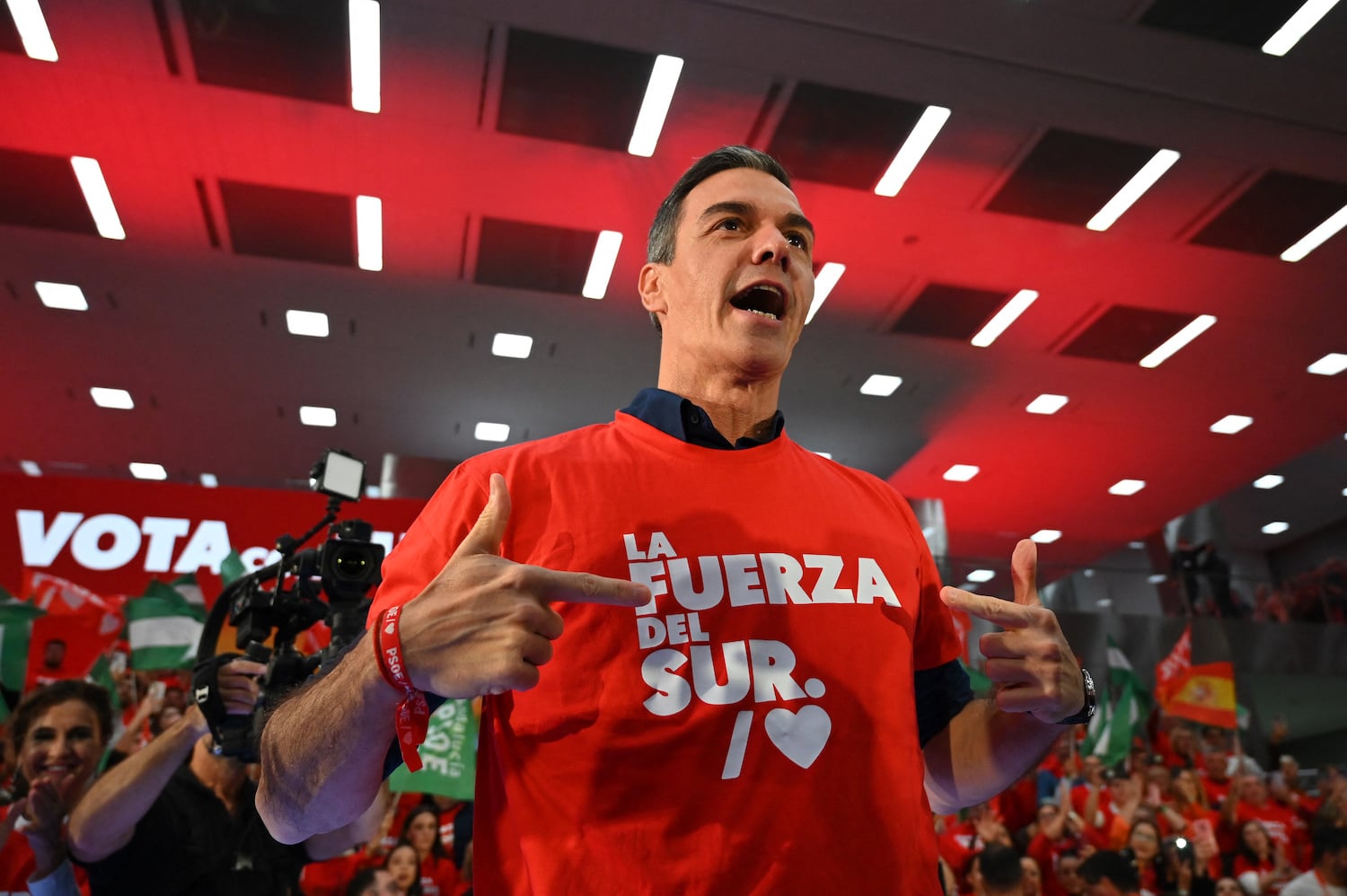
Spain holds elections this weekend—and under normal circumstances, Prime Minister Pedro Sánchez would be cruising to victory. First elected in 2018, Sánchez has established himself as Europe’s longest-serving social democratic leader. He has made Spain the best-performing economy in the European Union. His willingness to welcome immigrants, challenge U.S. President Donald Trump, and describe Israel’s military campaign in Gaza as a genocide have also turned him into an icon of the international left. But Sánchez’s standing at home has eroded significantly in recent years. His government is mired in corruption scandals, his blanket amnesty for separatists involved in Catalonia’s illegal 2017 independence referendum has alienated many voters, and his plan to offer a pathway to citizenship to more than 500,000 undocumented immigrants has provoked a right-wing backlash. After more than eight years in office, he is also confronting considerable voter fatigue. Spain holds elections this weekend—and under normal circumstances, Prime Minister Pedro Sánchez would be cruising to victory. First elected in 2018, Sánchez has established himself as Europe’s longest-serving social democratic leader. He has made Spain the best-performing economy in the European Union. His willingness to welcome immigrants, challenge U.S. President Donald Trump, and describe Israel’s military campaign in Gaza as a genocide have also turned him into an icon of the international left. But Sánchez’s standing at home has eroded significantly in recent years. His government is mired in corruption scandals, his blanket amnesty for separatists involved in Catalonia’s illegal 2017 independence referendum has alienated many voters, and his plan to offer a pathway to citizenship to more than 500,000 undocumented immigrants has provoked a right-wing backlash. After more than eight years in office, he is also confronting considerable voter fatigue. Now, a worsening housing crisis is threatening to become another political liability for Sánchez. Yet he also sees it as an opportunity: By making housing the defining issue of the election, he may be able to divert attention from his political vulnerabilities while mobilizing the left-wing voters he needs to remain in power. Last month, Sánchez dissolved parliament and called a snap election for Nov. 29, roughly seven months ahead of schedule. His biggest electoral challenge is not defeating a surging right but mobilizing left-wing voters. If Spain’s center-right and far-right opposition parties take control of the government, it will likely be because many left-wing voters stay home. An estimated 1.4 million left-wing voters are expected to sit out the elections, according to polling. That’s what happened in another snap election called by Sánchez in 2023. That year, despite losing the popular vote to the center-right People’s Party (PP), Sánchez and his Spanish Socialist Workers’ Party (PSOE) managed to remain in power through skillful coalition-building with separatist parties from Catalonia. The statistics behind Spain’s housing crisis are eye-popping. Between 2015 and 2025, average home prices rose by 80 percent, while rents climbed 87 percent. Nominal wages, by contrast, increased by just 30 percent. An estimated 40 percent of Spanish renters spend an average of 40 percent of their after-tax income on rent and utilities. The burden is even heavier for young people and lower-income households. According to the Bank of Spain, the country currently faces a housing deficit of approximately 750,000 homes, a structural supply gap that could exceed 1 million homes by 2028. Spain’s housing crisis has its roots in the 2008 financial collapse, when the burst of a speculative property bubble made the country an epicenter of a global crisis that also engulfed the United States. That year, Spain experienced the steepest decline in construction activity of any EU country, and new building virtually ground to a halt. Banks also tightened mortgage lending. The resulting financial crisis, which lasted from 2008 to 2013, brought down thousands of businesses—particularly banks—and pushed unemployment to 25 percent. In 2012, a $124 billion EU-backed rescue package restructured and recapitalized Spain’s financial system. Efforts to revive the economy had the unintended consequence of exacerbating the housing crisis. One example is the residence-by-investment program, known as the golden visa. Introduced in 2013, the program sought to attract overseas investment by relaxing restrictions on foreign purchases of Spanish property. It granted Spanish residency to anyone acquiring real estate valued at a minimum of $550,000, or depositing $1.1 million in a Spanish bank. Foreign property purchases surged, fueled by Chinese and Russian investors. But much of the investment flowed into areas where housing was already scarce and expensive: the urban centers of Barcelona and Madrid; the coastal areas of Andalusia, Catalonia, and Valencia; and the Balearic and Canary Islands. In these markets, an influx of foreign capital contributed to rising property prices, putting homeownership increasingly out of reach for locals. Responding to public pressure, the Sánchez government abolished the program last year. Spain’s efforts to promote tourism have also been a mixed blessing. In 2024, the country welcomed a record 94 million international visitors, making it the world’s second-most-visited destination after France. Tourism now contributes $220 billion to the Spanish economy, accounting for 12.6 percent of GDP. But in many cities, the tourism boom has transformed entire neighborhoods into overcrowded tourist zones that overwhelm and alienate locals. Tourism has also increased demand for foreign workers. According to the Elcano Royal Institute, Spain’s immigrant population stands at 9 million, with approximately 600,000 people arriving annually since the end of the COVID-19 pandemic. Many newcomers compete for low-rent apartments that have traditionally been available to young people and longtime residents. Elcano data also shows that young Spaniards leave their parental homes and begin to establish independent households at an average age of 30.3, four years later than the EU average. More than 80 percent of Spaniards aged 16 to 29 still live with their parents, compared with an EU average of 68 percent. For several years, the housing crisis has been convulsing Spanish politics, making the country home to Europe’s most vocal anti-tourism movement. In Barcelona, activists have even sprayed tourists with water guns. City officials have responded with sweeping measures to curb tourism, including some of Europe’s highest tourist taxes, a moratorium on new hotel construction, and a ban on Airbnb-style short-term rentals scheduled to take effect in 2028. But efforts to rein in tourism have set regional and local governments against federal officials in Madrid, who continue to promote tourism expansion by increasing capacity at Spanish airports. It was an unexpected human tragedy, however, that propelled the housing crisis to the top of Sánchez’s agenda—and helped set the stage for next week’s election. On Sept. 23, police evicted Maricarmen Abascal, an 87-year-old disabled woman, from the Madrid apartment she had called home for 70 years. Urbagestión, the investment company that purchased her building in 2018 from a real estate firm, had sought to raise her rent by 230 percent. When she refused to leave, authorities removed her on a stretcher. Her eviction sparked a wave of protests that culminated in hundreds of housing activists occupying Madrid’s central square. Maricarmen died on Oct. 7. Shortly after her eviction, the Congress of Deputies rejected a PSOE-backed bill that would have introduced rent caps and restrictions on corporate property purchases. The legislation faced stiff opposition from conservative parties, including Junts, a Catalan separatist party that nominally supports Sánchez. Opponents argued that the proposed restrictions would further constrain housing supply. Earlier this month, responding to popular pressure, Spain’s interim parliament passed a separate housing bill aimed at limiting evictions and curbing real estate speculation. The PP opposed the legislation and pledged to repeal it if elected. Confident that he will soon be in power, PP leader Alberto Núñez Feijóo welcomed Sánchez’s call for early elections. Polls show a statistical dead heat between the PSOE and the PP. But because neither party is expected to win enough seats to control the Congress of Deputies outright, the far-right Vox—currently Spain’s third-largest party—could emerge as kingmaker. A PP-Vox coalition appears to be a likely outcome of the post-election negotiations. This partnership is not novel: It has been in place at the regional level since 2022 in four autonomous communities: Castilla y León, Aragón, Extremadura, and Andalusia. Vox has used regional governments to advance a nationalist and socially conservative agenda. Yet the PP might be walking into a trap of its own making. As in 2023, a snap election is giving Sánchez another opportunity to demonstrate his mastery of the political comeback. Polls that year also predicted a potential governing majority for the PP and Vox, but that outcome failed to materialize. Sánchez ultimately outmaneuvered Feijóo by assembling a governing coalition. There is a powerful political paradox here: Sánchez is politically vulnerable because of the housing crisis. After all, it was under his watch that housing evolved from a growing concern into a full-blown crisis for Spanish voters. But the opposition’s resistance to his proposed remedies may allow him to turn a political liability into a potentially powerful campaign issue. Framing the election as a referendum on who can best address Spain’s housing woes may offer Sánchez his strongest path to reelection. Rather unexpectedly, the housing crisis has allowed him to shift the campaign’s focus away from corruption and immigration and toward an issue with the potential to mobilize young voters, renters, the elderly, and lower-income households, while also resonating deeply with his Socialist base.
Pedro Sánchez’s Big Bet
Full Article
Original Source
Read the full article at Foreignpolicy →KhanList aggregates and links to publicly available news content. We do not host full articles from third-party sources. Always verify important information with original sources.