
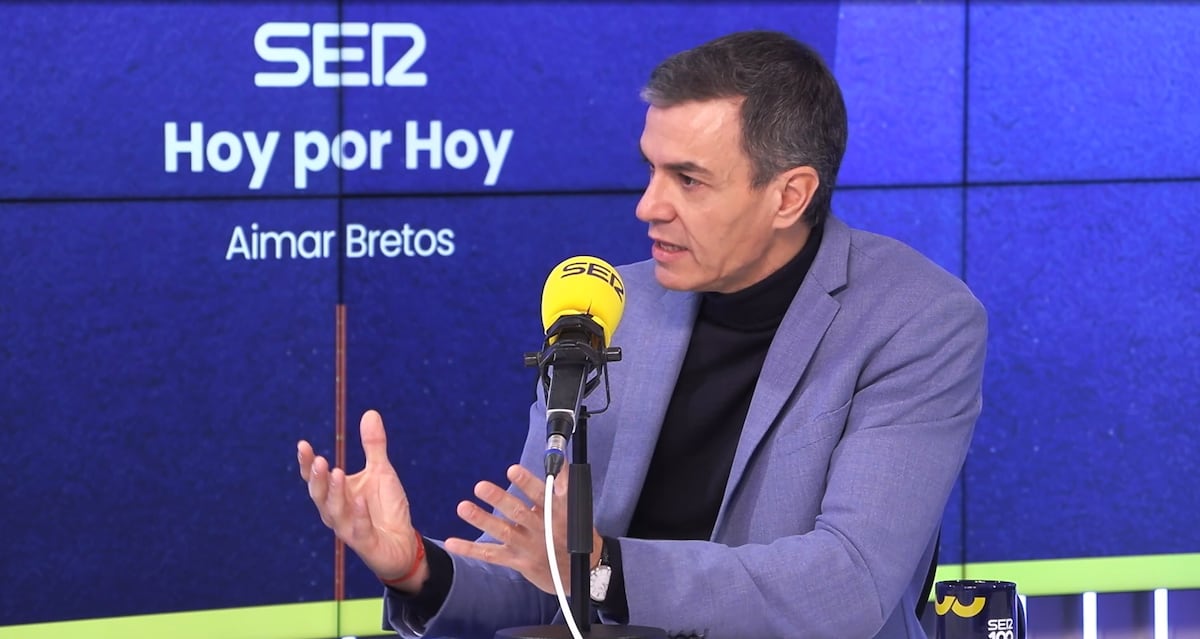
Spanish Prime Minister Pedro Sánchez has said he has polling data suggesting his Socialist Party (PSOE) could finish first in Sunday’s election and secure enough parliamentary support to form another left-leaning government. He urged voters on Friday to “make their votes count” as he sought to shore up support for the Socialists ahead of Sunday’s election.“The data suggests that the PSOE has a very good chance of becoming the leading party, which is an essential prerequisite for a progressive coalition government,” Sánchez said in an interview with Cadena SER radio network. He pointed to what he described as growing voter mobilization, arguing that it could prevent the right-wing People’s Party (PP) and far-right Vox from securing a parliamentary majority and leave room for a progressive government.Sánchez went further, saying he could not envisage losing the election. He called for a parliamentary majority that would allow his government to push through housing policies without being blocked by what he described as an obstacle formed by the PP, Vox and Junts, the Catalan pro-independence party.Asked whether a progressive majority could be formed without Junts, Sánchez replied: “Our data suggests there could be a progressive majority in Parliament.”01:59Feijóo insiste en el "usted calladita" a Colau tras el debateEl presidente del PP, Alberto Núñez Feijóo, y la líder de Frente Amplio, Ada Colau, en el debate del jueves en Madrid. Photo: Juan Medina (REUTERS) | Video: EPVThe leader of the PP, Alberto Núñez Feijóo, was also interviewed on Cope radio on Friday, half an hour after Sánchez. For a few minutes, the two candidates’ interviews overlapped. On the housing crisis, Feijóo argued that the problem could not be solved through “government decrees.” Instead, he said, the answer lay in “bricks, construction, cranes and economic activity.”“We are going to build one million homes,” he said, repeating one of his campaign pledges. Acknowledging that the target would be difficult to achieve, he pointed out that Spain was building 500,000 new homes a year in 2006 and 2007, before the 2008 financial crisis, “when we didn’t even need them.” His own proposal, he said, was to build 250,000 homes a year.Feijóo also outlined other housing measures included in the PP’s election manifesto. These include reforming land-use laws to speed up development and construction, changing the law governing shared ownership of apartment buildings to make it easier to divide larger flats into smaller units, and introducing legislation to tackle illegal occupation of homes (known in Spain as okupación).“I reminded Sánchez that this was already in his 2023 manifesto,” Feijóo said, referring to the proposed anti-squatting legislation. “I raised it again yesterday [during Thursday’s televised debate between four party leaders], but they didn’t respond.”Debate controversyThe first question put to Feijóo concerned the remark he directed at Ada Colau, leader of the left-wing alliance Frente Amplio, during Thursday’s televised debate. Criticizing the government’s handling of the deadly floods in Valencia, Feijóo turned to Colau and accused her of having remained “calladita” — literally, “quiet” or “silent.” But his choice of words caused controversy: he used the feminine diminutive, which in Spanish can carry a patronizing or belittling tone. In the context in which he delivered it, the remark also sounded like a direct order for Colau to keep quiet. Sánchez called Feijóo’s comment “sexist” and “deeply inappropriate,” while the PP leader sought to play down the controversy. “The parties supporting the government have kept calladito and calladita for these seven long years,” he repeated.Tax cutsFeijóo was less than clear in his interview with Cope about the PP’s promise to adjust the lowest income tax bracket for inflation, a measure known in Spain as deflactación del IRPF. The change would prevent taxpayers from being pushed into higher tax brackets simply because their wages rise with inflation, rather than because their purchasing power has increased.“We will adjust income tax depending on the budgetary and revenue capacity we have available,” the PP leader said. He added that his party had an entire parliamentary term to fulfil the commitment in full and would implement its election program “tax by tax.”However, he warned that he feared the worst when it came to the state of Spain’s public finances. His comments echoed remarks he made in an interview with YouTuber Jordi Wild, when he also appeared to temper expectations of the tax cuts the PP has promised if it forms the next government. Sánchez, meanwhile, seized on Vox’s proposal to cut public spending by €112 billion ($122 billion) to warn of what he called an “involución” — a reversal of social progress. The term has become a recurring theme of his election campaign.“The majority of people in this country do not want to see the welfare state dismantled,” the prime minister said. He criticized the far-right party for proposing cuts equivalent to 6% of Spain’s GDP, adding: “To put that into perspective, that’s how much we spend every year on the entire public healthcare system.”Sánchez also accused the PP of wanting to open the door to privatizing the pension system. “What the PP and, of course, Vox are proposing is the privatisation of the public pension system,” he said.Sign up for our weekly newsletter to get more English-language news coverage from EL PAÍS USA Edition
Pedro Sánchez confident he can secure another term for Spain’s progressive government
Full Article
Original Source
Read the full article at English →KhanList aggregates and links to publicly available news content. We do not host full articles from third-party sources. Always verify important information with original sources.