
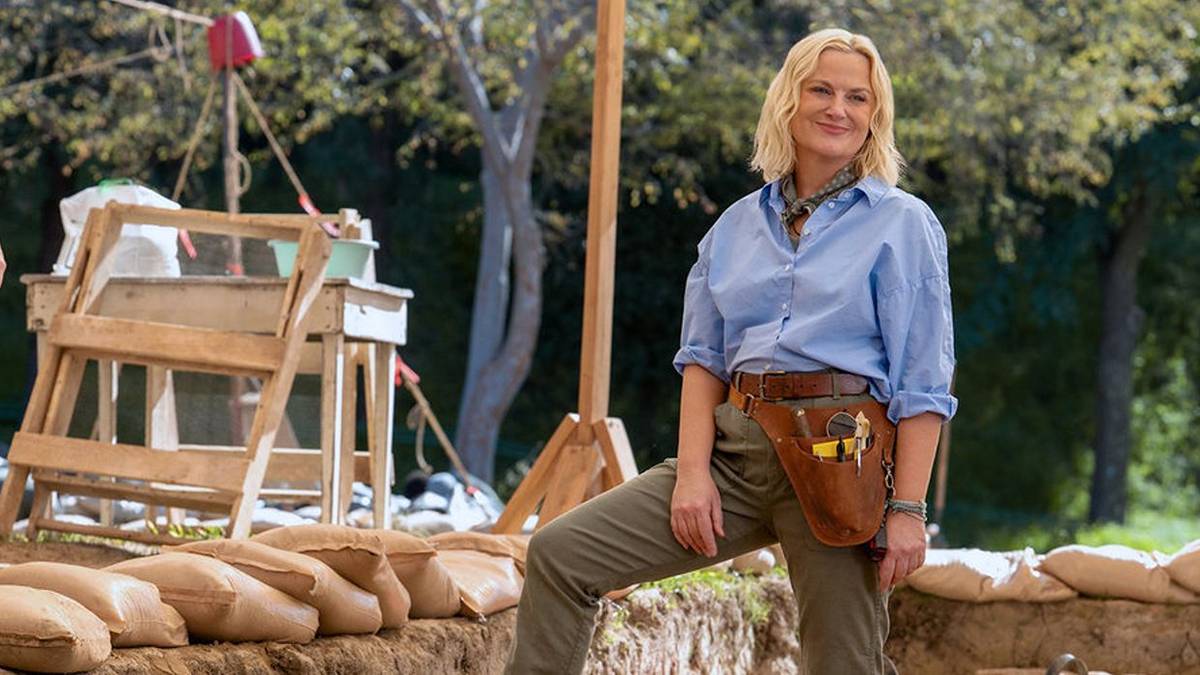
Image via Peacock Published Nov 19, 2026, 12:00 PM EST Jessica is a journalist, editor, TCA critic, and multimedia storyteller with a decade of experience covering pop culture, film, TV, women's sports, lifestyle, and more. She earned her degree in journalism from the University of North Carolina-Wilmington with a focus in creative writing before moving to N.Y.C. and getting her start at The Huffington Post. (She still misses those nap pods.) She's covered multiple film festivals, recapped some of your favorite series, worked too many red carpets to count, and even yapped on a podcast or two. When she’s not interviewing your favorite showrunner or ranking Ryan Gosling's best roles for places like UPROXX, Teen Vogue, Marie Claire, The Daily Beast, and Cosmopolitan, she’s busy being a full-time hype woman to her cat, Finn. You can find her on Bluesky and, sadly, Twitter. Sign in to your Collider account Amy Poehler hasn't led a TV comedy in over a decade, and the return vehicle she's chosen for herself is, of all things, an archaeological workplace comedy set in Greece. Dig, Peacock's new 10-episode half-hour series from Poehler, Mike Schur, and J.J. Philbin, based on Kate Myers' bestselling novel Excavations, reunites the Parks and Recreation brain trust, adding in a dash of Hugh Laurie for good measure. It’s a strong starting lineup, and yet, Dig spends its early episodes trying to be a workplace comedy, leaning on dig-site hierarchies and academic turf wars, when what it actually turns out to be good at is something else entirely. Stick with it. The show finds itself once everyone stops bickering over chain-of-command nonsense and starts working together to solve a mystery (and maybe excavate their own long-buried issues). 'Dig' Gives Amy Poehler Her Best Ensemble Since Pawnee Poehler plays Elise DeBellnick, a career archaeologist who has spent what feels like her entire adult life serving as the right hand to Dr. Neville Wycombe (Laurie), a legendary, pompous, impossibly charming British professor who keeps almost retiring every summer. She dreams of leading her own dig in Scotland, if the gods of academic funding allow it, but every season Wycombe announces his grand departure and then just . . . stays. The students clearly love him. What they don’t love is Elise's management style, which is blunt and humorless and entirely too by-the-book for a group of twenty-somethings spending their sun-drenched holiday on the Aegean coast. The women surrounding Elise are where the show loads most of its more interesting character work, though it takes a while for any of them to land. Geraldine Viswanathan plays Dylan, a former dig favorite who ghosted Elise and the site years ago under circumstances the show treats as a big reveal but lands with a thud. Antonia Thomas is Clare, the hyper-competent lab manager who is roughly a decade younger than Elise and stuck in a Cold War with her that the show gestures at without ever making you feel the weight of. Dylan and Clare have history too, through Clare's fiancé Gary (Jon Pointing), who used to date Dylan. The love triangle, or whatever geometric shape this is, doesn't generate nearly as much tension as the show seems to think it should, mostly because we're never given enough about these people to understand why they'd care about each other this deeply, or at all. Their backstories are a bit too fill-in-the-blank, even for this modern age of television. Then there's Patty Borkman. Fina Strazza, in a performance that should have casting directors rearranging their call sheets, plays Wycombe's twitchy, overeager assistant like a cartoon mouse who somehow earned a research fellowship. She's the character the show doesn't seem to realize it needs the most. Where the other women arrive preloaded with backstory the writers expect you to care about without earning it, Patty is a blank page, and Strazza fills her in with a goofy, wide-eyed sincerity that feels completely unmanufactured. She endears without trying. She's odd in a way the show badly needs more of, a little left of center in every scene she's in, and her chemistry with Poehler sneaks up on them both. Kayvan Novak is a highlight as Stavros, the local Greek mayor who is ridiculous and openly besotted with Elise. The show also sprinkles in cameos from familiar Parks and Rec faces like Mo Collins, which land as fun surprises without being asked to carry too much weight. Instead, the focus is on the setting and job it houses. ‘Dig’ Works Better as a Caper Than a Workplace Comedy The central mystery involves the discovery of a rare artifact the team dubs "Pretty Woman," and this is where Dig starts losing me. The discovery itself feels contrived, too perfectly timed to kick the plot into gear right when it needs kicking. It doesn't help that the artifact looks like it was unwrapped from museum gift shop packaging an hour before they shot the scene. For a show about people who spend their lives sifting through centuries of grime and sediment, nothing about this find has any texture. It's too clean, too white, too pristine. (Someone in the props department apparently decided that ancient Greek statues should look like they were 3D-printed yesterday.) It robs the discovery of the weight it needs to carry the back half of the season, and the resulting whodunit, while competently plotted, never feels like much is actually at stake. But you push past it because what Poehler is trying to do with her characters is genuinely worthwhile. Schur, Philbin, and the team clearly want Dig to be an archaeology Hacks, but the early episodes lean almost too hard into the workplace comedy template with departmental rivalries played for laughs and the whole "dysfunctional team at a quirky job" structure that Schur has built a career on. It's fine. Some of it is sharp. But it's also where the show is weakest, because the dig site never quite feels like a real place with real stakes, and the workplace dynamics can't generate friction when we don't understand why half these people showed up in the first place. Poehler is doing something interesting with Elise even in these early stretches, though, playing a woman whose competence has fossilized into rigidity, whose commitment to one man's project has started to look less like loyalty and more like a failure of nerve. The show just isn't giving her enough to push against yet. Where Dig transforms is around the midpoint, once the mystery forces the four women into actual collaboration. The workplace comedy scaffolding falls away, and what replaces it is a caper driven by friendship. The shift isn't subtle, and it's not entirely smooth, but it works because the actors have been building chemistry in the margins all along. Part of what helps it along is the generational math. Poehler has talked about how Elise sees herself at 19, 29, and 39 in the women around her, and when the show leans into that, it shines. Patty's wide-eyed intensity reminds Elise of who she was before she got cautious. Dylan's restlessness mirrors the version of herself that almost left. Clare's desire to be appreciated for her talents is what Elise feels now. They shouldn't get along, and for most of the early episodes they don't, but the mystery strips away the professional pecking order and forces them to actually see each other. The Final Verdict on ‘Dig’? Stick With It Image via Peacock What saves Dig from collapsing under its own structural wobbliness is the thing you'd expect: the people in it are really, really funny. Laurie, who studied archaeology at Cambridge in real life, starts the season doing what amounts to a prestige comedy cameo, with his kerchiefs and copious Eton references. But somewhere around the midpoint, he unlocks something warmer and more vulnerable, and his scenes with Poehler in the back half of the season become some of the show's strongest. Strazza is the other revelation. She's a dark horse in a cast of heavy hitters, and she commits to Patty's weirdness with a fearlessness that most young actors would sand down into something safer. Instead, she lets Patty be strange and awkward and a little too intense, and it works because Strazza never signals to the audience that she's in on the joke. Dig has the bones (sorry) of something great, and by its final stretch, it's closer to great than the first few episodes would have you guess. The setting is gorgeous when the show ventures off the lot and actually shoots in Greece and southern Italy. Poehler and Laurie are as good a comedy pairing as you'll find on television right now. The worldbuilding never fully recovers from the early stumbles, and Dylan's backstory stays paper-thin no matter how many scenes Viswanathan throws at it. But once the four women lock in and the show stops trying to be an office comedy with shovels, the gap between what Dig is and what it could be narrows considerably. But Amy Poehler on a television set, doing what she does best with people who know how to write for her, is something we’ve been missing for too long. We’re glad Peacock unearthed her talents again for this one. All 10 episodes of Dig drop November 23 on Peacock. Release Date November 23, 2026 Network Peacock Showrunner J. J. Philbin, Michael Schur Directors Dean Holland, Rebecca Asher, Morgan Sackett, Heather Jack Writers Amy Poehler, Michael Schur, Ama Anane Pros & Cons Amy Poehler and Hugh Laurie together are electric, especially in the back half when the show lets them get past the mentor/protégé shtick and into something messier and more real. Fina Strazza is a genuine find, the kind of debut performance that makes you want to track everything she does next. The show gets significantly better as it goes, and the late-season stretch where the four women are actually working together is some of the most satisfying comedy on a streamer this year. Early episodes lean too hard on workplace comedy mechanics that the worldbuilding can?t support, leaving you to fill in character motivations the script skips over. The ?Pretty Woman? discovery feels manufactured and looks it too.
Peacock's New Workplace Sitcom 'Dig' Unearths Amy Poehler's Best TV Role in Years | Review
Full Article
Original Source
Read the full article at Collider →KhanList aggregates and links to publicly available news content. We do not host full articles from third-party sources. Always verify important information with original sources.