
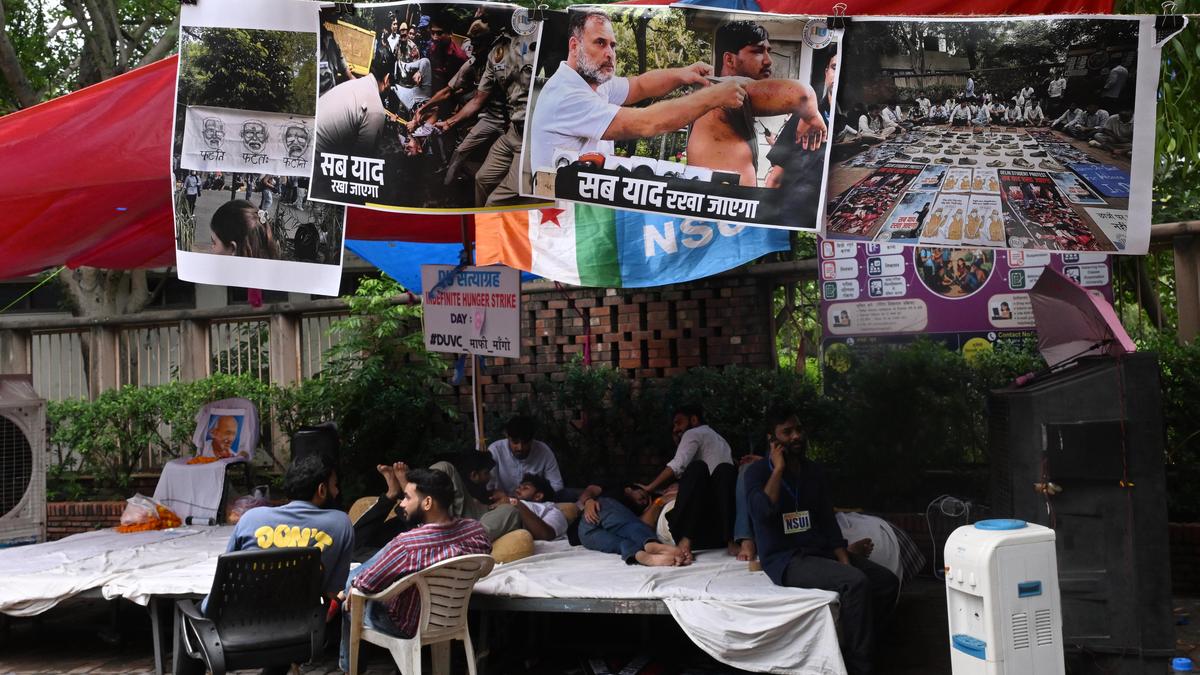
In every constitutional democracy, the right to disagree with the government is not a privilege granted by those in power; rather, it is a fundamental right guaranteed by the Constitution. The freedom to question, criticise, protest, and seek accountability forms the very foundation of democratic governance. When these freedoms are curtailed through the use of criminal law, prolonged incarceration or arbitrary restrictions on speech and assembly, democracy itself begins to weaken.Privilege versus free speech case in Supreme Court disposed of in half an hour after two-decade waitRecent observations by the Supreme Court judge Justice Ujjal Bhuyan have once again brought this constitutional principle into sharp focus. Speaking at the National Law Institute University at Bhopal, Justice Bhuyan warned that India’s democratic space is shrinking, and expressed concern over the growing tendency to criminalise peaceful dissent. His remarks deserve careful attention, not merely because they come from a sitting judge of the Supreme Court but also because they reaffirm the values embedded in the Constitution.Justice Bhuyan has reminded us that peaceful debate and dissent are the life and blood of democracy. Citizens must be able to express disagreement with government policies without fearing arrest, intimidation or prolonged imprisonment. He questioned why protesting students, activists, journalists, and ordinary citizens are increasingly denied bail for extended periods. Bail, he suggested, should not become a tool of punishment before trial. Equally concerning is the growing practice of imposing bail conditions that effectively restrict an individual’s right to free speech or participation in public life.Made to sufferHis observations raise an important constitutional question: if liberty is the rule and detention the exception, why are individuals who have not been convicted of any offence often made to suffer prolonged incarceration? Justice Bhuyan illustrated this concern through recent incidents. He questioned the arrest of eight Muslim men in Varanasi who were detained for consuming chicken while breaking their Ramzan fast on a boat in the Ganga. He pointedly observed that there exists no law prohibiting such an act, and asked how citizens could be denied liberty for months in the absence of any legal prohibition.He criticised the refusal to permit a peaceful pro-Palestine demonstration in Mumbai, emphasising that peaceful assembly and expression cannot be curtailed merely because the views expressed may be unpopular or politically inconvenient to those in power. These examples underline a larger constitutional concern: criminal law must address genuine crimes, not suppress lawful expression or peaceful assembly.The framers of the Constitution understood that democracy cannot survive without disagreement. Article 19(1)(a) guarantees the freedom of speech and expression. Article 19(1)(b) guarantees the right to assemble peacefully without arms. Together, these rights ensure that citizens can question authority, advocate reform, organise movements, and hold governments accountable. Reasonable restrictions may certainly be imposed under the Constitution, but such restrictions must remain exceptional, proportionate, and legally justified. They cannot become routine instruments to discourage criticism or silence inconvenient voices. The constitutional promise is clear: disagreement with the government is not equivalent to disloyalty to the nation.Justice Bhuyan’s remarks echo principles consistently articulated by former Chief Justice Dhananjaya Y. Chandrachud. Long before becoming Chief Justice, Justice Chandrachud delivered what has become one of the most widely quoted judicial observations on democratic freedom in his dissenting opinion in the Bhima Koregaon matter: “Dissent is the safety valve of democracy. If dissent is not allowed, the pressure cooker may burst.” This simple yet profound observation captures the essence of constitutional governance. Democracies remain stable not because disagreement is suppressed, but because disagreement is allowed to find peaceful and lawful expression.Throughout his judicial career, Justice Chandrachud repeatedly affirmed that freedom of speech is non-negotiable in a constitutional democracy. He consistently emphasised that constitutional courts exist to protect citizens against arbitrary exercise of state power, especially when fundamental freedoms are threatened.Justice B.V. Nagarathna has likewise emphasised that constitutional democracy depends upon independent institutions and constitutional morality. She has repeatedly reminded legal audiences that democracy survives only when constitutional values prevail over political expediency. Judicial independence, institutional integrity and protection of civil liberties are not abstract ideals; they are practical safeguards against authoritarian tendencies. Her speeches consistently reinforce the principle that constitutional governance requires institutions willing to protect individual liberty even when doing so may be unpopular.The strongest judicial reminder of this constitutional responsibility remains the legacy of Justice Hans Raj Khanna. During the Emergency, Justice Khanna stood alone in defending the principle that life and personal liberty cannot become hostage to executive power. His lone dissent in the ADM Jabalpur case has since become one of the defining moments in India’s constitutional history. History ultimately vindicated his courage. His dissent reminds every generation that constitutional rights matter most precisely when governments seek to curtail them.Courts are not merely forums for resolving disputes. They are constitutional guardians entrusted with protecting citizens against arbitrary state action. When peaceful protesters, students, journalists, academics, or civil society activists are subjected to prolonged incarceration without timely trials, the concern extends beyond individual cases. It raises broader questions about the health of constitutional democracy.Justice Bhuyan’s observations, therefore, should not be understood as commentary on isolated incidents. They constitute a reminder that constitutional freedoms require constant vigilance. The judiciary cannot remain indifferent if criminal law begins to function as a deterrent against peaceful democratic participation. Strong democracies do not fear criticism.Governments that enjoy public confidence need not silence peaceful dissent. They answer criticism with dialogue, evidence, and accountability, not arrests, prolonged detention, or restrictions on speech. The criminal justice system was created to punish genuine criminal conduct. It was never intended to become an instrument for managing political disagreement or discouraging peaceful civic participation. History across democratic societies demonstrates that suppressing dissent rarely strengthens governments. Instead, it erodes public trust in institutions and weakens constitutional legitimacy. The Constitution envisions a Republic where citizens are free to question authority without fear. The right to dissent is inseparable from the freedoms guaranteed under Part III of the Constitution.Justice Ujjal Bhuyan’s recent remarks, together with the constitutional vision consistently articulated by Justice D.Y. Chandrachud, Justice B.V. Nagarathna, and the enduring legacy of Justice H.R. Khanna, reaffirm a timeless democratic truth: Peaceful dissent is not a threat to the Republic but it is one of its greatest strengths. The true measure of a democracy is not how it treats those who agree with the government, but how it protects those who peacefully disagree. Criminal law must remain an instrument for combating crime, not a means of silencing citizens. When peaceful debate is protected, constitutional democracy flourishes. When dissent is criminalised, it is not merely individual liberty that suffers instead it is the Constitution itself that is diminished.Jantar Mantar and the right to dissentJustice Ujjal Bhuyan’s observations are not merely constitutional ideals; they resonate deeply with recent events at Delhi’s Jantar Mantar, where thousands of young people gathered peacefully to demand accountability for repeated examination irregularities and the protection of their future.The protests, led largely by students and young citizens, were rooted in constitutional values. They sought dialogue, transparency and institutional accountability. Yet, reports of baton charges, the use of pellet guns, mass detentions, prolonged custody and extensive surveillance have raised serious questions about whether the constitutional right to peaceful assembly was adequately protected. The Supreme Court has since directed that no coercive action be taken against the protesters, ordered the release of detained minors and called for an independent inquiry into allegations of police excesses.These developments underscore the very concerns Justice Bhuyan articulated. When peaceful protesters are treated as law-and-order threats rather than citizens exercising fundamental rights, the constitutional balance begins to shift. Criminal law is intended to punish genuine criminal conduct, not to deter peaceful dissent or create a climate of fear around democratic participation.This is precisely why the words of Justice D.Y. Chandrachud — that “dissent is the safety valve of democracy” — remain profoundly relevant. It is also why the legacy of Justice H.R. Khanna continues to inspire generations of judges and citizens alike: the Constitution derives its strength not from unquestioning obedience, but from the courage to protect liberty even in difficult times.The young people at Jantar Mantar were not merely protesting an examination system. They were asserting a larger constitutional principle, that citizens have the right to question authority, demand accountability, and seek justice through peaceful means. Whether one agrees with every demand they raised is ultimately beside the point. In a constitutional democracy, the legitimacy of peaceful dissent does not depend on the popularity of the cause; it depends on the Constitution itself.If India is to remain the world’s largest democracy in both size and spirit, peaceful dissent must never be viewed as an act of defiance against the nation. It must be recognised for what it truly is: an expression of faith in the Constitution and in the democratic promise of the Republic. Criminal law should remain a shield against crime, not a weapon against conscience. For when peaceful voices are silenced, it is not merely dissent that is diminished, indeed it is democracy itself.Mano Thangaraj was a Minister in the previous DMK government in Tamil Nadu
Peaceful dissent is a constitutional right
Full Article
Original Source
Read the full article at Thehindu →KhanList aggregates and links to publicly available news content. We do not host full articles from third-party sources. Always verify important information with original sources.