
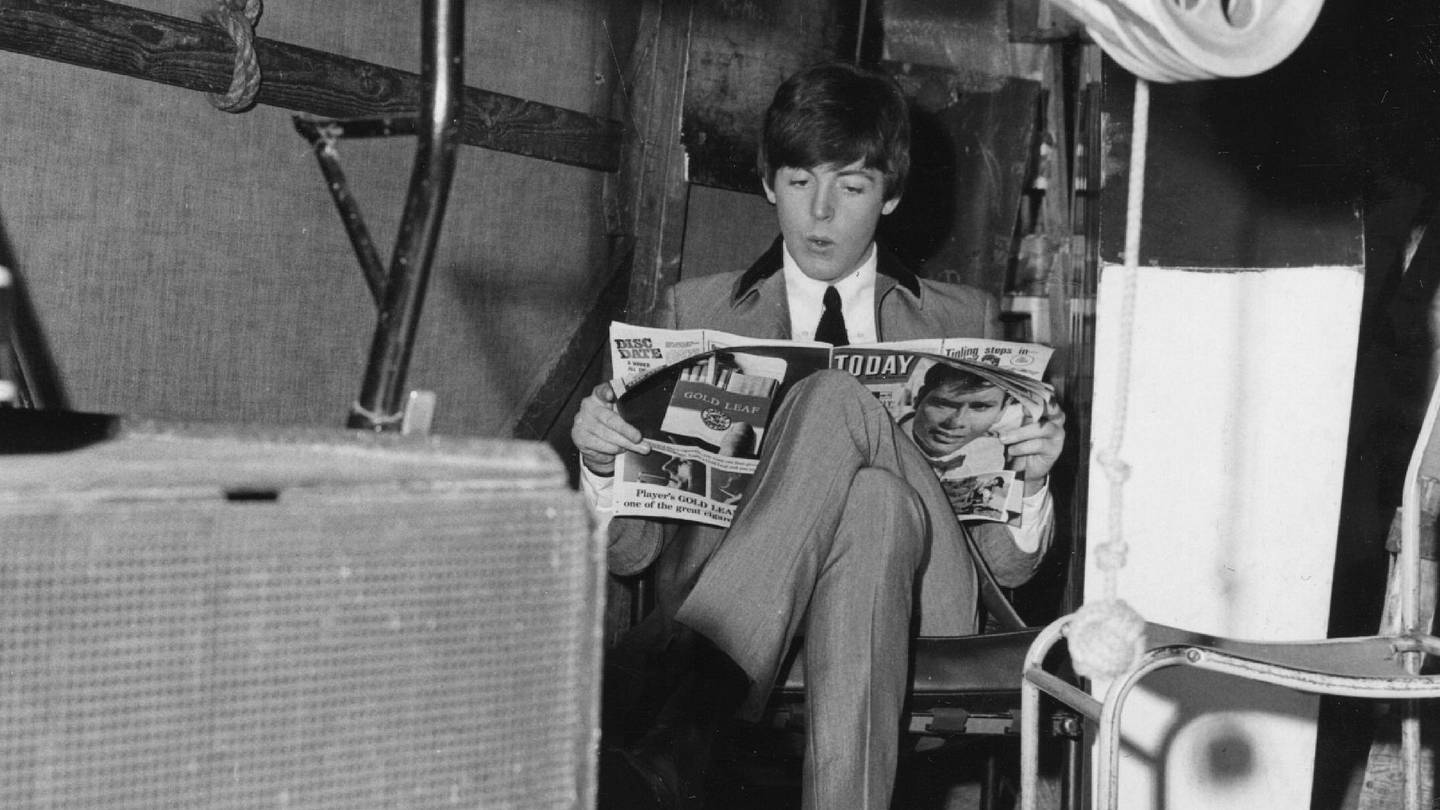
Paul McCartney is the writer behind classic songs including “Yesterday” and “Hey Jude,” so it’s no surprise that this wordsmith has a love for well-told stories.While his bandmate George Harrison preferred spiritual classics like Autobiography of a Yogi, John Lennon enjoyed surrealist and counterculture literature, and Ringo Starr was reportedly often seen reading comics in the studio, McCartney has occasionally mentioned a preference for classic English literature. In particular, he cited Charles Dickens’ The Life and Adventures of Nicholas Nickleby as his favorite book in a 2013 Twitter Q&A. Yet this is far from the only text that has influenced his vast body of work.The books Paul McCartney lovesPaul McCartney With Guitar | Robert R. McElroy/GettyImagesOver the years, McCartney has occasionally discussed the books that have shaped him. When asked about his favorite British writers in a 2014 interview, the musician was quick to cite Dickens along with Dylan Thomas, the Welsh poet and writer behind the poem “Do not go gentle into that good night.”Clearly, though, there was something about Dickens’ The Life and Adventures of Nicholas Nickleby that stood out. This 1839 novel was initially released as a monthly serial, and follows the title character, who is left penniless after his father’s death. To support his mother and sister, he acquires a teaching position at a squalid boarding school, and is later exposed to a variety of characters and cruelties in London. The book is considered a satire that takes aim at society’s treatment of children, corruption in the education system, and other social injustices.An early love of literaturePaul McCartney of the Beatles circled in a school photograph 1950s | Mirrorpix/GettyImagesMcCartney’s love of literature was heavily influenced by Alan Durband, a passionate, Cambridge-educated teacher who taught at the Liverpool Institute for High School Boys when McCartney was a student. “He inspired my love of reading and opened things up for me so much that I came to live for a while in a fantasy world drawn from books,” McCartney wrote in his book The Lyrics: 1956 to the Present. Durband often emphasized the importance of small details in literature, an approach that can be seen reflected in McCartney’s highly specific style of songwriting. He also exposed McCartney to Dickens and William Shakespeare, among other greats.How books shaped McCartney’s songwritingBeatles 1963 reading a newspaper | Mirrorpix/GettyImagesMcCartney went on to incorporate literary references into much of his work. The lyric “and in the end the love you take / Is equal to the love you make” from the Beatles track “The End” was inspired by the way Shakespeare often closes his scenes with couplets. Additionally, McCartney’s song “Jenny Wren” takes its name from a character in the Dickens novel Our Mutual Friend.In The Lyrics: 1956 to the Present, McCartney also cited Lewis Carroll and Edward Lear, both pioneers of the “nonsense writing” tradition whose influence can be seen in Beatles tracks like “Yellow Submarine.” He and Lennon bonded early on over their mutual love for the genre. “I like surrealist art, I also like surrealist words,” McCartney shared. “A great example of this is Lewis Carroll writing Alice in Wonderland—it’s a crazy thing, you’ve got a cat sitting in a tree that grins and talks, and you’ve got Alice falling down a hole and meeting the red queen, and so on. That whole tradition was something that I loved, and when I met John, I learned that he loved it too. So, it was something that became a bond between us.”Over the years, McCartney has written a number of books himself. In addition to The Lyrics: 1956 to the Present, he is also the author of the children's adventure novel High in the Clouds, the children's picture book Hey Grandude! and its sequel, Grandude's Green Submarine. All that, of course, is in addition to well over 1,000 original songs that have, fittingly, earned him the nickname "The Dickens of Rock."
Paul McCartney's Favorite Book Is a Satirical English Classic
Full Article
Original Source
Read the full article at Mentalfloss →KhanList aggregates and links to publicly available news content. We do not host full articles from third-party sources. Always verify important information with original sources.