
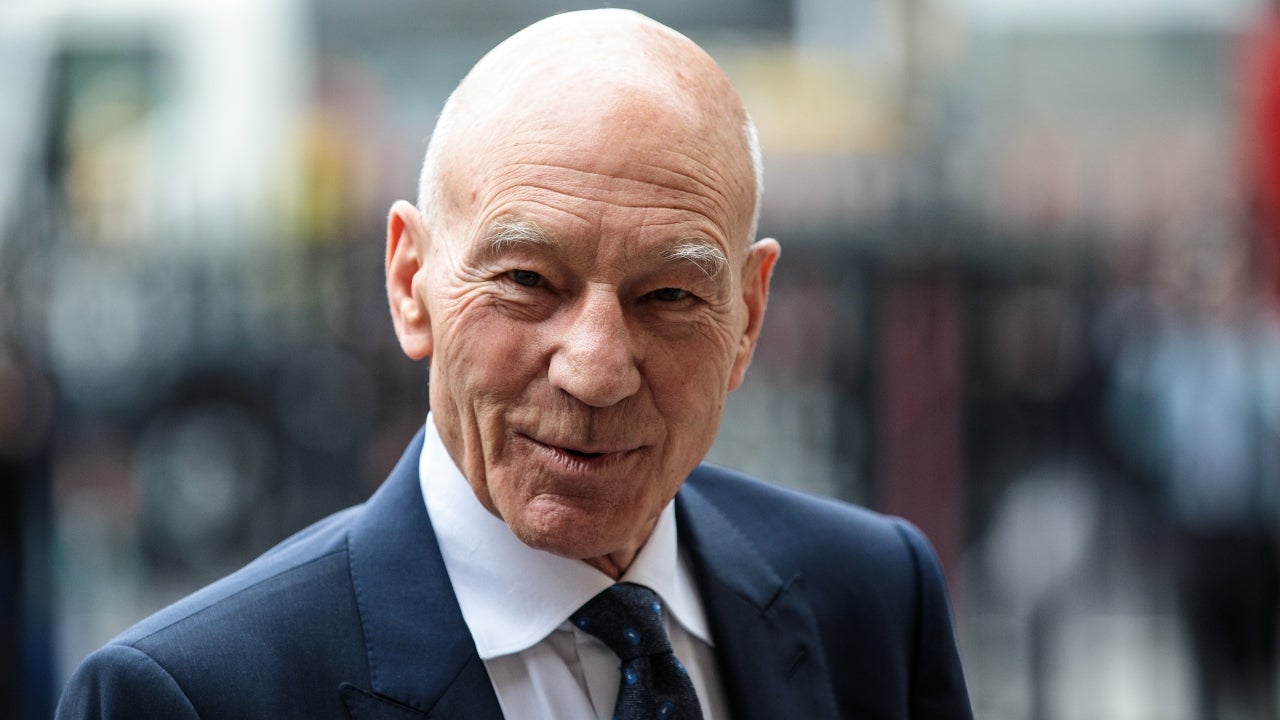
Patrick Stewart, who died this week at the age of 86, came from a background you probably never would have guessed but always knew was there.He was the son of working-class people — his mother was a textile worker, and his father fought in World War II before becoming a laborer — but he always had an air of austerity and sophistication. The way words rolled around inside his mouth, whether they involved some arcane Starfleet detail, Shakespearean verse or something to do with mutants, made everything feel gilded and refined. Dialogue was gold-plated, even if it was a dirty joke or an odd aside. There was always a playfulness, undoubtedly the product of an upbringing that left him with a chip on his shoulder and something to prove, that grounded even his loftiest performances. He was an unparalleled titan of stage and screen (he won two Laurence Olivier Awards and a Grammy Award) who could also, just as convincingly, present Godzilla with the Lifetime Achievement Award at the 1996 MTV Movie Awards or pitch Ricky Gervais a movie in which he would telepathically remove women’s clothes. “She’s trying to cover up,” Stewart, playing a heightened version of himself, told Gervais’ struggling actor. “I’ve already seen everything.” He will be greatly missed. Stewart began acting onstage in the late 1950s and became a member of the Royal Shakespeare Company in 1966. A year later, he made his debut on “Coronation Street,” the long-running English soap opera. In the 1970s and early 1980s, he co-starred in a number of high-profile television productions, including “I, Claudius” (based on Robert Graves’ 1934 novel), John le Carré’s “Tinker Tailor Soldier Spy” (and its follow-up, “Smiley’s People”) and a BBC production of “Hamlet” in which he played Claudius opposite Derek Jacobi as Hamlet. On the big screen, Stewart made early appearances in John Boorman’s “Excalibur” and David Lynch’s “Dune.” Both films were largely overlooked at the time of their release but have since become cult classics. The same could be said of Tobe Hooper’s bonkers “Lifeforce,” a movie more commonly remembered for its elaborate special effects and the frequent nudity of star Mathilda May than for anything Stewart did, sadly. In 1987, of course, Stewart’s life would change forever when he was cast as Jean-Luc Picard, captain of the Enterprise-D. The show’s early production was chaotic, particularly as Gene Roddenberry, creator of the original “Star Trek” series, attempted to maintain control. The elaborate production often felt rushed and out of control, but Stewart’s performance, both steely and sensitive, served as its anchor. Even when the show tackled outrageous scenarios, Stewart brought profound depth to the role. This was especially evident in episodes like “The Inner Light,” from Season 5, in which Picard lives an entire lifetime on an alien world. Stewart played Picard in all 176 episodes of “Star Trek: The Next Generation,” as well as the pilot episode of “Star Trek: Deep Space Nine,” four “Star Trek” movies and countless video games. He returned to the character in 2020 for “Star Trek: Picard,” which concluded with a triumphant third season in 2023 that brought together much of the “Star Trek: The Next Generation” cast. For so long, Stewart was such a constant, dependable presence — on our television screens, in our movie theaters — that it was easy to take him, and the nimbleness of his performances, for granted. He became like an old friend, someone you consulted for guidance, a north star of goodness and understanding. Wherever you were going, he could steer the way. In 2000, Stewart landed another of his most iconic roles, this time as Professor Charles Xavier in Bryan Singer’s “X-Men.” The film predated the superhero boom ushered in by Marvel Studios (Kevin Feige was a young associate producer on the movie) and helped establish that comic book source material could be taken seriously. Stewart’s casting as the telepathic leader of a group of superpowered mutants was straight out of the pages of Wizard Magazine — who else but Stewart could essay the role of an erudite, British, worldly figure who could also be warm and welcoming? It says something that, more than 25 years later, he was still playing the role. His final announced big-screen appearance will be in “Avengers: Doomsday,” which opens this Christmas. But the joys of Stewart’s career can often be found elsewhere, not in the marquee characters or franchises but in the smaller, stranger roles to which he brought just as much intensity and dedication. He appeared in or performed in dozens of projects over the decades: He hosted a 1994 episode of “Saturday Night Live” with Salt-N-Pepa as the musical guest; starred in a TNT movie version of “A Christmas Carol”; and voiced a character in 16 episodes of “Family Guy” and 122 episodes of “American Dad!” (as Stan’s boss at the CIA). Stewart was the original narrator for Tim Burton’s “The Nightmare Before Christmas.” Director Henry Selick ultimately replaced his narration in the film, but Stewart’s version appeared on the official soundtrack album, including the deleted epilogue. Stewart was also a really, really good villain, which speaks to his talent as a performer, especially considering how frequently he radiated goodness in his personal life. Among other things, he was a passionate advocate for pit bulls and fostered several of the dogs, a breed unfairly maligned in the U.S. and subject to breed-specific restrictions in the U.K. In Richard Donner’s underrated thriller “Conspiracy Theory,” made at the height of Stewart’s pop culture prominence, he plays a scheming CIA operative who gets his nose bitten off by test subject Mel Gibson. Stewart oozes smarmy malevolence, and it really is a joy to watch. But his best bad-guy role was probably in Jeremy Saulnier’s brilliant, edge-of-your-seat feature “Green Room,” in which Stewart played the leader of a group of murderous neo-Nazis in the Pacific Northwest who intend to hunt down and kill a punk rock band playing at their bar. Stewart is pure evil. He makes the already thrilling movie nearly unbearable. It is a singular, terrifying performance that only Stewart could have realized so fully. We reached out to Saulnier, who said this about Stewart: “Sir Patrick Stewart was the real deal. A man of his talent and stature had no business making a scuzzy little punk rock film like ‘Green Room.’ But his sense of adventure and generosity led him deep into the woods of Oregon with a bunch of kids and an unproven director to experience something very special. He will forever have my admiration and gratitude for his kindness, his leadership, his wit and for showing the world at large what exactly a true gentleman is. My heart goes out to Sunny and to all those who hold him dear.” Earlier this year, Stewart voiced a sheep in the charming mystery “The Sheep Detectives.” In a lesser actor’s hands, it could have been something throwaway — just a job. But Stewart brought a dignified elegance to his performance as the elder sheep in a flock attempting to make its way without its shepherd (played by Hugh Jackman, Stewart’s frequent “X-Men” colleague). The sheep’s feelings of being lost without their north star are surely how many of Stewart’s fans must feel today. Stewart was always a constant reminder of how good we could be if we put our minds to it. It didn’t matter whether he was piloting a starship, wheeling around a mansion or lending his voice to cartoon characters and talking sheep. Without Stewart, the world is less regal, less dignified, less sure. Without our Captain, how will we find our way?
Patrick Stewart Spent His Career Leading Us Forward | Appreciation
Full Article
Original Source
Read the full article at Thewrap →KhanList aggregates and links to publicly available news content. We do not host full articles from third-party sources. Always verify important information with original sources.