
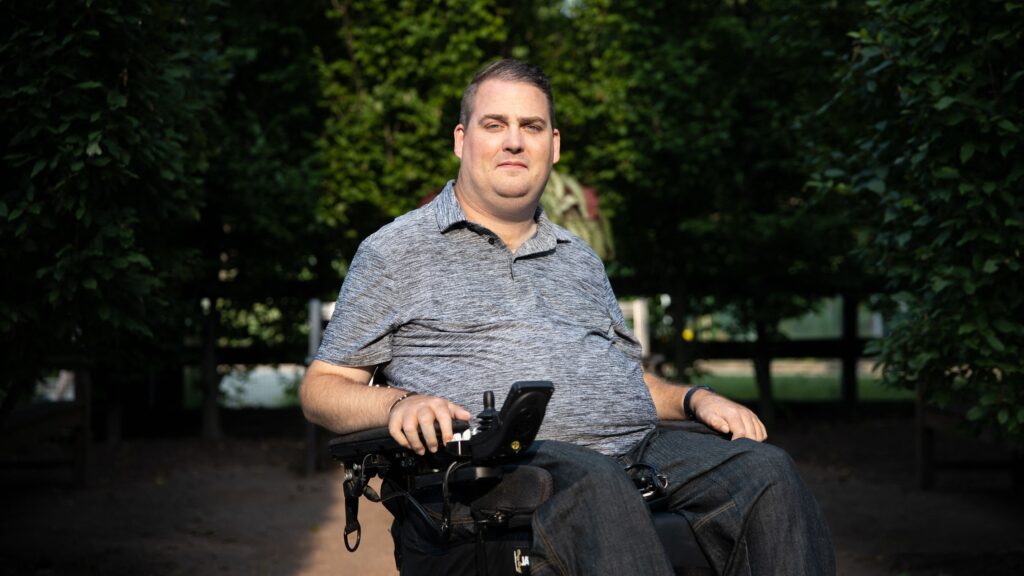
So you’ve been diagnosed with ALS — what now? Maybe you join a clinical trial for a brain implant that could help you do things like move your hand or talk to your loved ones. But can you influence the research as a participant? And what happens to the data collected from your brain when the study ends? A new report addresses these and other questions, exploring how trials of implanted brain-computer interfaces can better address the interests and concerns of participants, who often join in a last-ditch attempt to improve their communication, mobility, or autonomy. Published by the BCI Pioneers Coalition last week, the report outlines 13 recommendations for startups, researchers, and regulators on managing post-trial care, informed consent, and neural data privacy. “These studies can sometimes last years, and it becomes a big part of someone’s life. You want there to be as much agency from the participant as possible,” said Ian Burkhart, who co-founded the coalition, with other participants in early studies of implantable BCI devices, to share patient feedback with developers and researchers. Burkhart said the report emerged out of discussions between him and other study participants, who felt they had very little say in how trials were conducted. The recommendations arrive as the field moves from a niche, proof-of-concept phase into a humming neurotechnology startup ecosystem with eager investors and multiple clinical trials testing implanted devices’ safety and efficacy. Ethicist and UCLA researcher Anna Wexler believes that scientists need better policies to ensure participants’ rights and autonomy. “There is no good solution right now. We talk about potentially mandatory insurance policies, escrows, and institutions committing support, but right now we just don’t actually have solutions,” Wexler said during a panel at a recent brain-computer interface industry conference in New York. STAT spoke with Burkhart about his own experiences as someone with tetraplegia and as a former BCI user shopping around for his next device. He wants to make sure that during his next trial, he has more clarity around the study’s overall expectations, what he can do with the data generated, and what will happen to his care after he is explanted. You were implanted in 2014 with a device at Ohio State University that helped you move your arm. What happened when the study ended? When our study was starting to wind down because of some funding issues, the institutional review board said, “Well, we can just have them have the device taken out, and then if it gets funded again, they can just put another one back in.” Like, that’s great when it’s not you that’s going through experimental brain surgery. To me, it really just minimized my experience down to something more akin to a lab rat versus being a human. The [IRB and the institution] claim to be supportive of the researchers trying to get additional funding and continue the work. And if they really were, they would have seen that it makes more sense to put a little bit more of a pause on it and wait for funding to come through if possible, instead of doing something as disruptive as having surgery. Can’t patients just say no to this? Most informed consents right now, they’re more of a one-sided agreement protecting the research team and institution versus protecting what the participants may want. If you don’t agree to something, the alternative is to not participate. And that’s fine when you’re first signing up for a study. It changes once you’ve already been in a study and you’re re-consenting to continue on with the study, especially when there are very limited alternatives for treatment for this patient population. So it’s your only hope, you’re saying. Yes. And then, you know, you add in the psychological piece of using these devices to restore function after a disability. To my knowledge, everyone that’s used a device has an acquired disability versus being born with their disability. So they have that capability, and then they have their disability, and that capability is taken away from them, and then these devices help restore some of that function, and then it’s taken away again. If there’s real technical reasons that the device stops working or we’re not able to use this technology anymore, that’s one thing. But if there’s just a well, it’s easier for us to administratively close the study, and we can start it back up again in the future, that doesn’t seem like a valid reason to take away and have someone psychologically experience a little bit of their injury or their disability again. How does that compare to other BCI users’ experiences? They have had similar experiences where they don’t really know what the end of the study is going to look like. And as a participant, you can leave at any time, but also the researchers can kick you out of the study at any time, within their rationale. It’s a little bit of a challenge there when you are doing something as intimate as going into the lab multiple times a week, multiple hours at a time, and it becomes such a big part of your life. For it to just be abruptly stopped can be really challenging. … You know, Nathan Copeland, he’s passed 11 years [with a device] now. That’s practically a millenium in this fledgling industry. What should long-term care look like for BCI users? We’re past the proof of concept phase [for these devices]. Is there any support for people to maintain these devices, not in a way that you know we’re forcing a company or institution to keep up a manufacturing line, but can there be decisions made earlier on that will allow, if you need a new battery, you can get a battery from company A, B, or C? Versus it’s only one company that makes the battery, and if that company’s out of business, then you’re done? What kind of support can be available so that you can potentially slowly wind down the trial and not have it be as abrupt? I knew when I signed up [for my study] that this wasn’t going to be a forever thing. It was only supposed to be up to a year and a half, but it continued, we were able to reconsent and expand on the study, and it became a much larger part of my life than I envisioned. To then have such an abrupt ending is not something that anyone wants to go through. I only had access to the device when I’m going to the lab. Now that people are using these devices at home and you know out in the wild, it’s a much more significant change when there is that abrupt end. The report talks a lot about giving participants more access to their neural data. What are you proposing? If you give the participant full ownership of that data, there should be a mechanism where the main research team can have first crack at that data, but then after, if the participant agrees, it allows them to open that up and let other researchers who may not have the resources to implant an individual and capture all this data to see what they can learn from that as well. I feel like I would balk at that if I was a researcher or regulator. It really just depends on what information it is, how much of a kind of delay that someone may get, and how exactly those experiments are structured. If I could have shared some of the raw data from my study, so someone sitting around in their basement trying to come up with different decoding algorithms, I think that’s beneficial for the field. And you know, if the researchers are actually motivated by what’s beneficial for the field versus getting their credit and publishing another paper and moving on, I think they would be open to that.That’s really the goal out of these types of devices to help individuals with disabilities have more independence, autonomy, agency over their lives. Are a lot of study participants asking to run raw data through decoding algorithms in their basement? I’ve certainly met a few. Most of the participants were like, “That’s way over my head.” But I think that there are plenty of people who would like to put their neural data into an AI tool and see what they can learn. My study has been over for six years now. All that data is hopefully still sitting on a server somewhere. I’m sure there’s something that someone with a fresh set of eyes could make sense of, potentially bringing a little bit of value. I certainly think it would be interesting to see what I can find out about my own data, being able to go into the research lab but then, on my own time, I can sit at home and run some other experiments that might be different. Get as much juice out of it as we can. Make sure it’s worth the squeeze. STAT’s coverage of disability issues is supported by grants from Robert Wood Johnson Foundation and The Commonwealth Fund. Our financial supporters are not involved in any decisions about our journalism.
Patients have little say in how brain implant trials are done. Ian Burkhart wants to change that
Full Article
Original Source
Read the full article at Statnews →KhanList aggregates and links to publicly available news content. We do not host full articles from third-party sources. Always verify important information with original sources.