
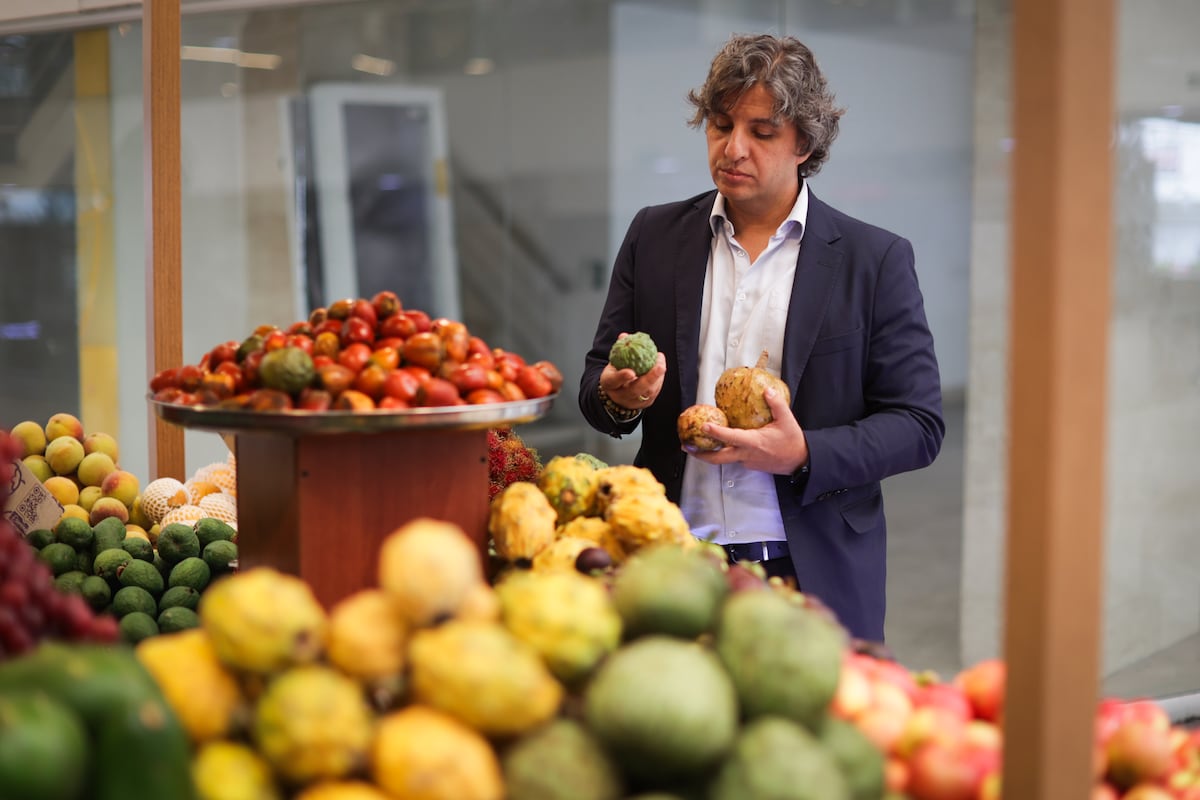
In May 2025, the research room at the fragrance company Finearom resembled a bustling marketplace: 20 fruits were laid out on a long table, alongside their respective seeds, leaves, peels and stems. A dozen researchers from this Colombian firm meticulously examined them, pinpointing each olfactory note that makes the passionfruit smell like passionfruit and the loquat like loquat. They asked themselves countless questions: What does sapote pulp smell like? How are mango and soursop similar? What fragrance distinguishes the guama pod from its spongy fruit?For months, the team members dedicated themselves to interpreting these scents, until they achieved the precise chemical formulas that would mimic all of the individual aromas. As if crafting a potion, they tested dozens of blends from over 2,000 synthetic raw materials: amyl acetate (banana scent), cinnamaldehyde (cinnamon)... These compounds not only provided flavors, but also qualities as abstract as creaminess, syrupiness, or pearliness. “There’s an olfactory pyramid that helps us understand what we first smell when we approach [the compound], what lingers in the background... that’s why it’s important to examine everything,” explains Mónica Castaño, the company’s sales director.Today, the company boasts a line of fruity aromas that will soon be available (in various formats) at a well-known Colombian supermarket chain. Collectively, the 20 flavors are a symbolic representation of a world that’s as vast and fascinating as it is unknown to most Colombians. Few are aware that around 2,500 species of fruits are cultivated in the country. Arazá, camu-camu and canangucha are just a few of the more than 400 species of wild fruits that grow in the Amazon. The cool climate of the Andean mountain range is perfect for planting lulo, curuba (banana passion fruit) and tamarillo (tree tomato), while the humidity and heat of the Chocó region are ideal for ripening naidí (açaí), borojó and chontaduro (peach palm). The options are vast: this is what happens when you have all the thermal zones within a single country. If you wanted to try a different fruit every day, you wouldn’t repeat one for practically seven years.Aromatic fruit extracts at Finearome in Bogotá, Colombia.ANDRÉS GALEANOMónica Castaño, head of sales for Finearome.ANDRÉS GALEANODried fruit at Finearome facilities.ANDRÉS GALEANOAromatic fruit extracts at Finearome facilities in Bogotá, Colombia. ANDRÉS GALEANOFernando Guzmán, owner of Finearome.ANDRÉS GALEANOFinearome lab in Bogotá, on July 2.ANDRÉS GALEANOColombia has always been a megadiverse country. But this richness is rarely associated with the fruits that — although they hang from palm trees or hide in pods throughout the territory — are seldom found in local markets. It’s estimated that only 5% of Colombia’s fruit species are commercially available. And, even when they are, they almost always go unnoticed. For Gian Paolo Daguer, this is absurd. This environmental engineer who is known as the “fruit guru” has spent years tasting them on his Facebook and Instagram channels. He brings varieties directly from local producers’ farms, in order to document this natural wealth. “How is it possible that, being from here, we haven’t tried papayuela (mountain papaya), rambutan, or moriche fruit?” he asks, in a Bogotá café.He has already tasted more than 400 types of fruits. And he recounts with amusement how some flavors are very difficult to describe. “We Colombians need to be ambassadors for our fruits. The French can find a thousand nuances in wine… and we don’t even know what [our fruit] tastes like. We can’t even put words to them,” he laments. Indeed, how does one describe the gritty texture of the sapote, the acidity of the mamoncillo (Spanish lime), or the sweetness of the mangosteen (queen of fruits) if our only points of reference are apples or bananas? “Colombia faces every obstacle imaginable when it comes to reaching its potential: black market economies, complicated logistics... but encouraging consumption should be promoted by the government,” Daguer suggests. “Schools should be serving [students] the most delicious fruits that are locally available, in whatever rural community they’re in.”It’s not so far-fetched to imagine a cafeteria serving granadilla (passion fruit) or feijoa (pineapple guava) for dessert, given that these fruits are easily harvested just a few feet from schools. Colombia, after all, has the widest variety of passion fruits in the world (like maracuyá), with some 170 edible varieties. The country boasts more than 27 types from the Annonaceae family (like cherimoyas, also known as custard apples) and around 42 varieties from the Inga genus (including guama, known as the ice cream bean). “We should incentivize this important bioeconomy,” Daguer says enthusiastically. While he knows there’s still a long way to go to explore these “2,500 potential ingredients,” he also acknowledges that there’s a burgeoning scene in the country which is seeking to popularize local products.Finearom isn’t the only player. Phitother, a Colombian laboratory that produces natural extracts, has also found fruits to be an excellent raw material. “Among our featured products, we’ve got chontaduro extract (or peach palm extract: Bactris gasipaes), which has shown very interesting antioxidant properties. It contains omega-3, omega-6, vitamin E and polyphenols — components that we’ve identified as effective when it comes to sun protection,” writes Luz Helena Núñez, the lab’s technical director, in an email. Phitother has also worked with avocados (Persea americana) for hair care, Andean blackberries (Rubus glaucus) as antioxidants and soursops (Annona muricata) for skin care.Papaya with duck, or fish in camu-camu sauceCuriosity isn’t just being stirred in laboratories. More and more Colombian restaurants are including these new flavors on their menus. For instance, there are famous Amazonian ice creams being served at Selva Nevada; lulo, borojó and naidí juices being poured at Rey Guerrero’s tavern; fish with camu-camu sauce and Amazonian pineapple being baked in Açai’s ovens; or breads with Colombian fruits being warmed at Mestizo. Each dish at Afluente features a different fruit. Jefferson García, the chef at this award-winning Bogotá restaurant, created one of the menu’s iconic dishes: duck with papaya, to honor his country’s biodiversity. “We have the second-largest concentration of fruits in the world. It’s such a treasure!” he tells EL PAÍS over the phone.An Annona or sweetsop in the hands of Gian Paolo Daguer at the Paloquemao Market in Colombia.Andres Galeano ANDRÉS GALEANODragon fruit at a stall at the Paloquemao market in Bogotá.Andres Galeano ANDRÉS GALEANOA selection of fruit at Paloquemao Market. ANDRÉS GALEANOCucamelón, which looks like a tiny watermelon, is an exotic fruit on sale at Paloquemao Market in Bogotá.ANDRÉS GALEANOA selection of fruit on display at Paloquemao Market.ANDRÉS GALEANOA stroll through the Paloquemao Market is enough to realize that the abundance García mentions is also a major tourist attraction. A young man in an orange cap walks by with a knife in his hand, accompanied by a handful of tourists with backpacks slung over their shoulders. He greets each stall owner by name, giving them hugs. They already know what he’s there for: they hand him the usual assortment and he slices the nine chosen fruits with his knife. He divides them into six portions. Then, he and the tourists play a guessing game: what will the fruits be like inside, will they be sweet or sour, will they have seeds, etc. Everyone’s mouth drops open at the sight of the mangosteen (the “queen of fruits,” which looks like a head of garlic inside a purple rind). The tourists are overwhelmed. They can’t believe this variety, which is so different from what they find in their own countries. “My favorite fruit is the Cape gooseberry!” a blonde woman exclaims, referring to the uchuvas. Meanwhile, her friend can’t decide between the curuba (banana passion fruit) and the breva (breba fig).These tour groups are becoming increasingly common in market squares. Some visitors explore La Perseverancia Market on their own, while others hire a guide at La Candelaria Market. At a stall in a shopping center in northern Bogotá, a young man sells a selection of fruits that varies depending on the season. “It’s funny that even I’ve come to know about our [national] fruits, because I see that [the tourists] like them. And it should be the other way around,” he notes.Sign up for our weekly newsletter to get more English-language news coverage from EL PAÍS USA Edition
Passion flower perfume and peach palm sunscreen: The industry emerging around Colombia’s 2,500 species of fruits
Full Article
Original Source
Read the full article at English →KhanList aggregates and links to publicly available news content. We do not host full articles from third-party sources. Always verify important information with original sources.