
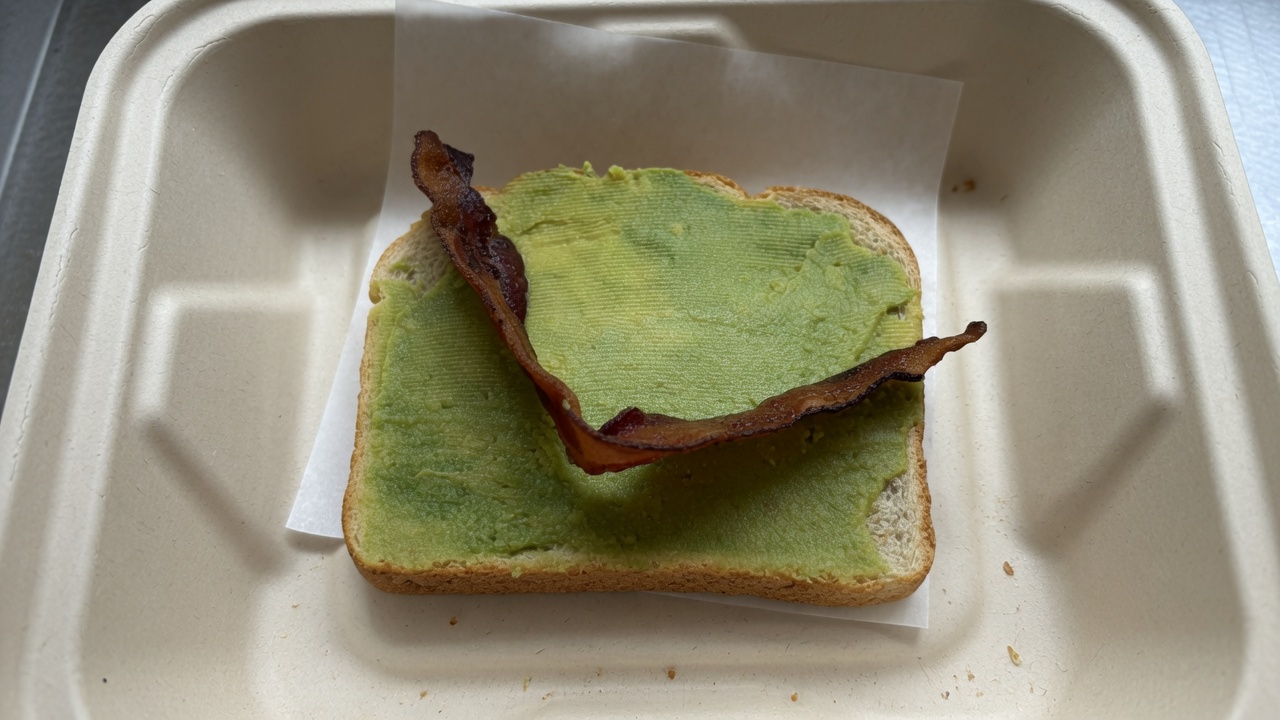
A passenger says she paid $19.64 at Chattanooga airport for what was supposed to be “toasted sprouted bread, with avocado, extra virgin olive oil, bacon, and crushed red pepper.” She received one piece of bread with little evidence of toasting, covered in green spread, with a single strip of bacon. There is no visible crushed red pepper, let alone any indication that someone in the kitchen cared. As a millennial, I feel contractually obligated to defend avocado toast. I cannot defend whatever Chattanooga Airport charged me $19.64 for. This is supposed to be toasted sprouted bread, with avocado, extra virgin olive oil, bacon, and crushed red pepper. pic.twitter.com/F4E1Ecpdwa — Clare Anne Ath (@clareanneath) August 2, 2026 There is also a price mystery here. Chattanooga airport’s current online menu lists avocado toast at Tailwind in Concourse C for $6.99 for one slice or $11.49 for two, with bacon adding $2. The menu describes smashed avocado spread, salt, crushed red pepper and tomato on Wheatberry toast. I’m not sure how they get to $19.64. Regardless, avocado toast isn’t trendy enough for $11.49++ anymore. The Chattanooga customer joked that, as a millennial, she was contractually obligated to defend avocado toast. But a decade ago smashed spring pea toast became the new avocado toast. Wags knows how to vet the new guys. #Billions #Showtime pic.twitter.com/Yj7lSGniln — BILLIONS (@SHO_Billions) April 4, 2018 Why Airport Restaurants Are So Difficult Chef Andrew Gruel responded that an airport restaurant he opened cost five to ten times as much to build as one outside an airport. He pointed to union labor, security requirements and the difficulty of finding employees. I’ve written extensively about why airport restaurants are usually bad. Ingredients and supplies have to pass through security. Deliveries are restricted to approved companies and specific times, so ordinary just-in-time restaurant logistics do not work. Storage and kitchen space are limited. Some concepts cannot use gas equipment and have to recreate their menu using electric appliances. Knives may have to be tethered and inventoried. Specialized equipment can be difficult to accommodate. Employees need airport credentials and background checks. Hiring takes time, while workers face airport commutes, remote parking and security before they even clock in. Customers have different tastes, short connections and departing flights. Restaurants need to gear themselves to high volume, fast service and the lowest common denominator tastes. The airport restaurant isn’t a destination. People do not travel to the airport for the food. They buy from whatever is available as sustenance while enroute to their gate. Rent and construction costs are high, and airports frequently take a percentage of sales in addition to rent. Many airport concession workers are unionized. Local laws often impose much higher minimum wages at airports than in the rest of the community. They can do this because they have largely captive customers and the capital investment isn’t going elsewhere, and because vendors have to pay more for labor anyway to get workers to the airport and to attract workers able to pass background checks and to cover extra time from parking lot, through security, to their worksite. Airports Do Not Choose Vendors For Quality Airport concession contracts can run for a decade or longer. Once a master operator wins, the market is mostly closed. I’ve written about St. Louis planning to extend HMSHost’s contract through 2031 without seeking competing bids, while its local partners had lobbyists and were significant political donors. At BWI, Maryland selected a newly created company headed by a former governor’s chief of staff for a 20-year concession agreement, after experience requirements in the solicitation were changed. The new company planned to have HMSHost perform the actual operating work. And Atlanta has a long history of questions over whether airport contracts went to politically connected businesses rather than the best operators or lowest bidders. A private monopoly selected through a poor or politicized process is not a competitive market, and political actors at the airport aren’t optimizing for taste. Airport Street Pricing Fails Many airports cap concession prices at street pricing or street pricing plus 10% or 15%. Yet I’ve documented $28 beer and $11 fries, enormous variations in the price of Starbucks and Chex Mix, and airports allowing operators to evade price limits through vaguely labeled employee or benefit surcharges. The airport charges high rent and may take a percentage of sales. The concessionaire faces real higher costs than they do off-airport. That makes it tough to earn a normal return at the nominal price ceilings imposed by the airport. So vendors either ignore it or are encouragd to ignore it by airports recommending added surcharges on top of price, so that the vendor earns more while nominally complying because the ‘price’ (without surcharge) is similar to what one pays off-airport. We Shouldn’t Need As Much Expensive Bad Food To Begin With There is a more fundamental problem. We have designed airports around the assumption that passengers should arrive absurdly early, walk long distances past overpriced retail, and endure uncertain security queues. Airports tell passengers to arrive several hours before departure. Even Chattanooga says two hours which is silly. New airport terminals frequently require longer walks because more space and more passenger exposure generate additional concessions revenue. DFW and O’Hare even removed moving walkways because travelers using them skipped stores. The purpose of an airport should be to get passengers to it, through it and out of it as quickly as possible. Restaurants and lounges mitigate wasted time, and meet nutrition needs during easted time. But that’s not the purpose of an airport. We should make airport food less necessary, at least for passengers flying non-stop, with predictable, adequately staffed and risk-based security; real-time waits; compact curb-to-gate layouts; moving walkways and without a mandatory trek through a duty-free maze. You don’t need overpriced, disappointing restaurants when flying JSX. Topics on this page
Passenger Paid $19.64 For One Sad Slice Of “Avocado Toast” — Why Airport Food Is So Bad
Full Article
Original Source
Read the full article at Viewfromthewing →KhanList aggregates and links to publicly available news content. We do not host full articles from third-party sources. Always verify important information with original sources.