
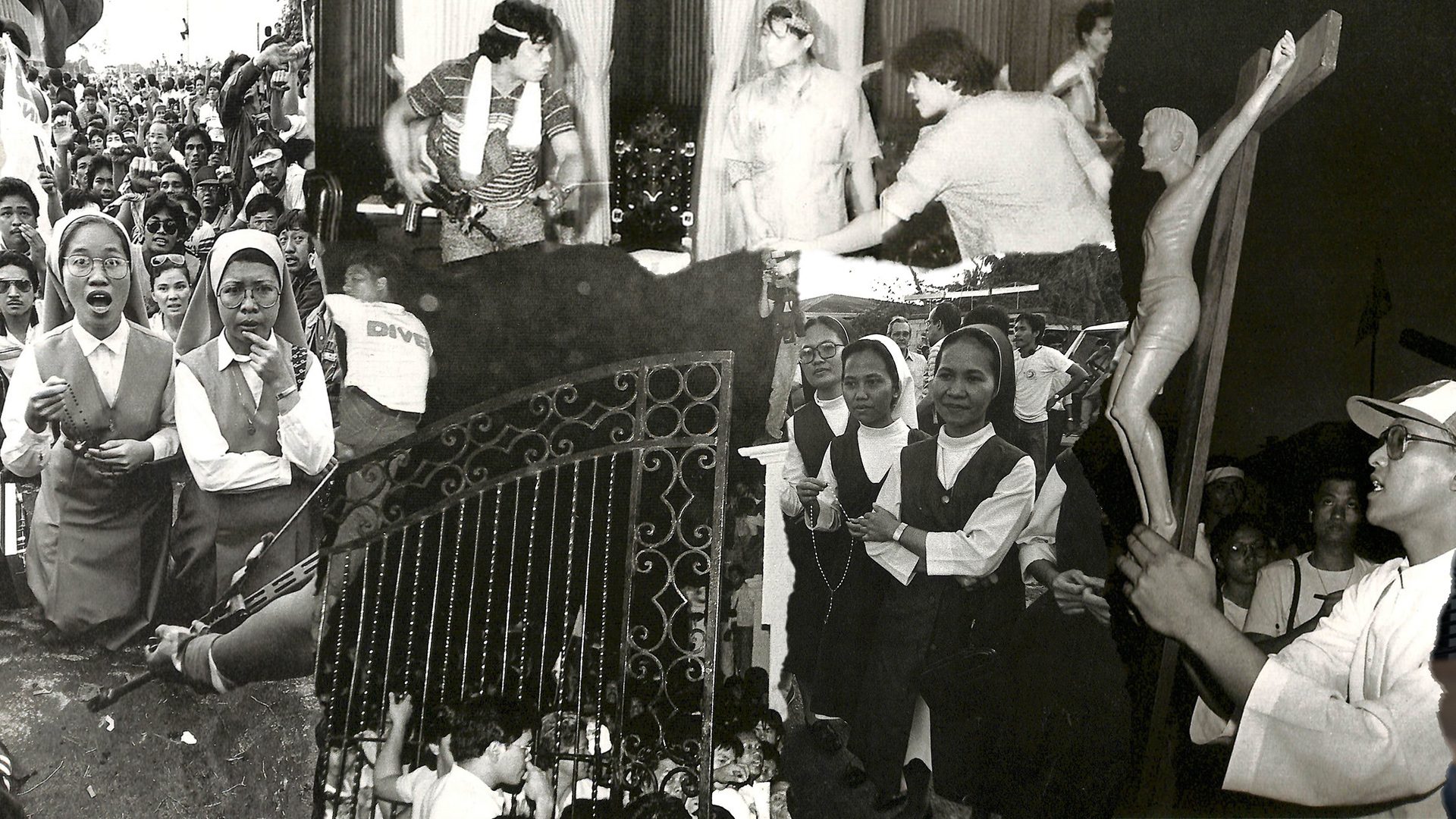
The EDSA People Power Revolution in 1986 was a significant nonviolent movement that helped overthrow a dictatorship in the Philippines, with the Church playing a crucial role in mobilizing grassroots efforts for social justice. Fifty-two years after the Sacred Heart Novitiate raid, former detainees reflect on their experiences and the lasting impact of Martial Law, emphasizing the importance of remembering their struggles for future generations. Despite the challenges of healing from past political wounds, the detainees express a commitment to sharing their stories and honoring the sacrifices made for freedom, highlighting the need for collective remembrance and learning from history. This is AI-generated. Read the article for full context. Report any errors. READ: Part 1: The novitiate raid that pulled the Church into EDSA and beyond Twelve years after the raid, the 14-year dictatorship under Martial Law was eventually toppled during the EDSA People Power Revolution in February 1986. By then, tens of thousands of activists, journalists, and anyone who dared to oppose the State had been detained, tortured, disappeared, and killed. Amid the chaos of the 1986 snap elections, Jaime Cardinal Sin once again called on the Filipino people to peacefully rise up against the pervasive silencing by the State. Archbishop Socrates Villegas said in an interview with Rappler that while the newly minted Cardinal was “very quiet” during his early days in Manila, Cardinal Sin eventually grew vocal in “protesting against the persecution of the Church” in the wake of the raid. Described as a political role model of active nonviolence movements in democratizing states around the world, the first EDSA Revolution was pivotal in many ways. For one, People Power contributed significantly to overthrowing a dictatorship without bloodshed. Civilians employed unarmed yet confrontative tactics, such as peaceful rallies, boycotts, strikes, and roadblocks to induce pressure and confront an authoritarian state. Another feature of People Power was its collective and bottom-up nature. Through EDSA, previously isolated grassroots efforts galvanized into an organized pro-democracy mass that did not only challenge violent state conditions, but also sought to promote social justice. The moral and practical social leadership of the Church as a trusted nonviolent force for deep social change continues until today. One shining example in our contemporary public arena is the recently established 2026 Truth and Reconciliation Commission. A Rappler report on the May 27, 2026, Commission launch explains how the organization aims to truth-tell stories about Duterte’s drug war. The Commission is independent of the government and relies on civil and church groups for its support. With Cardinal Sin gone, another Church shepherd now walks the journey to truth and freedom — Cardinal Pablo Virgilio “Ambo” David, who sits as the commission’s adviser. Like People Power One, the Church involvement through the 2026 Truth and Reconciliation Commission is likewise peaceful yet critical and mobilizes social groups from the bottom up. 52 years later Five decades later, the story of the Sacred Heart Novitiate raid has languished in oblivion, untold in history books and glossed over in Martial Law memorials. Despite its descent into obscurity, the raid still triggers intense emotions among the detainees, now in their mid-seventies and the sunset of their lives. Today, former detainees of the Sacred Heart Novitiate raid are able to tell their stories more safely, more spontaneously. Seeking closure and meaning, the detainees reflected on their everyday life after their release from prison. As Jun lamented, “Right after that [the raid] kasi, walang (there was no) debriefing. Like, we were cast to the winds. Kaniya-kaniyang survival (Every man for himself).” Jun lived his life “hiding in plain sight.” On the day of his release, Rene had no one to fetch him. Nor did he have any pocket money for his transportation. “Kaya ’yun ang hindi ko maano-ano ’yung huling ano na ’yun. Talagang I know, maraming nag-iiyakan noon […]” (I could never forget that day. A lot of the released detainees were really crying.) For Karen Tañada, she remembered pivoting into “regular development work” and distancing herself from the group. “At a certain point, parang ayoko rin muna. Parang medyo umiwas din ako na masyadong direct na sumama dun sa mga ano ng KASAPI,” she said. (At a certain point, I thought I didn’t want to involve myself directly with the activities of KASAPI.) Oya Andres, who was under surveillance, uprooted herself and emigrated to the United States. According to her, a “person” would suspiciously visit her house and school to ask about her “extracurricular activities.” Before fleeing for her safety, she made sure to dispose of any material evidence of her activist life. For years, her mind “blocked out” her memory of the raid. It was such unfreedom during Martial Law that Jojo wanted to stress to the future generations: “[H]indi madali noon ang karapatan natin magsama, magpulong, assembly. Huwag natin i-te-take for granted yun. Nung araw […] krimen ’yun para sa gobyerno.” (It was not easy to exercise our right to meet, organize, and assemble. Let us not take that for granted. Back then, to the government, such rights were a crime.) For Beth, the raid is a story of changing a world marred by suffering. “I realized that […] maybe my path is actually to be a professional rather than, you know, go to the hills. […] We craft our own ways of trying to change our world, you know, in that sense, our country,” she said. SAMPLE PAROLE CARDS. Detainees report to the military about their whereabouts and activities. Photo by Beth King Similarly, for Tessam, what was important for her was that she felt vindicated. “I felt may kabuluhan na puwede kong ’yun ang legacy ko na lang sa mga anak ko at sa mga apo ko (I felt there was meaning; that can be my legacy to my children and grandchildren). I may not be a good example in terms of a good mother or a perfect mother, but at least half of my being Tessam, […] I offered a little, a little time for the country that we love,” she said. For Malaya*, the raid inspired her lifelong commitment to active non-violence. “Condemn the act but not the doer. Anger is important to motivate people to action. But I learned […] if you let anger be your sole motivation for your action, you will be doing the same harm that was done to you,” she said. However, healing from political woundedness proved to be complex and messy. Fr. Maico Rescate still hesitated to talk about the raid, struggling to navigate remembering in a post-dictatorship society. For Boyet, doubts about personal and political meaning remain chronic, prolonging into old age. As he reflects on a life that fought for human rights and bore the brunt of systemic violence, Boyet asks, “Ano ba naiambag ko? Meron ba?” (What did I contribute? Did I contribute anything?) Fifty-two years later, the arrested members of KASAPI are well in their eveningtide. Soon, they will no longer be here to tell their stories of idealistic youth, filled with hope to transform a society wrought with oppression and injustices. Those stories came with deep wounds, both personal and organizational costs. Even after the restoration of democracy, remembering these stories can be painful, too. But they each want their grandchildren and the future generations to know how they bravely fought for the freedom we enjoy today. Only in honoring our nation’s historical sacrifices can we learn from the past, and collectively heal as a wounded society. – Rappler.com Editor’s Note: Written with contributions from Fr. Maico Rescate✝, Oya Andres, Tessam Castillo, Rene Castro, Jojo Deles, Beth King, Boyet Montiel, Tina Montiel, Malaya, Karen Tañada, and Jun Zamar. *Interviewee name kept anonymous as requested Our project is supported by the Ateneo de Manila’s University Research Council. Our study team was composed of Cristina Montiel, Joshua Uyheng, Ariana Enriquez and Frodo Uranza of the Political Psychology for Democratization Research Laboratory.
Part 2: The raid, the Catholic Church, EDSA and beyond
Full Article
Original Source
Read the full article at Rappler →KhanList aggregates and links to publicly available news content. We do not host full articles from third-party sources. Always verify important information with original sources.