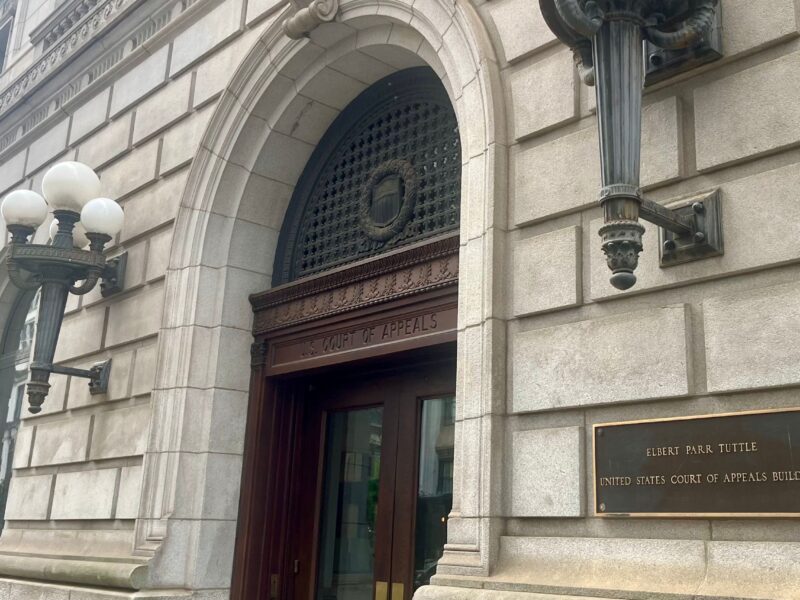
The Center for Special Needs Trust Administration filed for bankruptcy after an internal investigation revealed its co-founder stole at least $100 million from trust funds for disabled clients.ATLANTA (CN) — The parents of a disabled child urged an 11th Circuit panel Wednesday to overturn an order stalling their claims against companies they say were complicit in a Florida nonprofit’s scheme depleting funds from the child’s medical care trust.Todd and Kelli Chamberlin say a bank, five companies and the co-founders of the nonprofit Center for Special Needs Trust Administration facilitated and concealed $100 million of misappropriations from special needs trusts.A Florida federal judge in 2025 upheld a bankruptcy court’s enforcement of an automatic stay blocking their negligence, conversion and breach of fiduciary duty lawsuit. A bankruptcy stay temporarily protects debtors from attempts to collect debts.But the Chamberlins say their lawsuit only raises claims for trust beneficiaries’ direct injuries.“From our perspective, we purposefully avoided the automatic bankruptcy stay,” plaintiff attorney Jonathan Streisfeld of Kopelowitz Ostrow said. “We didn’t go after the debtor’s officers and directors. We filed claims alleging torts by other people, those other people being non-debtors that violated independent duties that we allege existed in favor of these special needs trust beneficiaries or aided and abetted the debtor in the misappropriation of the assets.”The nonprofit filed for Chapter 11 bankruptcy in 2024 after an internal investigation revealed co-founder Leo Govoni transferred money from trusts under the organization’s administration by issuing loans to companies he controlled.The accounts of more than 1,000 of the center’s 2,000 vulnerable and disabled clients were partially or entirely drained.U.S. District Judge William F. Jung ruled in February 2025 the lawsuit interfered with the court-appointed trustee’s administration of the case. Jung found the Chamberlins would violate the stay if they pursued claims against Govoni at the same time as the trustee.An attorney for chapter 11 trustee Michael Goldberg told the panel the entire appeal is moot due to a recent $120 million judgment entered against Govoni for breach of a loan funded with the stolen trust money.John Dicks of Akerman LLP said Goldberg had worked to enforce the loan and recover the same funds the Chamberlins are pursuing. Dicks argued letting the Chamberlins recover money themselves, independent of the bankruptcy estate, would violate the bankruptcy code and harm other creditors.U.S. Circuit Judge Nancy Abudu also appeared concerned with the broader implications of the plaintiffs’ claims.“Even though you’re not going after the debtor, the money you are going after could end up being money that the debtor would use to pay off a bigger pool of creditors. So that still seems problematic,” the Biden appointee said.But Streisfeld told the panel the assets are not bankruptcy estate assets.“The broader group of creditors that are not special needs trust beneficiaries should not have an opportunity to have their claim satisfied using this money that was not the debtor’s money begin with,” Streisfeld said.Fellow Biden-appointed U.S. Circuit Judge Embry Kidd questioned whether the plaintiffs would even be able to figure out which of the assets belong to them.“I get your point that at the outset they were set up separately, but there’s still the fact that you need to trace [the assets] and there seems to be this co-mingling,” Kidd said. “What matters is what do we know now about these assets and are you able to disentangle it?”Streisfeld argued tracing assets is only important if you’re trying to sue the debtor. Dicks, however, told the panel the record shows the money was co-mingled, cannot be traced and is therefore property of the estate.“The Chapter 11 trustee as part of its duties hired a forensic accountant,” Dicks said. “The bankruptcy court relied on the report of the forensic accountant and specifically found the money was not traceable.”Special needs trusts like the one set up for the plaintiffs’ son are largely funded by court settlements and other awards from catastrophic personal injury cases. Their purpose is to let beneficiaries receive distributions while continuing to qualify for and receive public assistance benefits like Medicaid.The scheme left the Chamberlins and other families without crucial funds for care.Govoni and former accountant John Witeck were indicted by a federal grand jury in June 2025 on wire fraud, mail fraud, money laundering conspiracy and bank fraud charges.According to the indictment, Govoni used the stolen money to fund a brewery, travel via private jet, buy real estate, pay debts and make deposits into his personal bank accounts.Kidd and Abudu were joined on the panel by U.S. Circuit Judge Kevin Newsom, an appointee of Donald Trump. The panel did not signal when a ruling will issue in the appeal.Subscribe to our free newslettersOur weekly newsletter Closing Arguments offers the latest about ongoing trials, major litigation and rulings in courthouses around the U.S. and the world, while the monthly Under the Lights dishes the legal dirt from Hollywood, sports, Big Tech and the arts.Additional Reads
Parents of disabled child ask 11th Circuit to revive $100M trust theft class action
Full Article
Original Source
Read the full article at Courthousenews →KhanList aggregates and links to publicly available news content. We do not host full articles from third-party sources. Always verify important information with original sources.