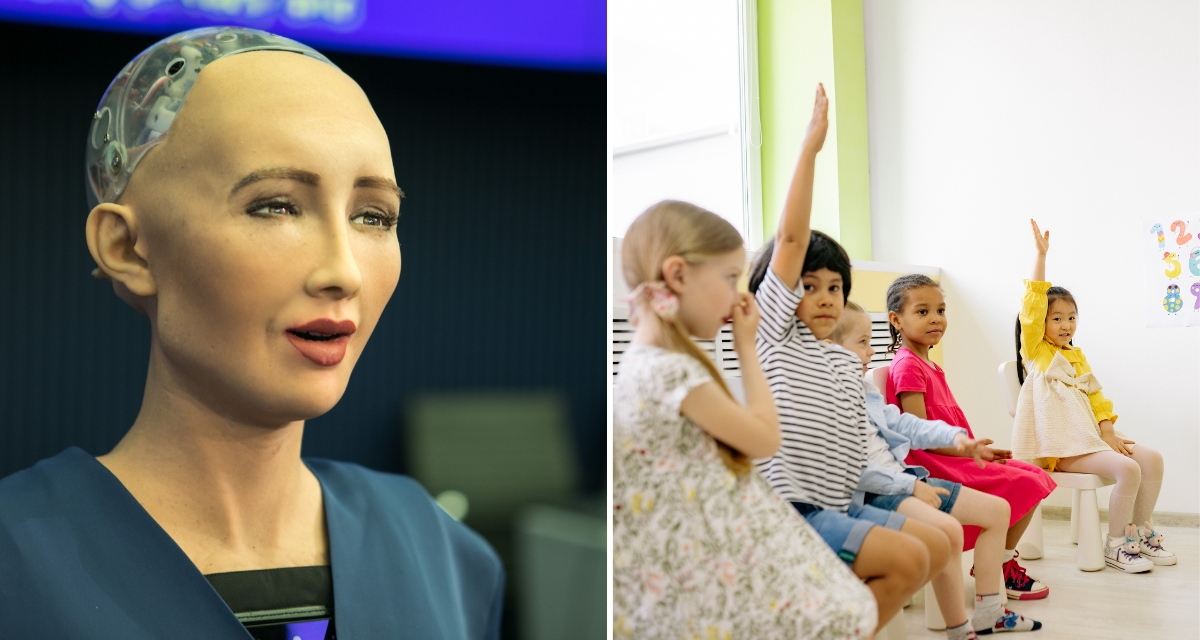
Nothing says back-to-school quite like chatter over technology. Some parents are heading to school board meetings to demand their kids receive minimal screen time. Other parents are finding out that their children are or will be exposed to AI technologies without their consent. America has a teacher shortage problem that only seems to increase every year. It’s a multi-pronged issue that requires a multi-pronged approach to address. Some school districts, however, are tackling the issue in ways that are making both parents and teachers uncomfortable. Case in point? New Mexico and Portland public schools introduced an AI program called Amira Learning. She’s marketed as a reading growth learning agent. Amira Learning concerns Humanoid on laptop next to teenage boy.Photo Credit: Canva According to the National Assessment of Educational Progress (NAEP), only 33% of fourth graders read at or above the proficient level in 2022. School districts across the country have been looking for ways to address this reading crisis while also struggling with the teacher shortage. Amira Learning likely feels like an obvious choice for some school districts. A computer program that promises to increase reading proficiency while freeing up the teacher’s time? What could possibly be the issue? Tech policy expert Ifeoma Ozoma sees plenty. She voiced them in an interview with New Mexico’s worker-owned independent civic media co-op, 505omatic. Ozoma shares, “Amira Learning, it’s an AI voice recognition, literacy-assessing program. The state and district have contracted with Amira for kindergarten through second graders, and then third grade, optional. Of the parents that I’ve spoken to, not one got a notification from their principal or from teachers that their children, five, six, seven, eight years old, would have their voices recorded, and none of them were given the option to opt out.” Parents aren’t given the choice to opt-out Students on laptops.Photo Credit: Canva 505omatic clarifies that this is not something parents are even informed of at the beginning of the year. Ozoma confirms that parents are not given any prior notice about Amira or that this AI company has access to their child’s voice. “Not only are they using the software for the beginning, middle, and end-of-year assessments, kids are talking about using it every day. Every other day. Multiple times a day. Multiple times a week. There are many issues with it replacing the engagement that kids should be having with teachers, and what that means about making a case for having fewer teachers, and for not investing more in human resources and in literacy coaches,” Ozoma says. Loss of human interaction Ozoma’s concern about schools reducing the need for human educators may not be without cause. Over in New York, a school district is planning to introduce Sally, a humanoid robot. The humanoid “teacher assistant” is debuting at Salamanca City Central School District in western New York. Sally has silicone skin and long brown hair covering her machinery to help give her a more human look. She can only move her arms, hands, head, and face, not walk around the classroom. The robot teacher’s assistant will be greeting students at Salamanca High School this fall. It’s a move that concerns some parents since the high school is on the Seneca Nation reservation, which serves mostly indigenous students, according to New York Focus. The outlet highlights a response from a concerned parent, Sierra Abrams. “We already have so many issues in our community, including environmental issues,” she said. “I just don’t understand the concept of adding AI onto that. Bringing it into the school district is contradicting everything we believe, in my opinion.” Humanoid robot teachers Humanoid robot.Photo Credit: Canva New York Focus points out, “Salamanca is the only incorporated city in the United States located entirely within a Native American reservation. The school district serves roughly 1,300 students, including 32 percent who identify as American Indian or Alaska Native and 79 percent who are economically disadvantaged.” The school board voted to purchase the robot from Realbotix for a discounted price of $57,590. That’s about a $37,000 decrease from the product’s base price. Unlike Amira, Sally will be in high school classrooms and won’t store students’ voices or have facial recognition. Her teaching tenure will start in robotics and AI classes, and will be moved to other classes if successful. Realbotix and the school district are working together closely in an attempt to ensure safety, including flagging school administrators if a student mentions self-harm or suicide. Parents raise concerns Both Amira and Sally seem to be something parents aren’t getting much say in, which is causing concern. Ozoma tells 505omatic, “I’ve had parents report that their children are incredibly stressed out by it. You have 25-plus kids in a class; they all have headsets on. They’re staring at a laptop, and they’re all supposed to be doing their assessments at the same time.” Ozoma adds, “For this private company, it’s in the contracts with all of the districts in all of the state. The value is in the data harvesting. They have terabytes, at this point, of voice data from five-to-eight-year-olds. That is valuable for training models, and if the company decides at some point, ‘You know, the assessment model isn’t making us enough money,’ what if they turn around and sell data or models to Mattel?” Parents and educators in the comments of 505omatic’s video sounded off. One person says, “As a kindergarten teacher, I hate it. Please understand that as a teacher we aren’t given a choice whether or not to use it. We actually get in trouble if we don’t get our weekly minutes in. This is the worst program we’ve ever used.” A mom writes, “My daughters in third grade hated it. They complained it was weird, which it is, and that it often didn’t even hear correctly because the noise level of the class. They kept forcing it anyway. I HATE the fact that they have their voices now and use them for training.” Another educator shares, “I am a TA and my students use tech like this. Once I witnessed a girl in tears as she kept repeating the same word back to the AI over and over again, a word which she was reading correctly and which the AI didn’t understand.” No data selling ‘promise’ The Amira CEO’s promise of “never selling a child’s data” isn’t comforting to parents, either. “‘Never sell our data’ but they’ll have a data leak somewhere down the line orrr they’ll start using the kids data for furthering this invasive ‘ed-tech,’” one concerned person says. Willamette Week investigated the Amira contract with Portland Public Schools and found something that contradicts the Amira CEO’s claim about never selling kids’ data. The outlet completed a records request that revealed, “Buried in the contract is a long list of data the software collects from students.” Portland School Board member Stephanie Engelsman quickly raised concerns about the revelation. Willamette Week says the information collected includes migrant status, languages spoken, place of birth, disability status, and more. Engelsman tells the outlet, “Federal immigration officers, if they get their hands on data that shows a family is a migrant family and/or where someone is born, they can get a judicial warrant based on that information.” She later adds, “I have concerns about the district entering into AI contracts and bringing AI platforms into our classrooms without a board policy and specific guardrails.” One parent sums it all up, writing, “How bout we pay teachers what they’re worth so we can have enough teachers. And not burnt out teachers working 2 jobs. How bout that?”
Parents are raising the alarm as schools roll out robot and AI teachers without consent
Full Article
Original Source
Read the full article at Upworthy →KhanList aggregates and links to publicly available news content. We do not host full articles from third-party sources. Always verify important information with original sources.