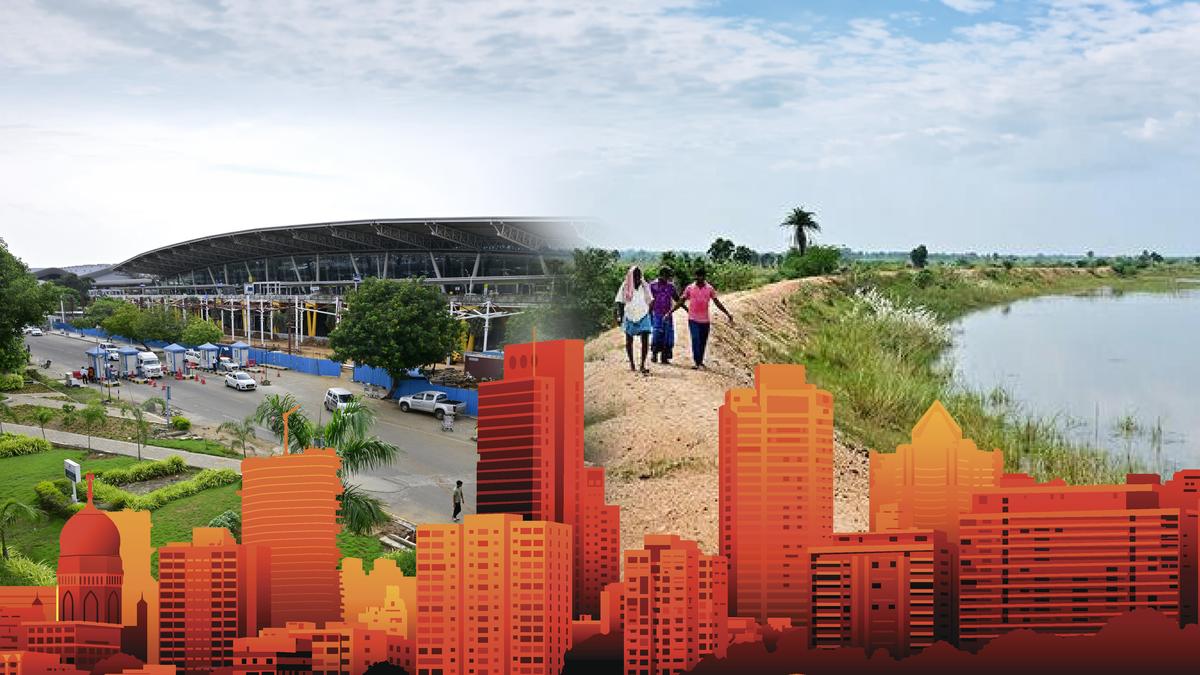
Till last month, P.S. Mahesh, promoter of Banyan Tree Estates, marketed his DTCP-approved seven-acre villa plot layout at Pudupattu village near Sunguvarchatram in Kancheepuram district as an investment offering a “100% profit guarantee”, banking on its proximity to the proposed Parandur greenfield airport.But this month, the social media promotions for his company’s layout do not mention the word ‘Parandur’ anywhere in them. Instead, they just mention “Buy your land near Sunguvarchatram”.That’s because the ruling Tamilaga Vettri Kazhagam (TVK) government has almost given up on the proposed ₹27,400-crore Parandur greenfield airport project. The government’s stand is in line with the party’s stand to support the locals who are against the proposed airport, as it would affect several water bodies across 13 villages. The State government now feels there is not enough vacant space to build a runway without affecting the waterbodies, and hence it is not pushing ahead with the proposed airport. “The announcement of a large infrastructure project like an airport will surely result in a substantial increase in land prices in that region. While investors who moved in early would be alright, those who got in at a later stage may be stuck”Mehul DoshiPresident, CREDAI ChennaiAs a result, realtors in the region have no option left but to stop promoting their projects.“Parandur airport was a big opportunity for growth for real estate investors. Without that, there is a slowdown,” says Mahesh. For instance, his Aerovilla project at Pudupattu village near Sunguvarchatram was seeing a ₹50 to ₹100 per sq.ft. price appreciation every month until May this year. After the Assembly election results and with a new government, there has been no appreciation in prices due to the general apprehension about the future of the Parandur airport project.“While the price per sq. ft should have moved to around ₹1,500 per sq. ft by now, we are still quoting the same ₹1,300 per sq. ft that was prevailing a couple of months ago. Layouts closer to the existing Chennai–Bengaluru National Highway continue to command around ₹2,500 per sq. ft,” says Mahesh. “A correction in land prices is a natural consequence when a major infrastructure trigger is withdrawn. However, it would be inappropriate to assign a uniform percentage decline across the entire Parandur region, as every micro-market behaves differently”Sanjay ChughCity head & director, Anarock Property Consultants Pvt. Ltd, ChennaiHe also adds that earlier, there used to be several enquiries daily; now they are down to a trickle, thereby indicating a slowdown in the Parandur region.“There are enough factories in the region, including Samsung, Dell and Foxconn as well as other infrastructure projects such as Dry Port at Mappedu, the Chennai Peripheral Road connecting Mamallapuram to Minjur and the new Chennai–Bengaluru expressway to take care of long-term growth,” he says.Drop in land pricesIf market sources are to be believed, there has been roughly a 30% drop in land prices in the region. (While land is measured in acres, developed layouts are sold on a per sq. ft basis.) “A correction in land prices is a natural consequence when a major infrastructure trigger is withdrawn. However, it would be inappropriate to assign a uniform percentage decline across the entire Parandur region, as every micro-market behaves differently,” says Sanjay Chugh, city head and director, Anarock Property Consultants Pvt. Ltd, Chennai. “As for Chennai, the East cannot be developed due to the Bay of Bengal, the north is full of chemical and petrochemical industries, and the south has the atomic power station at Kalpakkam, as well as the Vedanthangal bird sanctuary. An airport cannot be promoted in these regions, and that leaves only the West. If not Parandur, the government has to identify a new place only in that region and no where else near Chennai”Rajesh BabuManaging director, Asset AdviseAreas where prices had risen sharply on speculation are likely to witness a steeper correction, while locations supported by industrial activity and existing infrastructure may experience relatively moderate adjustments. The market will eventually stabilise once prices align with prevailing demand and long-term development prospects, Chugh adds.Over the past few years, several developers and plotted development companies have launched projects in the broader Parandur–Sriperumbudur–Kancheepuram corridor. These include G Square Realtors, Urban Tree Sameera Lands & Construction, DRA, StepStone, Premier Housing & Properties, GTK Foundations, VGN, ABI Estates and JR Properties, among others. Most of these projects were launched across the growth corridor rather than immediately adjoining the proposed airport site. “Parandur airport was a big opportunity for growth for real estate investors. Without that, there is a slowdown”P.S. MaheshPromoter of Banyan Tree Estates“The announcement of a large infrastructure project like an airport will surely result in a substantial increase in land prices in that region. While investors who moved in early would be alright, those who got in at a later stage may be stuck,” says Mehul Doshi, president, CREDAI Chennai. Ironically, the proposed Sriperumbudur airport, announced in 2006, was also abandoned, and Parandur now appears to be headed down a similar path. Around that time, Mumbai-based Hiranandani launched a large residential township in Oragadam, while the UAE-based ETA Group developed an SEZ-cum-residential township near Sunguvarchatram, anticipating stronger demand from the proposed airport. The projects were completed, but the airport never materialised.“It has been 20 years, and still there is no airport. Normally, it takes seven to eight years for any greenfield airport to come up. And that means Chennai is stuck with its existing inadequate airport for almost another 10 years at least. This is at a time when other cities like Bengaluru and Hyderabad are overtaking Chennai in terms of airport infrastructure, and Bengaluru is even talking about a second airport beyond the existing one,” Doshi adds.According to Chugh, investors who entered the market solely on the airport growth story may have to recalibrate their investment horizons. Distress selling may not be the most prudent approach unless liquidity is an immediate concern. Developers, on the other hand, will need to reposition their projects by highlighting the region’s proximity to the Sriperumbudur manufacturing hub, the Chennai–Bengaluru Highway and other industrial and logistics developments. The focus is likely to shift from speculative appreciation to affordable plotted developments and housing that caters to the growing industrial workforce.Looking ahead“Investors should hold on with their investments in the region and if possible, increase their investments,” says Rajesh Babu, managing director, Asset Advise, a consultancy firm in Chennai. His reasoning? “As for Chennai, the East cannot be developed due to the Bay of Bengal, the north is full of chemical and petrochemical industries, and the south has the atomic power station at Kalpakkam, as well as the Vedanthangal bird sanctuary. An airport cannot be promoted in these regions, and that leaves only the West. If not Parandur, the government has to identify a new place only in that region and no where else near Chennai,” says Babu. Eco-concerns in the region Requires 5,300 acres across 13 villages for the airportThe project will impact several waterbodies located in the regionChengalpet, Kancheepuram, Thiruvallur districts have the most lakes and ponds in the regionThese waterbodies help in flood mitigation as they allow water gradation and excess water to flow into the sea through channels and riversConstructing the airport and a large runway would mean interfering with these waterbodies and that will lead to environmental disaster, feel the localsThe writer is a journalist from Chennai.
Parandur airport uncertainty slows western Chennai land market
Full Article
Original Source
Read the full article at Thehindu →KhanList aggregates and links to publicly available news content. We do not host full articles from third-party sources. Always verify important information with original sources.