
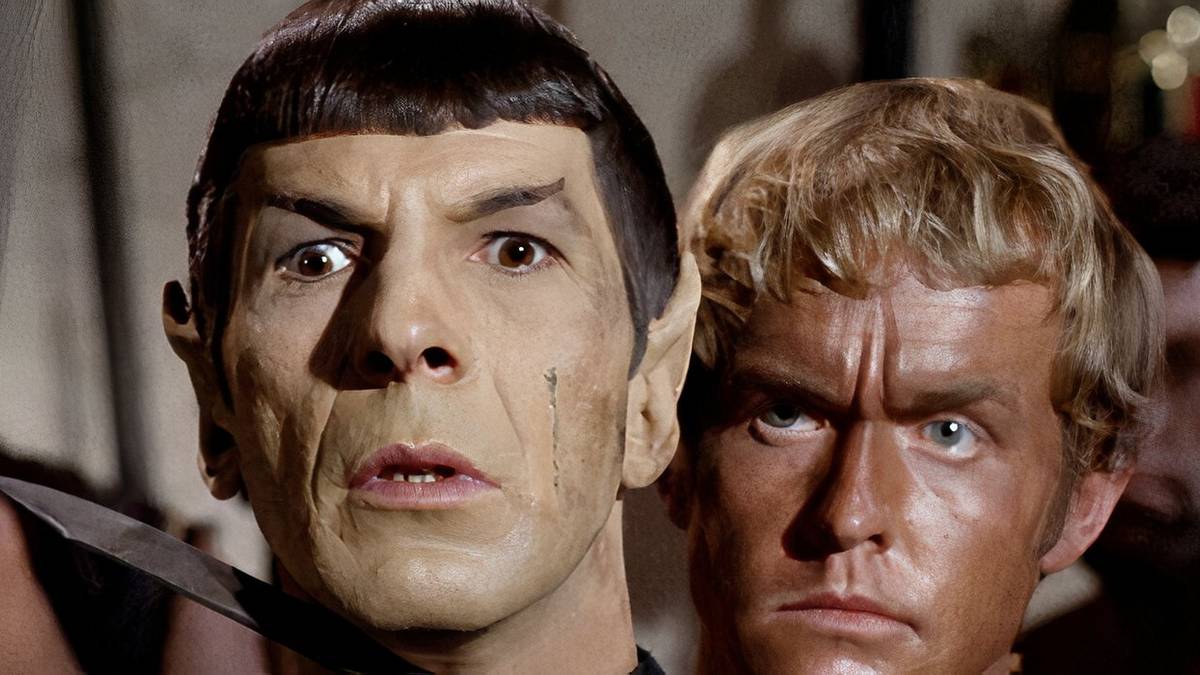
Image via Paramount Television Published Nov 19, 2026, 5:27 PM EST Julio is a Senior Author for Collider. He studied History and International Relations at university, but found his calling in cultural journalism. When he isn't writing, Julio also teaches English at a nearby school. He has lived in São Paulo most of his life, where he covers CCXP and other big events. Having loved movies, music, and TV from an early age, he prides himself in knowing every minute detail about the things he loves. When he is older, he dreams of owning a movie theater in a small countryside town. Sign in to your Collider account Science fiction may not be for everybody, but it certainly provides us with the widest range of stories, from epic sagas of universal proportions to more intimate and philosophical tales. On television, it's certainly the most ambitious, with many series exploring. Sometimes it's easy to understand why it struggles with the uninitiated, though, as many such series often become so preoccupied with their own fictional universes that everything just feels overwhelming... Unless you've got some truly human drama at the core. That's what Battlestar Galactica is all about. While sci-fi household names like Star Trek still feel like they are more about the universe than the people who inhabit it, this 2000s Syfy classic feels like the opposite, with a complex universe that remains focused on the people who inhabit it. ‘Battlestar Galactica’ Uses Its Sci-Fi Premise To Tell an Essentially Human Story The original Battlestar Galactica series was created back in 1978 by Glen A. Larson as a sort of "response" to Star Wars, but it became truly great only decades later, when sci-fi TV veteran Ronald D. Moore gave it his own twist in 2003. Still reeling in the aftermath of 9/11, the new series draws from that paranoia and tells a story in which humanity fights for survival against an enemy of its own making. With so much at stake, it's hard not to engage with what is happening on screen. COLLIDERInteractive Long-range scan active Movies/Science Fiction/Survival Assessment Collider Survival Assessment Which Sci-Fi WorldWould You Survive? 8 questions · 5 worlds · one honest verdict Five of the great screen futures, and not one of them is built for comfort. Answer eight questions about instinct, loyalty and the line you would cross, and the scan will tell you which one you would still be standing in. Worlds in range ▦︎The Matrix ◈︎Mad Max ◑︎Blade Runner ▲︎Dune ✦︎Star Wars Begin the scan Question 01 of 08INSTINCT The world as you know it ends overnight. What is your first move? No wrong answer. There is a wrong hesitation.AFind out what is really going on behind all of it BGrab a vehicle and as much fuel as you can carry CKeep your head down and show up to work anyway DLearn the rules of whoever is in charge now EFind other people and start organizing ← Back Keys 1 to 5 or A to E · Enter to advance Next Question 02 of 08RESOURCE You can stockpile exactly one thing. What is it? Choose carefully. You are not getting a second run.AInformation nobody else has BFuel CClean money and cleaner documents DWater EA ship that can get you off-world ← Back Keys 1 to 5 or A to E · Enter to advance Next Question 03 of 08THREAT Which kind of enemy scares you the most? Be honest about what keeps you up.AOne that can be anywhere, wearing anyone's face BA convoy of people who want what you are carrying CSomeone who looks exactly like you DA rival family that has been planning your downfall for generations EAn empire with unlimited resources and no patience ← Back Keys 1 to 5 or A to E · Enter to advance Next Question 04 of 08AUTHORITY How do you handle the people in charge? Every world has them. Even the ones that pretend otherwise.AAssume they are lying and work around them BNobody is in charge where I am CFollow the orders, file the report, stay invisible DStudy them, get close to them, outlast them EJoin whoever is fighting them ← Back Keys 1 to 5 or A to E · Enter to advance Next Question 05 of 08ENVIRONMENT Pick the place you would rather wake up in: You will be there a while.AA grey city that feels slightly too perfect BAn endless desert highway CA rainy neon street at three in the morning DA dune sea with a fortress on the horizon EA crowded spaceport full of strangers ← Back Keys 1 to 5 or A to E · Enter to advance Next Question 06 of 08ALLIANCE Who do you want standing next to you? Pick one. You only get one.AA guide who knows far more than they are telling you BOne person you trust and nobody else CNobody. You work alone DA loyal circle you grew up with EA crew of misfits who argue the whole way ← Back Keys 1 to 5 or A to E · Enter to advance Next Question 07 of 08MORALITY Which line would you cross to survive? Everybody crosses one.ALying to the people closest to you BTaking what you need by force CLooking the other way DPlaying a long game that costs other people dearly EBlowing something very expensive up ← Back Keys 1 to 5 or A to E · Enter to advance Next Question 08 of 08PURPOSE What are you really fighting for? Last question. Make it count.AThe truth, whatever it turns out to be BTomorrow. Just tomorrow CSomething that finally feels like a real life DYour family's name EEveryone who cannot fight for themselves ← Back Keys 1 to 5 or A to E · Enter to advance Run the scan Scan completeYou would survive ▦︎ The Matrix The Resistance, Zion You take the red pill, you stay in Wonderland, and I show you how deep the rabbit hole goes. You would survive The Matrix because you were never fully sold on the version of reality you were handed. You notice the seams. You ask the second question. In a world built to keep people comfortable and incurious, that instinct is the whole fight, and it is why Morpheus would have found you long before you found him. From the Collider file The Wachowskis' 1999 film won four Academy Awards, including Visual Effects and Film Editing. Bullet time was shot with a rig of roughly 120 still cameras firing in sequence around the actors. Keanu Reeves trained in martial arts for about four months before a frame was shot, recovering from neck surgery the whole time. It opened the same year as Fight Club and eXistenZ, in a run of films about not trusting the world in front of you. Red pill energy Pattern spotter Built to question ◈︎ Mad Max The Wasteland Oh, what a day. What a lovely day. You would survive the Wasteland because you do not waste energy mourning the world that ended. You move, you improvise, and you are very good with whatever is bolted to the thing in front of you. Furiosa would let you drive. That is not a compliment anybody earns easily. From the Collider file Mad Max: Fury Road won six Academy Awards in 2016, more than any other film that year. George Miller storyboarded the entire film as roughly 3,500 panels before there was a script. The chase was shot almost entirely practical in the Namib Desert, with real vehicles and real stunt performers. Anya Taylor-Joy and Chris Hemsworth carried the prequel, Furiosa: A Mad Max Saga, in 2024. Keeps moving Improviser Good with engines ◑︎ Blade Runner Los Angeles, 2049 All those moments will be lost in time, like tears in rain. You would survive 2049 because you know how to be small in a very loud city. You keep your head down, you do the job, and you hold onto one private thing that belongs only to you. That quiet stubbornness is exactly what both Deckard and K run on, and it is what keeps either of them going when the case stops making sense. From the Collider file Blade Runner 2049 won Roger Deakins his first Oscar for cinematography, on his fourteenth nomination. The film also took Best Visual Effects, 35 years after Ridley Scott's 1982 original. Villeneuve shot it on large-format film and kept the fog and rain practical on set wherever he could. Three short films by Luke Scott and Shinichiro Watanabe bridge the 30-year gap between the two movies. Keeps her head down Private Noir soul ▲︎ Dune Arrakis Fear is the mind-killer. Fear is the little-death that brings total obliteration. You would survive Arrakis because you think in decades while everyone around you thinks in weeks. You read the room, you learn the customs, you wait. The desert does not reward speed. It rewards people who understand that patience is a weapon, which is the one lesson the Fremen never had to be taught. From the Collider file Denis Villeneuve's Dune won six Academy Awards in 2022, including Cinematography and Original Score. Hans Zimmer turned down Christopher Nolan's Tenet so he could score Dune instead. Dune: Part Two arrived in 2024 and brought in Austin Butler, Florence Pugh and Christopher Walken. David Lynch's 1984 version and Alejandro Jodorowsky's unmade one are both their own legends by now. Plays the long game Reads the room Patient ✦︎ Star Wars A Galaxy Far, Far Away Rebellions are built on hope. You would survive the galaxy because you never try to survive it alone. You collect people. You end up in the middle of other folks' problems and you stay anyway. Every version of this story, from the Falcon's crew to the Ghost's, runs on somebody exactly like that holding the group together. From the Collider file The 1977 original won six Academy Awards plus a special achievement award for sound effects. John Williams' score was recorded by the London Symphony Orchestra and became the best-selling symphonic film soundtrack ever. Andor took the galaxy somewhere colder and earned Emmy nominations for drama series in both seasons. The saga now runs across eleven feature films and a growing shelf of series on Disney+. Collects people Shows up Hope merchant Compatibility readout · top three 1 2 3 ↻ Retake the quiz Copied to your clipboard Scan filed byCOLLIDERCollider.com · The Sci-Fi Desk In this world, humanity has expanded throughout the stars and settled on multiple planets, forming the Twelve Colonies of Kobol. However, this age of peace and prosperity abruptly ends with a surprise attack from the Cylons, a race of androids created by humans. From tens of billions, the human population is reduced to about 50,000 and forced to flee into deep space aboard a small fleet, searching for a fabled thirteenth colony where they could supposedly rebuild in peace: Earth. This premise is a great setup for exploring many trademark sci-fi themes, but in Battlestar Galactica, the causes and scale of an apocalypse aren't as interesting as how people respond to it. In the end, humanity is made of people, and, with so few left, it's how they face all this, both individually and together, that matters more. At that stage, even seemingly mundane problems such as dwindling food supplies, political disagreements, and interpersonal conflicts can become matters of life and death. Worldbuilding in ‘Battlestar Galactica’ Works for Its Characters, Not the Other Way Around Image via SYFY One of the reasons why some people don't really like sci-fi is the sheer number of different universes there are, and how, ironically, they all feel very similar for those not in the know. It's difficult to place certain concepts in their respective franchises; for example, people often confuse Star Wars and Star Trek, which are diametrical opposites. Battlestar Galactica also suffers from this, of course, but what sets it apart is how, upon a closer look, everything feels like it was built to work around the story and its characters, not the opposite. Worldbuilding in Battlestar Galactica is as complex as it is in any other sci-fi franchise, but while there is inevitably some degree of exposition, we usually learn about things through the characters' experiences. The political structure, for instance, is a central source of conflict between Admiral William Adama (Edward James Olmos) and President Laura Roslin (Mary McDonnell), the same way military hierarchy and technological limitations shape the decisions and relationships of the pilots in the Colonial Fleet. The limited setting is also a big factor in why Battlestar Galactica feels different among sci-fi franchises. There is no galaxy far, far away for anyone to boldly go to; in fact, there is nowhere to go, lest the fleet gets found by the Cylons. Character interaction and reaction to the surrounding universe is what drives everything forward, and it's what makes the world of the series feel actually lived-in instead of something that simply existed before the series began. Franchises like Star Trek eventually fixed this, but only after Battlestar led the way. ‘Battlestar Galactica’ Is Science Fiction That Isn’t About Science Fiction For sure, Battlestar Galactica has plenty of sci-fi elements to justify some confusion with other franchises, especially for people who see the genre simply as "small ships shooting lasers in space." However, while most other corners of the genre are usually as preoccupied with lore itself (alien species, institutions, regulations, etc.) as they are with characters, it's Battlestar's very premise that doesn't allow for that. There is no room for the so-called "technobabble," otherwise everything will inevitably grow too far beyond the scope of the story. Worldbuilding is important, of course, but never as much as what the characters are going through. In the end, Battlestar Galactica succeeds because it doesn't feel obligated to make every episode about science fiction. Perhaps this is one of the reasons why it's so hard to bring it back for a revival — it would have to sacrifice too much of its identity to justify it with such a lean premise. Also, its real-world inspiration makes the series a true product of its time, so, unlike other franchises, there is no room for a reboot for the sake of it, just like there is no room for over-the-top self-referential lore. If anyone gets too caught up in that, they would become easy prey for the Cylons, after all. Battlestar Galactica is available to stream on Paramount+.
Paramount’s 4-Part Sci-Fi Beats ‘Star Trek’ at Its Own Game
Full Article
Original Source
Read the full article at Collider →KhanList aggregates and links to publicly available news content. We do not host full articles from third-party sources. Always verify important information with original sources.