
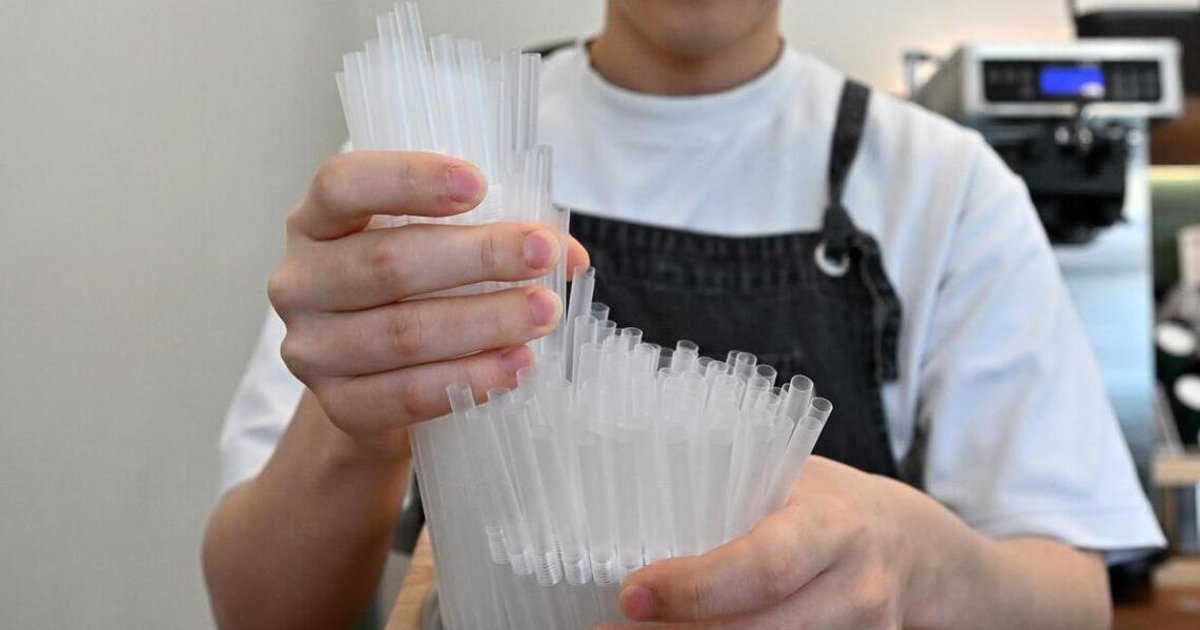
SEOUL – Paper straws have scored 6.33 times higher than conventional plastic straws in a government-commissioned study’s measure of carcinogenic impact through the course of manufacture, use and disposal.The report, commissioned by the Ministry of Climate, Energy and Environment and disclosed on Oct 21 by Representative Kim Wi-sang of the People Power Party, assessed the environmental impacts of four types of straws – conventional plastic straws, paper, biodegradable plastic and bio-based polyethylene (bio-PE).Researchers measured impacts from raw material production through disposal across 16 categories.The human carcinogenic impact figure is a modelled life-cycle measure, not a direct measure of cancer risk to people using the straws.The assessment assumed that 73.6% of discarded straws were incinerated and 26.4% sent to landfill, based on national waste statistics.Compared with conventional plastic straws, paper straws also had 2.04 times the acidification impact.Bio-PE straws were even worse, with 16.18 times the human carcinogenic impact and 5.9 times the acidification impact.Biodegradable plastic straws had 3.34 times the carcinogenic impact and 1.98 times the acidification impact.Conventional plastic straws had the smallest impact in 10 of the 16 categories, including climate change, acidification, particulate matter and human toxicity.Bio-PE straws had the largest impact in 10 categories, including ozone depletion, acidification and smog.Paper straws had the largest impact in three categories, while biodegradable plastic straws did so in two.South Korea introduced restrictions on plastic straws at cafes and restaurants in November 2022, but indefinitely extended the enforcement grace period in November 2023 amid public complaints and questions about the policy’s effectiveness.“The government must acknowledge the failure of its greenwashing policy, which fixated on ineffective substitute materials, and avoid repeating it,” Kim said. “Policy should focus on reducing the overall use of disposable products.”Bio-PE is made from renewable plant-based sources such as sugarcane, but it is chemically identical to conventional polyethylene and does not biodegrade. It is distinct from biodegradable plastic.Paper straws are often promoted as recyclable, but the study found that straws of all materials are difficult to recycle in practice. Researchers said their small size makes them hard for sorting facilities to separate. Coatings and adhesives can also hinder recycling.In a survey of 1,001 people included in the report, 87.5% said they preferred plastic straws. Some 54.4% supported providing straws only when customers requested them, while 18.4% opposed the policy.Researchers recommended that stores not provide any type of disposable straw by default and offer one only upon request. THE KOREA HERALD/ASIA NEWS NETWORK
Paper straws lose green gloss as study finds plastic fares better on key measures
Full Article
Original Source
Read the full article at Straitstimes →KhanList aggregates and links to publicly available news content. We do not host full articles from third-party sources. Always verify important information with original sources.