
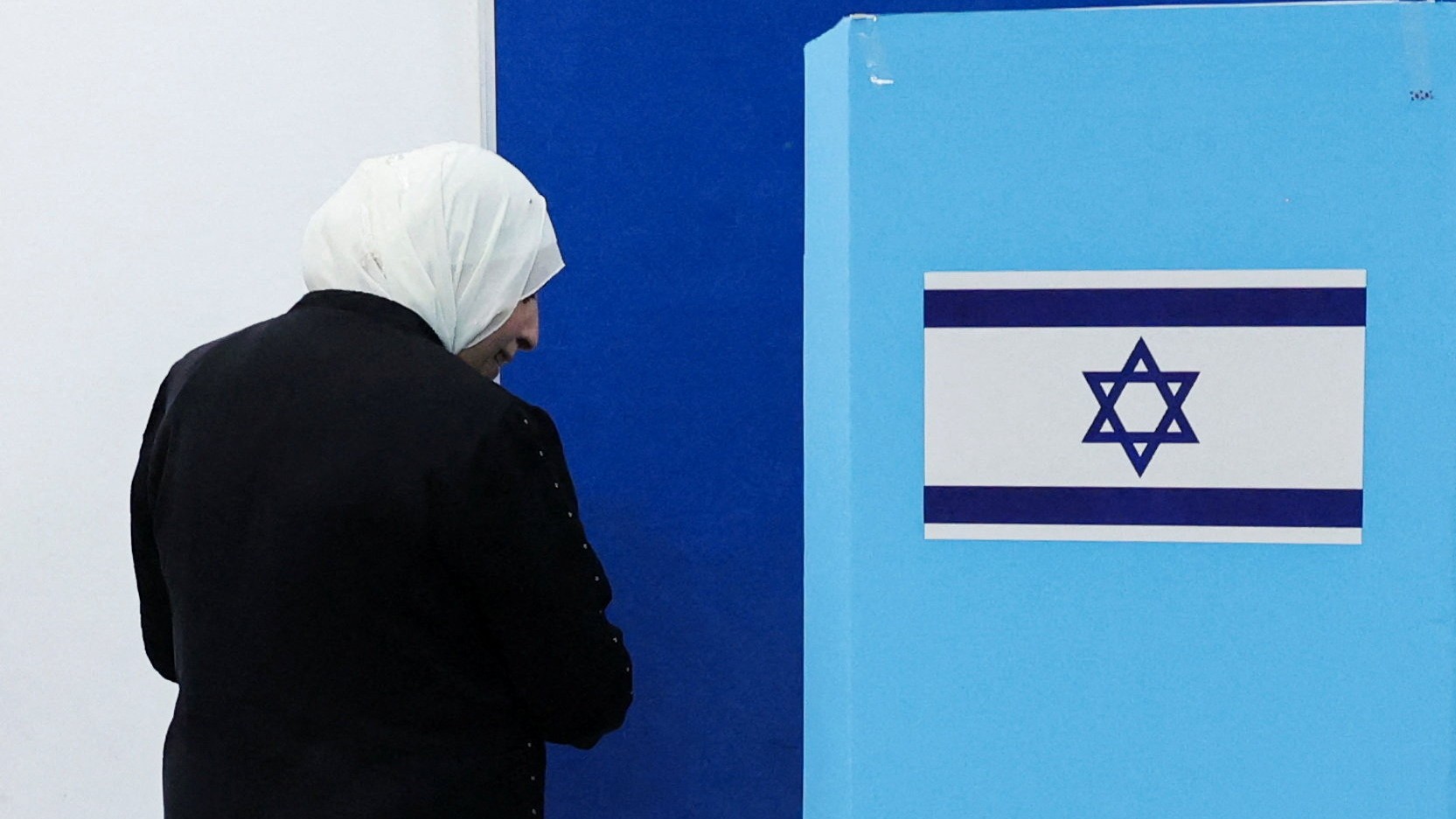
Ibrahim Said has boycotted Israeli elections since voting in 1980. Parties came and went, telling him they would defend his interests if elected, even promising to help return his lands in al-Birwa, the town his family were displaced from during the 1948 Nakba. But nothing ever changed for the better for Palestinian citizens of Israel. Israeli democracy had nothing to offer him and his community, the 70-year-old felt. This year, the situation is completely different. “Without a doubt, we must vote this time. We are living in fear,” Said tells Middle East Eye in his garage in the Galilee. New MEE newsletter: Jerusalem Dispatch Sign up to get the latest insights and analysis on Israel-Palestine, alongside Turkey Unpacked and other MEE newsletters Election day is on Tuesday, four years since the last polls that put Benjamin Netanyahu back in office and gave vast power to his Jewish supremacist allies Bezalel Smotrich and Itamar Ben Gvir. In that time, Israel has waged a genocide in Gaza and life in the occupied West Bank has been suffocated with shutdowns, economic strangulation and routine, increasing settler attacks. 'A sense of security has completely vanished - I feel not just like a second-class citizen, but like a twentieth-class one' - Ibrahim Said, Palestinian citizen of Israel Meanwhile, for Palestinian communities in Israel, organised crime has been allowed to run rampant by the Israeli authorities and the level of violent discrimination has exploded. Even showing an ounce of concern for Palestinians in Gaza and the West Bank can see Palestinian citizens of Israel arrested and sacked, or subjected to terrifying online and media hate campaigns. There are three political parties that have even made the deportation and displacement of Palestinians key parts of their electoral campaign. Smotrich’s Religious Zionism party, for instance, promises to “Judaise” the Galilee and Negev, two areas of Israel where hundreds of thousands of Palestinians live. The stakes for Palestinian citizens of Israel have never been higher. “We do not feel safe. A sense of security has completely vanished - and I mean security on every level,” Said says. “I feel not just like a second-class citizen, but like a twentieth-class one.” No confidence in the system In the 2022 election, just 54 percent of Palestinian citizens of Israel voted. Some polls and analysts are suggesting on Tuesday that could jump to 68 percent or higher. That would give the Joint List and Raam, the parties traditionally representing the Palestinian community, around 15 out of the 120 seats in Israel’s parliament, the Knesset, matching an all-time high in 2020. “I believe turnout could reach 72 percent or 73 percent. God willing, perhaps even higher. Election day may bring many surprises,” Ameer Fakhoury, an analyst at Israel’s Vanleer Institute think tank, tells MEE. Palestinians are not going to the polls simply seeking to repeal the 2018 Nation-State Law that enshrined Jewish supremacy over Palestinian citizens, nor to secure additional budgets or obtain further rights. 'We are voting to prevent displacement and protect the most basic conditions of our existence' - Ameer Fakhoury, analyst “We are voting to prevent displacement and protect the most basic conditions of our existence,” Fakhoury says. Fakhoury notes that ordinarily, minority participation in elections expresses confidence in the democratic system. Here, he argues, it is the opposite: “a lack of confidence in state institutions and an attempt to cling to the political forces or government arrangements that might offer some protection”. “Today, survival has become the dominant motivation,” Fakhoury says. “When Palestinians inside Israel say they are voting to prevent what happened in Gaza or the West Bank from happening to them, consider what that actually means,” he adds. “They are saying they want to prevent ethnic cleansing or genocide. And from whom? From their own state. From the state of which they are supposedly citizens.” 'I remain deeply apprehensive' Jowan Safadi has spent the weeks leading up to polling day torn about what path he will take. The renowned musician, who is popular across the Arab world, has always made a point of boycotting Israeli elections, which he tells MEE is “on the basis of a very simple principle: elections are supposed to be a democratic process, and this state is not democratic”. Between the Jordan River and Mediterranean Sea, he notes, there are almost equal numbers of Jews and Palestinians living under Israeli control. Yet just the 2.1 million Palestinian citizens of Israel can participate in Israel’s legislative elections – 20 percent of the country’s official population – and not even Safadi’s wife is among them. What's behind the rise of the Palestinian vote in Israel's 2026 election? Read More » “The entire arrangement is unfair from the outset. You are given a very narrow space in which to exercise political influence, but you can never genuinely reach a position where you can meaningfully influence Israeli policy,” he says. “The electoral process merely provides a democratic facade, allowing Israel to claim that it is a democracy. That has always been the principal reason for my refusal to participate.” Yet Safadi has begun re-examining his position. The extremism that has taken over the Israeli government and society demands some sort of action, and voting may be one of the very few options available to Palestinian citizens like the musician. “My only hope is that changing the people in power might bring someone who is slightly less barbaric and sadistic. We are essentially talking about moving from something terrible to something marginally less terrible,” he says. “Even then, I remain deeply apprehensive, because I know that the alternatives could be worse.” Debate about voting among Palestinians like Safadi who have traditionally boycotted the elections has been highly charged and drawn controversy within the community. Safadi says he couldn’t sleep after writing on social media that he may vote this year. “I kept thinking about it. How could I do this? Who would I vote for? How could I possibly choose among these people?” he says. “It may well be that boycotting elections could produce better results in the long term than participating in this particular election.” Spurred by the far right Safadi says if he votes it will be despite the campaigns run by the Joint List and Raam, not because of them. He believes something has “collapsed” within Arab politics, and watching the Palestinian parties campaign as normal is galling after everything that has happened in Gaza, the West Bank and Israel. “We are facing an existential crisis, a threat to our very existence, yet these politicians continue to behave as though nothing fundamental has changed. Even after a genocide, their political language has not changed in proportion to the enormity of what has happened.” Like many people that MEE has spoken to, Safadi credits Smotrich and Ben Gvir with getting out the Palestinian vote. Israel’s 2026 election: Who are the main leaders and where do they stand on the key issues? Read More » “The Israeli right has done more to persuade me to vote than the Arab parties themselves,” Safadi says. “Ben Gvir and Smotrich have effectively done the campaigning for the Arab electoral lists.” This has been felt materially by the Arab parties in other ways. According to a source in the Joint List, the parties are spending far less money campaigning than in previous years because voters are being compelled to act by the terrifying rhetoric being used by Smotrich’s Religious Zionism, Ben Gvir’s Jewish Power and Amcha Yisrael, a new far-right party founded by a notorious hardline former general. As Fakhoury the analyst puts it: “We have government ministers whose political activity centres on humiliating us, degrading our citizenship and attacking our very existence.” Hostility towards Israel’s Palestinian citizens is certainly not reserved for the far right alone. Adham, a mechanic in northern Israel who wishes to be identified only by his first name, recently attended a campaign event being held by Naftali Bennett, the leader of the Together, one of the opposition’s main parties. Members of the audience repeatedly asked whether Bennett would form a government with Arab parties. A former Mossad official, who attended the event to encourage people to vote for the former prime minister, repeatedly assured them that they would not form a coalition with Arab parties. “It wasn’t pleasant,” Adham says, “but I believe it’s just part of the campaign. They may change their position once the election results are in.” Such hostility has become routine from Jewish Israelis. Adham says that his wife has been ostracised at the school she teaches at since the 7 October attack and genocide in Gaza. 'Ben Gvir and Smotrich have effectively done the campaigning for the Arab electoral lists' - Jowan Safadi, musician But his priority, as a father of three, is to ensure that his children can live in safety when violent crime is allowed to run riot in Palestinian communities. “Organised crime and the number of people being killed in Arab communities keep me awake at night. I have two adult sons, and I don’t go to bed until they are home. I don’t allow them to stay out after 10 pm,” he says. “I worry about my children all the time, and this government has done nothing to protect us from crime.” So Adham will vote for Mansour Abbas’ Raam, a socially conservative party that has sought to attract voters by promising to deliver concrete benefits to the Palestinian community by allying with hostile Zionist Israeli political forces. Notably, Yoav Segalovich, a Zionist Jewish former police major-general known for his work tackling crime in Arab communities, is running on Raam’s list this year. Palestinian candidate Mansour Abbas, leader of the Raam party, holds his daughter as he places his vote at a polling station in Maghar, Israel, 27 October 2026 (Reuters/Rami Shlush) For many Palestinian citizens of Israel, the fundamental right to remain safe in their home is on the ballot paper. Last year, there were 252 homicides in Palestinian communities in Israel, and the first half of 2026 saw another 147. Police solved just 12 percent of those killings this year. But the feeling of insecurity runs far deeper than this. “Even when I want to visit a Jewish city or a mixed Arab-Jewish city, I feel afraid,” says Maha Mohammed, a teacher living in the Palestinian-majority northern town of Umm al-Fahm. “That includes Jaffa, which is my hometown, where I was born, and where my heart and sense of belonging remain. Even there, you find yourself walking around in fear. You worry about getting on a bus or walking through an area where Arabs and Jews are together,” she adds. “As a woman who wears the hijab, who’s clothing visibly reflects her religious identity, you feel anxious and cannot be entirely yourself. You also sense that the people around you may be afraid of you or uncomfortable with your presence. You start wondering whether someone passing by is frightened of you.” Mohammed says the women of Umm al-Fahm all say that crime and the lack of safety in the streets are among their greatest concerns. “They want safety for themselves, their children, their families, their neighbours, the people around them and their entire community. It is the most basic thing they are asking for,” she says. “We are voting to affirm that we exist, that we are here, and that our presence in this country matters.”
Palestinians are voting in Israel to ensure their very survival
Full Article
Original Source
Read the full article at Middleeasteye →KhanList aggregates and links to publicly available news content. We do not host full articles from third-party sources. Always verify important information with original sources.