
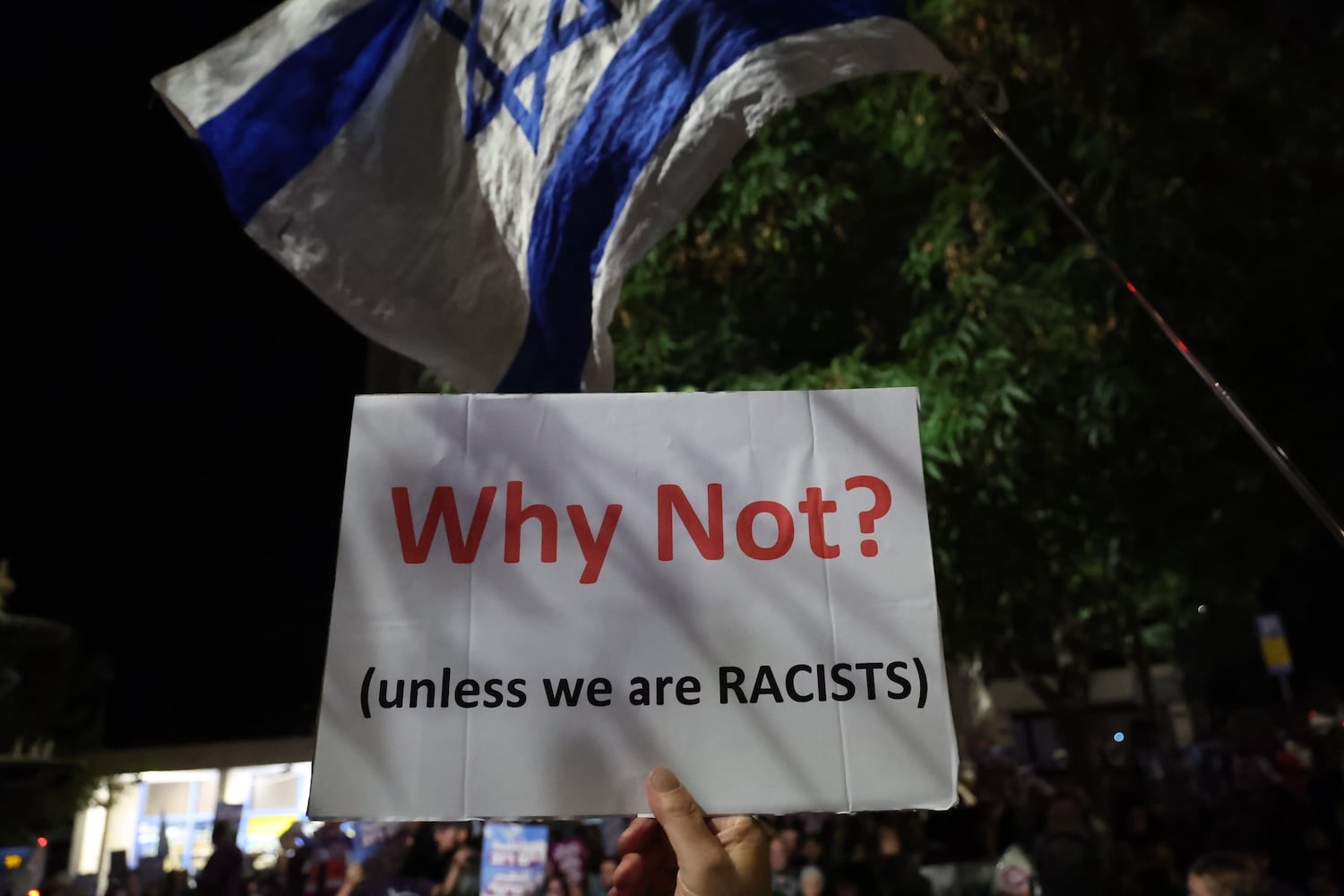
Much of the analysis since Israel’s election on Oct. 27 has described the result as a deadlock—a stalemate between the bloc led by Prime Minister Benjamin Netanyahu and the opposition led by Gadi Eisenkot. According to this framing, neither side managed to clinch a majority in the 120-member parliament, with Netanyahu and his satellite parties mustering 53 seats and Eisenkot and his bloc capturing 48. As a result, Israel now finds itself at a political impasse. But this conclusion is based on faulty arithmetic. It fails to take into account the single most striking aspect of the election: the fact that Palestinian citizens of Israel, who make up roughly 20 percent of the population, voted in unprecedented numbers, helping two Palestinian-led parties capture a record 19 parliamentary seats. Their votes were an explicit repudiation of Netanyahu and his policies, which means that their representatives in parliament should be counted as part of the opposition bloc—bringing the tally to 67 seats. By any objective accounting, this is not a deadlock; it’s a win for the opposition, or at least, it should be framed as such. Much of the analysis since Israel’s election on Oct. 27 has described the result as a deadlock—a stalemate between the bloc led by Prime Minister Benjamin Netanyahu and the opposition led by Gadi Eisenkot. According to this framing, neither side managed to clinch a majority in the 120-member parliament, with Netanyahu and his satellite parties mustering 53 seats and Eisenkot and his bloc capturing 48. As a result, Israel now finds itself at a political impasse. But this conclusion is based on faulty arithmetic. It fails to take into account the single most striking aspect of the election: the fact that Palestinian citizens of Israel, who make up roughly 20 percent of the population, voted in unprecedented numbers, helping two Palestinian-led parties capture a record 19 parliamentary seats. Their votes were an explicit repudiation of Netanyahu and his policies, which means that their representatives in parliament should be counted as part of the opposition bloc—bringing the tally to 67 seats. By any objective accounting, this is not a deadlock; it’s a win for the opposition, or at least, it should be framed as such. High voter turnout, especially from within a minority community that is constantly accused of being rejectionist, is what one hopes for in a healthy democracy. It reflects a collective determination to participate in the electoral process and assume ownership over the decisions and institutions that shape people’s lives. Americans can only envy such high turnout. But Israel is a country that prioritizes Jewish citizens and their rights over Palestinians. This is enshrined the 2018 Jewish nation-state law, which lays out the right to national self-determination solely for Jews. It’s also a country that largely treats Palestinian Israeli parliament members as external to the governing system. In Israel’s 78-year history, a Palestinian-led party has been included in a governing coalition only once, for just a yearlong period. So when the exit polls started to come in on election night, and it became clear that Palestinian Israelis were instrumental in blocking a majority for another Netanyahu coalition, Eisenkot— the leader of the largest opposition party—did nothing to signal that the two Palestinian-led parties would be welcome in his coalition. He has maintained that posture in the days since the vote. Eisenkot’s anti-Netanyahu bloc does not speak in one voice on this issue. One member of the bloc, a left-wing party known as the Democrats and headed by Yair Golan, has welcomed the idea of a governing partnership with the Palestinian-led parties. But two other parties have ruled it out. There are, of course, ideological and political differences among the Palestinian-led parties. One of them, the Joint List, is an amalgam of three different factions, and it tends to focus on the big diplomatic issues, including ending Israel’s war in Gaza and its occupation of the West Bank and advancing equality for Palestinian Israelis. The Joint List won 11 seats in the election. Its rival is the United Arab List or Raam, which prioritizes bread-and-butter issues, including securing larger allocations for its constituencies and ending home demolitions. The United Arab List, which captured eight seats, served in a governing coalition for one year, in 2021. But opposition leaders—along with much of the Israeli media and, of course, Netanyahu himself—broadly blur those distinctions, lumping all Palestinian Arab parties together in a blanket rejection and ignoring their electoral power. Netanyahu and others have also incited against them by describing them as terror supporters. Naftali Bennett’s Beyachad party and Avigdor Lieberman’s Yisrael Beiteinu—the two opposition factions that oppose partnering with the Palestinian-led parties—argue that to do so would be unpalatable to Jewish Israelis in the aftermath of the Hamas attack of Oct. 7, 2023. This claim ignores the fact that Palestinian citizens were also killed and abducted in the Hamas attack, were also part of the rescue services that saved lives, and also suffered heavy missile fire in the ensuing years of war (with their communities often lacking sufficient shelter). This, in addition to the fact that they are facing the worst wave of homicides on record due to unchecked organized crime—one of the issues that drove them to vote out the Netanyahu government. Even as Palestinian citizens have been shunned and excluded from Israel’s political spaces, this election has demonstrated that they remain omnipresent, relevant, and consequential to the country’s future. The importance of the vote lies in what it has exposed: that Israel’s insistence on being a Jewish and democratic state doesn’t hold if you continue ignoring and disenfranchising Palestinian citizens; that doing so has real implications for Israel’s already-flawed democracy and its commitment to civil rights; and, crucially, that without the support of Palestinian Israelis, it appears to be largely impossible for Jewish Israelis to unseat Netanyahu and move past his politics of war and intransigence. The insistence on dividing Israelis along ethnic and religious, rather than civic and political lines, is self-defeating if you want a change in power that is centered on policies, not identity. Some Israelis are increasingly coming to understand this. According to one survey conducted days after the election, a solid majority of opposition voters said that if forced to choose, they preferred a minority government that rests on the support of the United Arab List over a broad-based government with Netanyahu or another snap election. It remains a question whether Eisenkot will decide to break the taboo and normalize the Palestinian parties. He has specified four demands that any partner must meet to join a coalition: accepting Israel as a Jewish and democratic state, recognizing the foundational values of the Declaration of Independence, committing to mandatory national service for all (military or civilian), and declaring that Hamas is a terrorist organization that must be eliminated. These are tough conditions, but they leave at least some small room for maneuvering on both sides. One possibility would be for Eisenkot to form a minority government with some Palestinian Israeli lawmakers while relying on the support or abstention of others during key parliamentary votes. This could allow the sides to cooperate without compromising their platforms. And it would help all opposition leaders keep their core promise to voters to oust Netanyahu from office. Such a government could well be unstable and short-lived. But by taking a clear stance in favor of partnering with Palestinian Israeli parties, Eisenkot would be spearheading a shift in Israeli politics, one that could well impact future elections. Such a government would also be a clear repudiation of the racist, divisive, and anti-democratic zeitgeist personified and epitomized by Netanyahu, who has been trying to undermine the election results. Some cooperation could take place even before a new coalition is formed. Once the new members of parliament are sworn in on Nov. 10, Eisenkot has a majority in the house—with the help of the Palestinian Israeli parties—to elect a new speaker of the parliament. The speaker could help shape a new legislative agenda and begin to advance the issues on which the opposition campaigned—including establishing a state commission of inquiry into the security failures that led to the Oct. 7 attack and annulling the highly controversial and illiberal judicial overhaul laws. This would allow the new parliament to assume some powers from the Netanyahu coalition, even as he remains the caretaker prime minister with his ministers still in place. It would cement Eisenkot as a bold and competent leader who can deliver on the will of the majority while signaling to Netanyahu that, in this transitional period, he does not have carte blanche to engage in another unprovoked war, whether in Iran or elsewhere. And it would recognize the rights of the members of Israel’s Palestinian minority, who took it upon themselves to try to change their futures within the bounds and systems of an Israeli state that has repeatedly rejected them and discriminated against them. That’s a win-win.
Palestinian Voters Gave Eisenkot a Chance to Govern—He Should Take It
Full Article
Original Source
Read the full article at Foreignpolicy →KhanList aggregates and links to publicly available news content. We do not host full articles from third-party sources. Always verify important information with original sources.