
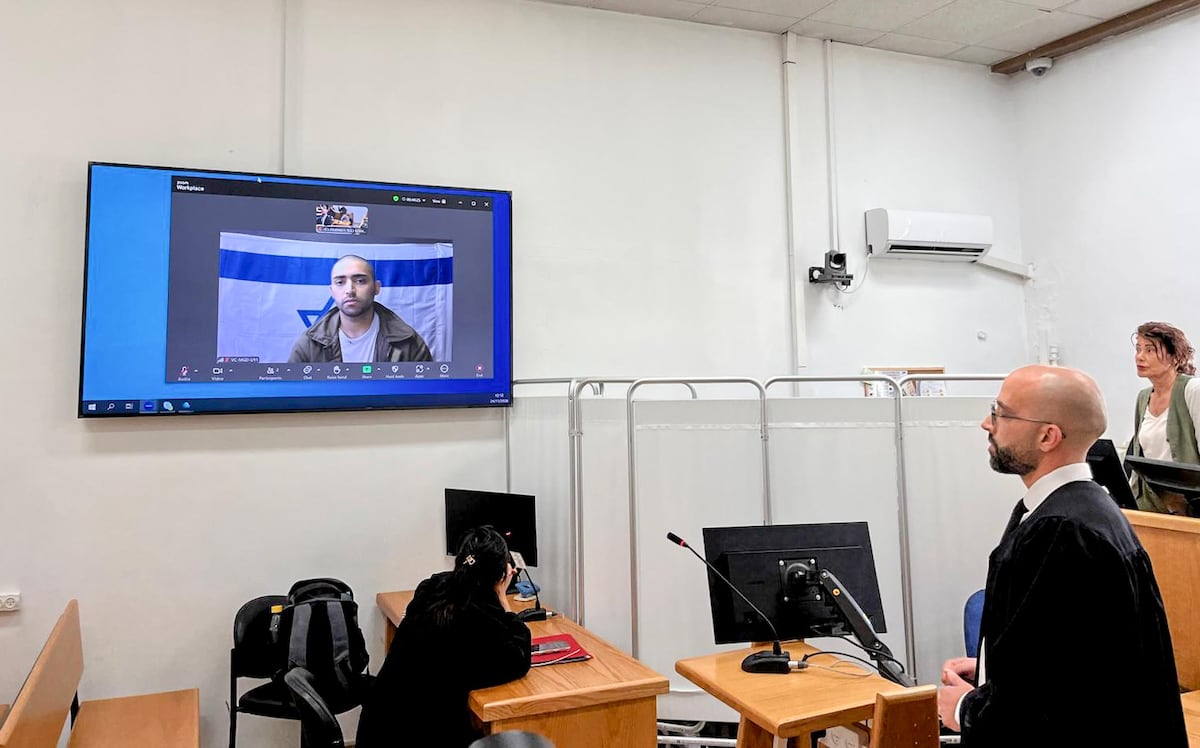
Mahdi Tunsi, a 26-year-old Palestinian and a well-known left-wing activist who advocates for peaceful relations between Jews and Arabs, was at the student residence of the Hebrew University of Jerusalem, where he is studying Sociology and Criminology, when Israeli security forces entered and took him away under arrest.That was 17 days ago, and the student remains in administrative detention, a controversial legal mechanism that allows Israeli authorities to extend a person’s detention for months, and even years, without trial or formal charges. That is why Tuesday’s hearing at the Jerusalem District Court was held behind closed doors. And that is why neither he nor his lawyer, Nasser Odeh, knows what he is accused of.“He looked worse at this hearing,” his lawyer said afterward, with little else he could reveal because of the secrecy surrounding the case. “I can’t share information even with the family,” he lamented.So far, the authorities have disclosed only that he is suspected of “conspiracy to commit a terrorist act.” The intelligence services have submitted, in writing and in a closed proceeding, the reasons they want his detention extended by six months. The judge is expected to rule on the request in the coming days. On Tuesday, she rejected a request to allow the university and diplomats to present their views.The press was allowed into the courtroom for only a minute on Tuesday, before the hearing began, enabling reporters to see him on a video screen with a serious and exhausted expression. His hair and beard were completely shaved off, whereas he had previously worn them long, and he was not wearing his glasses, despite the judge having ordered the prison service to return them to him.Speaking from Israel’s Megiddo Prison, with an Israeli flag visible in the background, he appeared from a wing where scabies has broken out among inmates. The prison, under the authority of ultranationalist National Security Minister Itamar Ben-Gvir, has become more a place of mistreatment than incarceration, according to critics.On Tuesday, Tunsi’s lawyer said that a doctor had seen him in prison but had not provided any medication. The Palestinian detainee described a violent arrest, even though police told the university that the operation had been carried out without incident.Maysam, his 21-year-old sister, was also barred from attending the hearing. Waiting outside the courtroom, visibly nervous and with tears in her eyes, she told reporters: “They took him from the heart of the university [...] There are no charges against him. He’s simply someone who loves studying. He should be finishing his degree, not sitting in prison.”The arrest took place on November 8. His family and friends only learned what had happened the following afternoon, when they contacted the police to report him missing. Neither the security forces nor the university informed them. Police had obtained a detention order based on terrorism-related suspicions that was due to expire within a week, after which he would have been released. But the Shin Bet, Israel’s domestic intelligence agency operating in Israel and the occupied Palestinian territories, stepped in and requested his administrative detention. His lawyer explained that questioning focused less on any alleged offence than on his political activism on campus and his involvement with various left-wing groups, chiefly the Standing Together movement.The court extended his detention without charge until last Sunday, but the intelligence services failed to send a representative to the hearing, so the proceedings were postponed until Tuesday. The profile of those attending reflected the growing attention the case has attracted, including European diplomats and Ofer Cassif, the only Jewish lawmaker among the 11 parliamentarians elected on the Arab Joint List in the October elections.Tunsi is far from the only administrative detainee. According to figures from the Israel Prison Service published by the human rights organisation Hamoked, there are another 3,100 such detainees in the West Bank. A further 1,320 people are being held under the category of “unlawful combatants,” a designation created specifically for Gazans. The use of administrative detention against Jewish Israelis was already rare, but Defence Minister Israel Katz has now banned it altogether, at a time when violence by Jewish settlers is at unprecedented levels.In little more than two weeks, however, the case has become a symbol. Around 150 people, both Jewish and Arab, gathered outside the courthouse on Tuesday carrying banners and chanting slogans such as “Stop political persecution,” “Freedom for Mahdi,” and “Argentina 1976 is happening here.” The day before, about 200 students had protested against his arrest on the Jerusalem campus where it took place, facing a small counter-demonstration by right-wing activists. Similar protests were held at Tel Aviv University and the University of Haifa.Unlike Palestinians in the West Bank, who are the usual targets of administrative detention, Tunsi is also a Jerusalem resident, giving him a different legal status: that of a permanent resident with freedom of movement throughout Israeli-controlled territory.As the case has drawn increasing attention, so too has the controversy over the role of the Hebrew University. Some critics accuse the institution of failing to prevent the arrest. Others fault it for changing its account of events, initially saying it had no knowledge of the operation and later stating that it had been informed “minutes beforehand,” as well as for waiting 10 days before issuing a carefully worded statement of clarification.“It’s a disgrace,” lawmaker Ofer Cassif said at the court. “It cannot be that students at an academic institution are afraid of what might happen to them if they speak out against the government. This is a situation we have seen before during dictatorships in Latin America and in Spain.”Last week, the Israeli Sociological Society said it was “horrified” by the detention and urged the heads of the country’s universities to “act to ensure that campuses and student residences remain safe and protected spaces.” Professors at the Faculty of Law issued a separate letter expressing their “concern” that the detention appeared to be linked to the student’s “public activity,” which “includes the expression of views critical of government policies.”He went on to argue that the campus where the arrest took place, on Mount Scopus, is “probably the most complex on the planet” because of its mix of Israeli and Palestinian students and the sensitivities involved. “This requires a great deal of common sense. Our campus is in a very fragile and delicate situation, on the verge of an explosion.”Noa Dagoni, executive director of Ir Amim, an NGO focused on the impact of the conflict on Jerusalem, attended Tuesday’s hearing in solidarity with Tunsi, who had served as a guide on tours the organization ran in his neighborhood of Silwan. She is not surprised that a Palestinian involved in Jewish-Arab activism was detained.“That kind of activism is what frightens the government most,” she told EL PAÍS. “It is the political potential for change that can emerge from that interaction.”Dagoni sees the arrest as part of two overlapping waves of repression. The first began in October 2023, when the Hamas attack triggered what she describes as a collective criminalization of Palestinians, including those with Israeli citizenship. The second has unfolded in recent weeks, fuelled by incitement from Benjamin Netanyahu’s government following the strong electoral showing of its allies in last month’s elections.On November 3, police arrested Abed Abu Shehadeh, a Palestinian journalist and activist with Israeli citizenship, at his home in Jaffa, near Tel Aviv. Five days later, he was released without charge and without ever appearing before a court.Sign up for our weekly newsletter to get more English-language news coverage from EL PAÍS USA Edition
Palestinian student jailed without charge after arrest at Jerusalem dormitory
Full Article
Original Source
Read the full article at English →KhanList aggregates and links to publicly available news content. We do not host full articles from third-party sources. Always verify important information with original sources.