
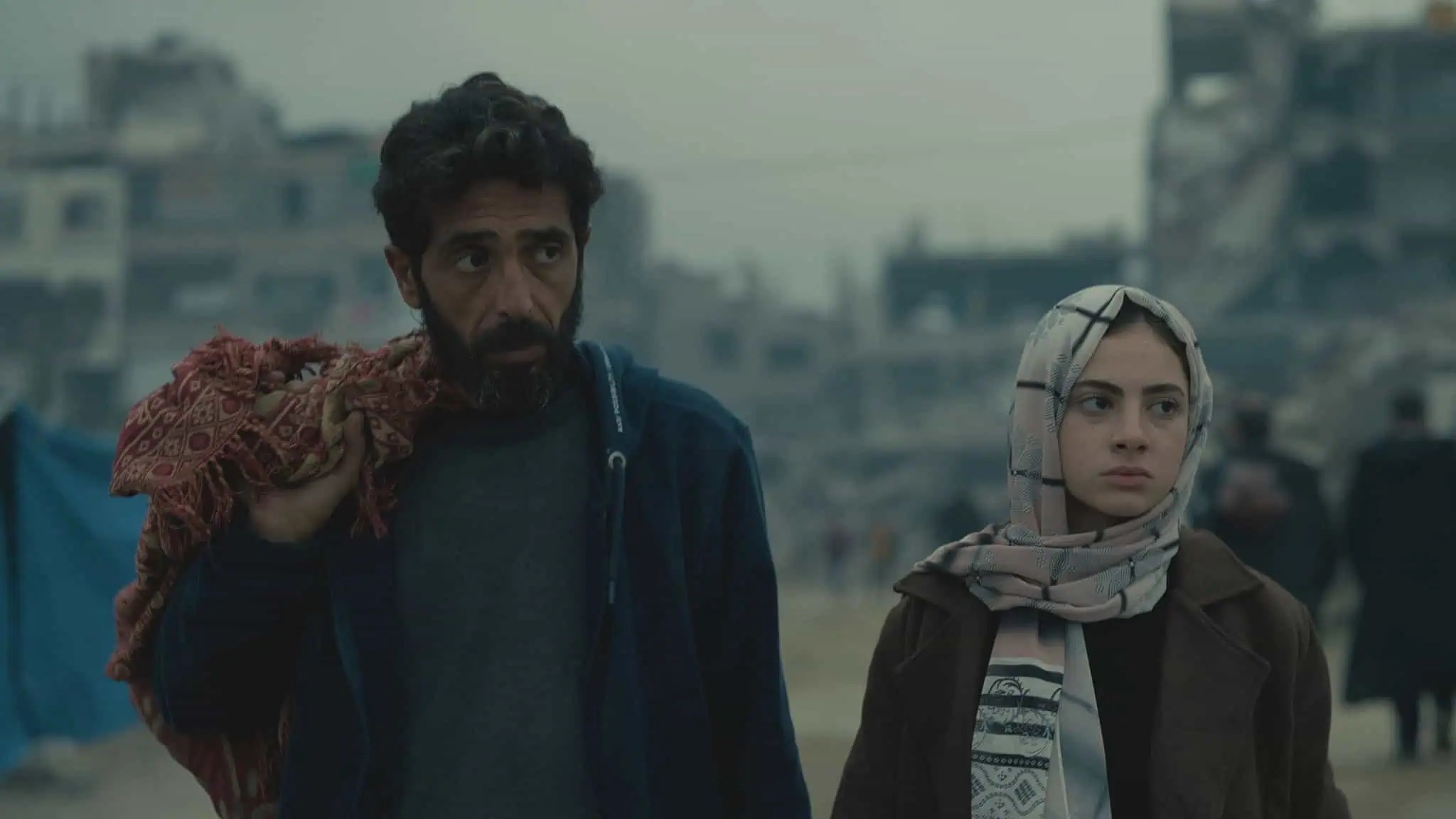
A year after the so-called ceasefire agreement between Israel and Hamas in October 2025, Palestinian and Israeli cinemas have been scrambling to capture a volatile reality shaped by questions more complex than those that emerged in the immediate aftermath of 7 October. Maintaining one’s dignity while surviving a sadistically dehumanising campaign targeting civilians was the central preoccupation of the handful of films about Gaza released between 2024 and early 2026. The 2026 autumn season, however, offers a different set of inquiries: the deeply asymmetrical power dynamics between the Israeli aggressor and the Palestinians; the viability of what has now become the wistful dream of a two-state solution; the lingering ache for a lost, irretrievable homeland; and the newly exposed, unflattering realities of Gaza’s informal economy. As the colossal success of NAZA has made evident, Gaza will continue to dominate cinema's narrative on Palestine for the foreseeable future. Yet, as this fall's crop of films suggests, new dimensions will gradually come into focus as Palestinian filmmakers continue to grapple with uncertain terrain post-7 October. New MEE newsletter: Jerusalem Dispatch Sign up to get the latest insights and analysis on Israel-Palestine, alongside Turkey Unpacked and other MEE newsletters Israeli cinema, meanwhile, will remain divided, caught between the pressure exerted by jingoist political leaders desperate to give their country a PR facelift and the competing impulse of leftist filmmakers seeking to restore the diminished international standing of a national cinema whose motivations can only be assessed on a case-by-case basis. Thirteen in Gaza The debut feature by Palestinian filmmaker Hosam Abu Dan is the first narrative film made by a Palestinian filmmaker inside Gaza since 7 October. It is also the most daring and controversial Palestinian film of the year: a coming-of-age story that doubles as a stark, unvarnished portrait of a Gaza populated by helpless fathers, war profiteers and sexual predators. The film is a frank examination of the inevitable moral concessions engulfing a segment of the male population whose deviation cannot be disentangled from the moral rot of occupation. India bans 'The Voice of Hind Rajab', citing threats to relationship with Israel Read More » Set in 2025, the film introduces newcomer Mary Ziyara as Raghad, a 13-year-old girl who has lost her mother and siblings in an Israeli strike that destroyed her home. Now relocated to a sprawling, dilapidated camp with her father (Firas Al-Masri), Raghad grapples with the confusion and anguish of puberty in a depleted environment where menstrual pads are considered a luxury. Jobless and desperate to provide for his daughter, Abou Raghad finds himself drawn into the web of Khalil (Ghassan Salem), a shady merchant who controls the trade and distribution of goods inside the camp by running a black market in humanitarian aid. Khalil offers Abou Raghad a job while harbouring barely concealed sexual desires for his daughter. His proposal to marry her soon becomes non-negotiable: It is the only means by which Raghad and her father can continue to survive in a lawless, inescapable purgatory. Abu Dan depicts a different reality of Gaza, one that cinema has yet to turn its attention to. When mere survival ceases to be the primary drive of existence, the director suggests, the excruciating struggle to reclaim a semblance of normality can prove equally devastating. Raghad is denied the opportunity to grapple with the ordinary anguish of adolescence: privacy is non-existent, sanitation is reduced to a bare minimum, and the mood swings and insecurities associated with body image and self-consciousness must be suppressed. Khalil, meanwhile, embodies the irrepressible force of capitalism, an inevitable by-product of a population plunged into economic disarray. Abu Dan strips Gaza's lived reality of the habitual political framing that dominates news coverage; in this particular Gaza, neither Israel nor Hamas has a palpable presence. Make no mistake; this communal strain, paranoia, and suffocating sense of entrapment are inseparable from the war. Khalil is a monster born of Israeli occupation. In this dog-eat-dog world, Abu Dan suggests, expecting every individual to behave honourably is both fanciful and fundamentally at odds with the primal nature of human survival. There are considerable similarities between Thirteen in Gaza and Abdallah Al-Khatib's Berlinale-winning Chronicles of a Siege. Abu Dan’s film, the winner of the Netpac Award at this year's Toronto Film Festival, is the edgier of the two, however. It is raw and oppressive to a fault at times, and unpleasant at others. Yet, by confronting a facet of life in Gaza that Palestinian cinema has been anxious to explore, and refusing to gloss over this uncomfortable dimension of the Palestinian experience there, Abu Dan has created one of the most authentic chronicles of his hometown. Citizen Osama Compared to Thirteen in Gaza, Citizen Osama comes across as a more conventional treatment of Gaza, albeit one distinguished by its refreshing humanism and surprising warmth. The sophomore documentary feature by Ahmed Hassouna, another Gaza-based filmmaker, chronicles the journey of Osama al-Ashi, a photographer turned war journalist after 7 October, as he navigates fatherhood, friendships, and the ethical responsibilities of documenting daily life in Gaza from the inside. Spanning roughly the first year of Ashi's baby's life, from mid-2024 to mid-2025, the film dispenses with a conventional narrative in favour of a character study of a good-hearted man who relishes the small blessings in his life amid otherwise overwhelming destruction. Over the course of the year, Ashi and his young family are forced into incessant moves from the north to the south, continually confronting the looming threat of displacement. Yet the young father perseveres. "Every other day, we say goodbye to a colleague," he remarks in the film's accompanying voiceover. Hassouna and Ashi punctuate their film with startling images: a band of journalists cracking dark jokes inside a moving vehicle navigating the rubble; men sprinting to retrieve the humanitarian aid dropped into the sea; and a population's hearty celebration of ceasefire, as people desperately endeavour to find reasons for hope. If Thirteen in Gaza captures the despondency of camp life, Citizen Osama illustrates the colossal yet often overlooked importance of urbanity, work, and a like-minded community. Seen side by side, the two films demonstrate that the enforced camps were never the natural or accustomed habitat for a people who want nothing more than normality. Citizen Osama breaks little new cinematic ground, nor does it offer a particularly revelatory portrait of post-7 October Gaza. But Ashi makes for a compelling and eminently watchable protagonist, one who never seeks to elicit sympathy from either his followers or the film's audience. By the film's conclusion, as Ashi plays with his young son, Hassouna underscores a fundamental truth: the struggle of ordinary Palestinians is no longer simply about being seen; they crave something far more basic - a dignified life, lived in freedom. Conversation with the Sea Being a fan of Palestinian filmmaker Muayad Alayan’s previous work, I have grappled for weeks now to find virtues in his latest feature, but frankly I couldn’t. Conversation with the Sea is sincere, well-intentioned, and politically significant in its underscoring of the precariousness of Palestinian existence inside Israel - an oft overlooked side of the Palestinian experience. But, to put it bluntly, it is also a poorly made film, marred by sloppy filmmaking and contrived storytelling. Award-winning veteran actor Kamel el-Basha (The Insult, Mo) plays Kamal, a 60-year-old widowed baker leading a quiet, largely isolated life in his old house in East Jerusalem. 'No Other Land': Israeli-Palestinian film wins Oscar for best documentary feature Read More » Estranged from his daughter for reasons revealed only in the latter part of the film, Kamal is still mourning the untimely death of his young son. The character finds his uneventful existence disrupted when he receives a court order from the Israeli National Insurance Institute demanding 75,000 shekels ($23,000) in unpaid social security contributions accumulated under his son’s name. His death, the documents show, has never been acknowledged for reasons unknown The penniless Kamal is thrust into a mission to prove that his son is dead and avoid the confiscation of his house. Initially convinced that his son drowned, Kamal begins to harbour doubts when inconsistencies emerge in the records, propelling him on a journey to investigate what actually happened to Wael. The film’s plot is inspired by a true story involving Alayan’s wife and father-in-law. Its surreal premise opens up several fascinating avenues for exploration, both aesthetically and narratively. Alas, the director opts for the most humdrum, pedestrian route, weaving a predictable domestic drama whose melodramatic excesses thoroughly dull its pointed political themes. The narrative’s biggest flaw is how goody-two-shoes Kamal is. He is presented as a conflicted man, consumed by guilt. Yet his greatest supposed transgression - leaving for the United States in search of a better life - is rooted in his desire to simply provide for his family. His internal conflict reeks of contrivance, seemingly imposed by Alayan to lend his character greater complexity. Instead, Kamal emerges as a martyr of circumstance, a dual victim of the American Dream and an Israeli occupation that denies Arab men of his ilk the financial security they seek. The flatness of Kamal’s character is mirrored in Alayan’s frustratingly calculated and outlandish depiction of Israelis. In a much-discussed, lengthy dinner scene that has drawn the ire of numerous critics, Kamal finds himself seated among a gathering of self-proclaimed liberal Israelis while awaiting the arrival of a woman named Einat. She may have been the last person to see his son before his death. Blithely ignorant of the structural persecution of their Arab neighbours, the dinner guests openly debate how Palestinian children should be educated to develop a more balanced view of Israel while shedding their supposedly toxic indigenous identity. Stiffly staged, awkwardly scripted, and outrageously performed, the dinner scene - the film’s centrepiece - stretches the limits of believability to breaking point through its sheer bluntness. Depict Israelis as villainous and entitled as you wish, but does it have to be so artless? So shallow? So obvious? Kamal’s journey culminates in an artificial reconciliation, but he learns little about himself, his son, or anything else. Nor does the film offer anything remotely insightful about the power dynamics between Palestinians and Israelis that Alayan briefly gestures towards. The sole point of intrigue remains the premise itself, which the director never fully develops or does much with. Even a straightforward legal drama might have proved more engrossing and worthwhile. Alayan is one of the most talented filmmakers of his generation. His first two features, Love, Theft and Other Entanglements (2015) and The Reports on Sarah and Saleem (2018), were bold, multifaceted genre films that tackled aspects of the convoluted Palestinian experience inside Israel that numerous filmmakers have shied away from. Conversation with the Sea, Alayan’s weakest and most compromised production to date, arrives at a vastly different and more difficult moment than his previous work, one in which the kind of internal criticism, biting irony, and sardonic humour that characterised his earlier films may be perceived as ill-suited to the current thorny political climate. But if filmmakers such as Abu Dan can take risks with their audacious and defiant portrayals, why can’t filmmakers of Alayan’s calibre do the same? The Road to Jericho Last, and certainly least, is the latest feature by veteran Israeli director Amos Gitai, arguably the most insufferable Middle Eastern film. A loosely structured essay film of sorts, it juxtaposes the lost promise of the Oslo Accords with the displacement of the Bedouin community of Khan al-Ahmar, whose members face eviction by the Israeli authorities. Gitai interweaves these two distinctly dissimilar strands of footage - the former culled from archival material, the latter shot by the director himself - with recitations of texts by the first-century Roman-Jewish historian Flavius Josephus, delivered by the likes of the late legendary French star Jeanne Moreau and iconic American director Samuel Fuller. A host of other major stars pop in and out of the film for no discernible reason: Irene Jacob, Sarah Adler, and, in disparate archival footage, Arthur Miller and Danny Huston, among others. Gitai draws on Josephus's meditations on the Roman-Jewish wars to establish parallels with the current political situation. The Road to Jericho mixes archival footage with scenes filmed by the director of Bedouin communities being displaced (Amos Gitai) But what exactly are these parallels? That history repeats itself? In what sense? That the cycle of land disputes, occupation, and displacement keeps recurring? But didn't the Roman-Jewish wars eventually come to an end after nearly 70 years - a period longer than the Israeli occupation of Palestine, whose end remains nowhere in sight? There are some suggestive equivalences concerning nationalism and fanaticism, as well as the fluid identities of the region, which challenge Israel's racist ideologies. But these parallels remain opaque throughout, owing to Gitai's unfocused, sophistic approach to material that is already flailing - an approach so enamoured of its own intellectual pretensions that it fails to produce a coherent or compelling discourse. As ever, Gitai remains a staunch believer in the Oslo dream, which, in the context of his work, now feels increasingly hollow and naive. His conception of this purported peace is dated, out of touch with present realities, and utterly divorced from Israel's colonial project which has been laid bare in the wake of the Gaza genocide, including in the eyes of anti-Zionist Israelis. Time and again, through various strands of footage, he has his subjects insist that "compromises from both sides must be made in order to achieve peace". But on whose terms is this conditional peace? What does it entail? And will it bring an end to the oppression of Palestinians? Gitai crams his unwieldy treatise with such empty platitudes. He wears his heart on his sleeve, and his sympathies for the Palestinian cause are palpable throughout much of his work. Yet, like many liberal Israelis, his lofty vision of harmonious coexistence fails to confront the intrinsic venality and imperialism of a political creed that has always been deeply questionable and fundamentally flawed, even during the Oslo years.
Palestinian and Israeli films present different shades of reality amid genocide
Full Article
Original Source
Read the full article at Middleeasteye →KhanList aggregates and links to publicly available news content. We do not host full articles from third-party sources. Always verify important information with original sources.