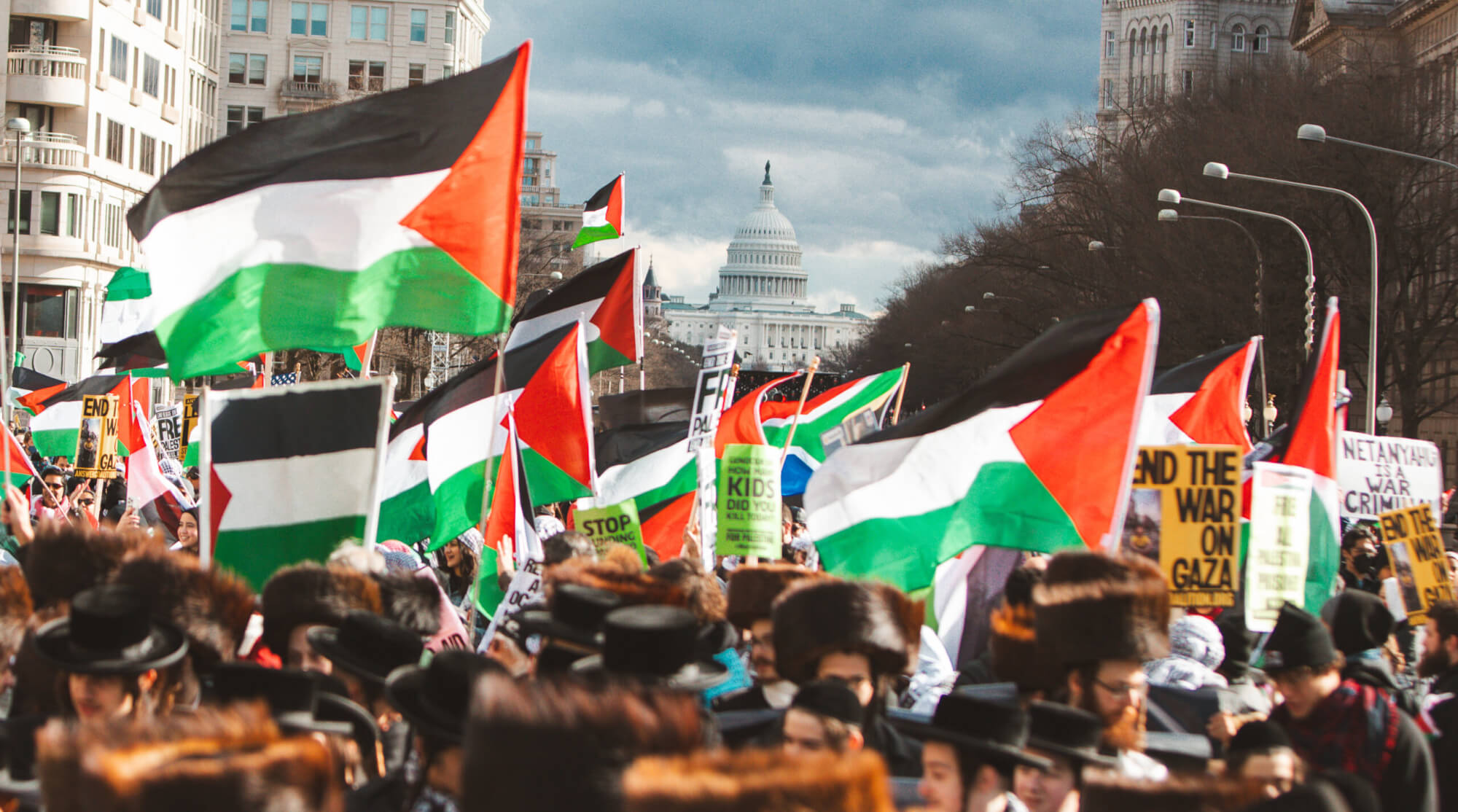
When Salim Totah and Dr. Fuad Shatara appeared before the U.S. Congress in 1922 to oppose the Balfour Declaration, they were asking America to pay attention to a people most Americans knew little about and a cause few cared to understand. Their audience was small, their influence negligible and the political odds overwhelmingly stacked against them. Yet those early Palestinian immigrants understood something that would shape the next century: Palestine would have to be defended not only in Jerusalem and Jaffa, but also in Washington, New York, Detroit, Chicago and every American city where Palestinians built new lives. More than one hundred years later these efforts has transformed the American debate. Palestine is no longer absent from public life. Millions of Americans have marched in solidarity with Palestinians. University campuses have become centers of political activism. Churches, labor unions and civil rights organizations openly challenge policies that only a few years ago were considered beyond criticism. Members of Congress now speak of occupation, apartheid and even genocide, while younger Americans have shifted public opinion in ways that would have been almost unimaginable a generation ago. This did not begin after October 2023, nor did it happen by chance. It was built over decades by successive generations of Palestinian Americans. Scholars such as Edward Said and Ibrahim Abu-Lughod challenged the intellectual erasure of Palestine. The Association of Arab-American University Graduates and the General Union of Palestinian Students created spaces where Palestinian identity and political thought could flourish. James Abourezk demonstrated that Arab Americans could organize nationally and engage Congress as citizens. James Zogby and the Arab American Institute helped move electoral participation from the margins to the center of Arab American political life. Alongside them stood hundreds of local organizations and thousands of volunteers who kept the Palestinian cause alive through years when speaking publicly carried real professional and personal consequences. Their achievements deserve recognition for it changed America’s conversation about Palestine but unfortunately it failed to build the national political institutions capable of turning that achievement into sustained political influence. That is not a criticism of one generation or one organization. It is the unfinished story of Palestinian America itself. The easy explanation is that the community never had a fair chance. There is truth in that. Palestinian Americans organized on behalf of a stateless people while confronting a political establishment firmly aligned with Israel, a media landscape that rarely reflected Palestinian voices and, after September 11, a climate in which Arab and Muslim political activism came under unprecedented suspicion. Those realities shaped the community’s political development but they do not fully explain it. Other American communities also faced hostility, prejudice and political exclusion, yet gradually built durable institutions that outlived individual leaders and moments of crisis. Palestinian Americans became remarkably effective advocates. They educated, protested, organized conferences, raised humanitarian aid and responded to one emergency after another. They became far less successful at building permanent political institutions capable of accumulating experience, developing leadership, raising sustained resources and exercising influence election after election. Part of the reason lay in the community’s close relationship with the Palestinian national movement. For decades the PLO provided legitimacy, identity and a common national purpose. It united a dispersed people and gave Palestinian Americans a cause larger than themselves. But it also postponed an equally necessary task: building an independent Palestinian American political project rooted in American civic life. Too often, political priorities were shaped by developments in Beirut, Tunis, Gaza or Ramallah rather than by the realities of American politics. When the Palestinian national movement weakened, many Palestinian American organizations weakened with it because they had never fully established an independent political footing. Responsibility also lies with the Palestinian national leadership itself. For decades it failed to appreciate the strategic importance of the Palestinian American community. They had built successful careers, entered universities, businesses, law firms, hospitals and public institutions, yet no sustained effort was made to organize that growing community into a coherent political constituency. An extraordinary national asset was allowed to evolve largely on its own. The community must also be willing to examine its own institutions honestly. Hometown associations, like the Ramallah Palestine Federation for example, preserved memory and strengthened family ties. Churches and mosques sustained communities through war, displacement and repeated national crises. Their contribution should never be underestimated. But preserving identity is not the same as building political power. Few of these institutions saw voter education, leadership development, candidate recruitment or long-term political organizing as central to their mission. Charity work often replaced politics and annual banquets and commemorations became substitutes for institution-building. The past three years, though, have changed the political landscape more profoundly than any period in modern Palestinian American history. The movement is larger, younger, far more organized and more confident than ever before. It has allies across American civil society, growing support inside the Democratic Party and unprecedented visibility in national politics. The question today is no longer whether Palestinian Americans can influence the debate. The question is whether they are finally prepared to build the institutions capable of influencing political power itself. The political instincts of a younger generation are changing. They understand that demonstrations, however important, are only one part of political life and that in tandem campaigns, campaign financing and campaign relationships with elected officials matters. Those are the foundations of every successful political constituency in the United States, and Palestinian Americans are beginning to adopt them. The shift is already visible. The vote by 103 Democratic members of Congress to end unconditional military aid to Israel would have been politically unimaginable only a couple of years ago. Equally significant was what followed. Rather than limiting themselves to statements of support, Palestinian American organizers and their allies moved to protect those members politically by launching new electoral fundraising initiatives. The recently established American Priorities PAC marks an important departure from the way the community has traditionally engaged in American politics. Instead of relying primarily on a handful of major donors, it seeks to build a broad base of small-dollar, recurring contributions capable of supporting members of Congress who have taken political risks on Palestine. Whether this particular initiative succeeds is less important than what it represents. For perhaps the first time, Palestinian Americans are beginning to invest systematically in the electoral process itself rather than treating elections as events to be observed from the sidelines. That is an important lesson. Political influence in America is built not only through moral arguments or public demonstrations, but also through organization, voter mobilization, campaign financing, candidate recruitment and sustained engagement between elections. Communities that understand this shape public policy. Those that do not eventually discover the limits of protest, however justified or effective it may be. These developments are encouraging, but they remain fragmented. They are initiatives, not yet a strategy. That is why the next step should not be to announce yet another national organization. It should be to convene the community itself. For more than a century, Palestinian Americans have never held a genuine national political convention to answer a simple but fundamental question: how should they organize politically in the United States? That absence is itself part of the problem. Such a convention should bring together the broadest possible spectrum of Palestinian American life: established organizations, younger activists, elected officials and candidates, scholars, business leaders, professionals, academics, student organizers, women’s organizations, hometown associations, mosque and church leaders, philanthropists and independent voices. Its purpose should not be another conference, another declaration or another umbrella organization. Its purpose should be to reach agreement on a national political strategy for the next generation. Everything should be on the table. Should the community establish a democratically elected Palestinian American Congress? Should it strengthen and expand political action committees and electoral fundraising networks? Should existing organizations be linked through a permanent national coordinating body with a professional staff and agreed priorities? How should future candidates for school boards, city councils, state legislatures and Congress be identified, trained and supported? These questions should not be decided by a handful of individuals or by one organization speaking for everyone. They deserve an open national debate, and they deserve answers. One conclusion must be iron clad and crystal clear: Palestinian Americans must build their political future where they live and vote. Their connection to Palestine and its national movement remains permanent, but political influence in the United States will be built in congressional districts, state legislatures and the White House—not in Ramallah, Amman, Gaza or elsewhere in the region. That is where lasting political power is won, and that is where the community must organize itself. The first century of Palestinian American history was devoted to making America hear the Palestinian story. The challenge today is to build institutions capable of protecting those gains and turning them into enduring political influence. No one can say with certainty what the final institutional model should look like. The community may ultimately choose one model or several. What can no longer be postponed is the conversation itself. Palestinian Americans have reached a moment previous generations could scarcely have imagined. They possess the numbers, the education, the professional experience, the financial resources, the confidence and, increasingly, the political alliances to become a respected and influential force in American public life. What has been missing is not talent or commitment. It has been a shared national framework capable of bringing those strengths together. Sami MshashaSami Mshasha is the former Spokesperson and Director of Communication with UNRWA (United Nations Relief and Works Agency) for well over three decades (retired in 2022). He writes on Palestinian refugees, Palestinian politics and the evolving role of the Palestinian American community in U.S. public life.
Palestinian Americans changed the conversation. Now, can they finally build political power?
Full Article
Original Source
Read the full article at Mondoweiss →KhanList aggregates and links to publicly available news content. We do not host full articles from third-party sources. Always verify important information with original sources.