
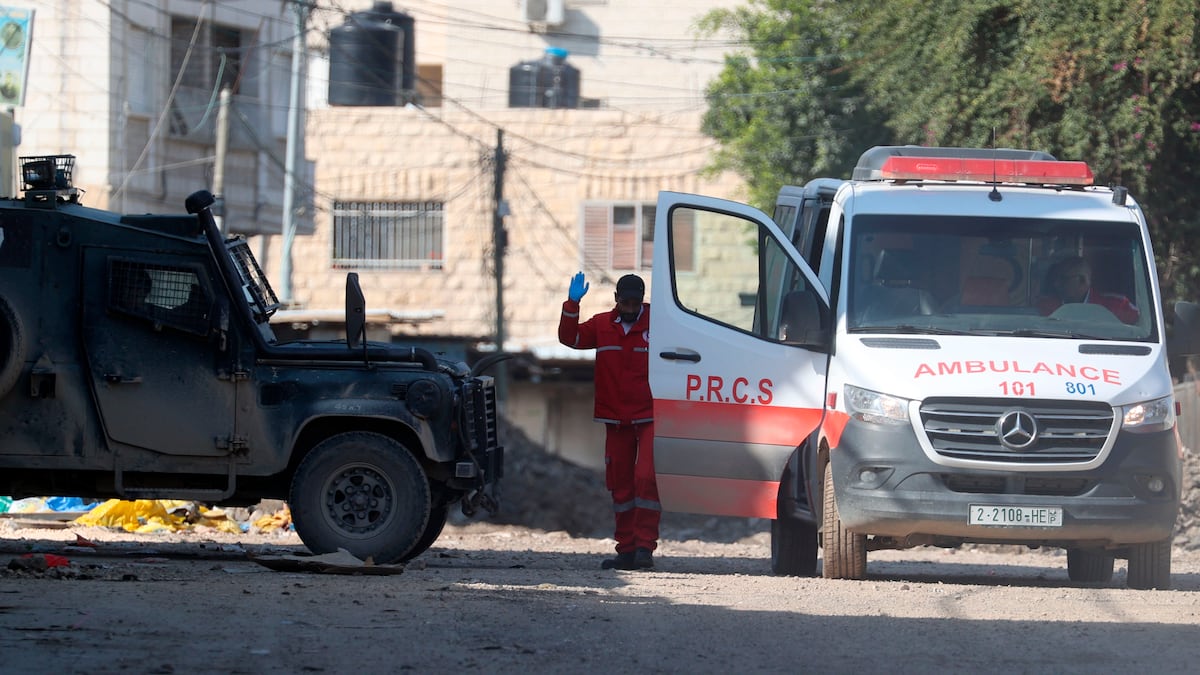
Mohammed Musa, a 52-year-old Palestinian volunteer paramedic, was driving an ambulance to assist people wounded in an attack by Israeli settlers near the West Bank city of Nablus when he was shot and killed. This happened in 2024, and his colleague Bashar Qaryouti recalls it today, noting that armed Israelis — whether civilians or military personnel — have attempted to kill him five times while he was responding to an emergency.Qaryouti cites this as an example of the physical attacks and obstructions by Israeli soldiers and settlers he faces while doing his job — incidents that have increased “drastically” over the past three years, according to a report published Monday by the Israeli NGO Doctors for Human Rights–Israel. Since this increase exceeds the overall rise in attacks and blockades in the West Bank — and since ambulances and paramedics are clearly marked as such — the NGO concludes that Israeli forces and armed settlers have made them a “direct target,” extending to the West Bank the pattern seen in Gaza and Lebanon.Yumaa Omran, an ambulance driver and paramedic in Huwara with 35 years of experience, recalls an incident that happened just three weeks ago: “The army ordered us to stop. One of the soldiers picked up a rock and threw it at the ambulance […] He pointed his gun at me and shouted, ‘Sheket! (silence, in Hebrew). ‘Shut up!’ We waited 45 minutes. I was afraid the boy [the patient] would die on me,” he told this newspaper a few days earlier in the town of Aqraba, in the northern West Bank, following the release of the report.In the West Bank, the emergency service for the half-million Israeli settlers operates with virtually no restrictions and uses the best roads, designed to connect the recognized territory of Israel with the settlements. In contrast, the three million Palestinians receive emergency care within the same territory through a network of ambulances — ranging from the main organization, the Red Crescent, to vehicles operated by municipalities, NGOs, or clinics — that is subject to delays and military checkpoints. Sometimes they are forced to transfer the patient from one vehicle to another because the metal gate is closed.The report, based on 25 testimonies from healthcare workers in the Nablus area, documents an increase in attacks, threats, intimidation, and obstacles in a line of work where every minute can mean the difference between life and death. The World Health Organization recorded 233 attacks in the West Bank (which has been under military occupation for more than half a century) against the healthcare sector — including 165 incidents involving medical transport — in 2025 alone. Cases of violence and obstacles to mobility rose from 93 in 2022 to 422 in 2024.Qaryouti says, therefore, that he always says goodbye to his family before getting into the ambulance in Qaryut, a village near Nablus, after a group of radical settlers tried to burn him alive inside it. “When I leave for a mission, I think I won’t make it home,” he admits.Then there is the impact on patients. Qaryouti laments that he sometimes encounters a barrier when trying to access a Palestinian town that is locked down, with no soldier or border police officer to whom he can explain that he needs to get to the hospital urgently. “Two months ago, a woman lost her unborn child inside the ambulance because of the obstructions at [the checkpoint in] Awarta. They closed the barrier on us and wouldn’t let us through,” he laments.He also cannot reach certain parts of the West Bank because it is too dangerous. Sometimes, the patient’s or injured person’s own family carries them to the Israeli barrier — a metal fence, a large concrete block, a pile of gravel — to carry them across to the other side by hand and load them into the ambulance.Yusef Diriyah, an ambulance driver and paramedic in Aqraba, recalls how the soldiers reacted after recently stopping him in another village, Qusra, and seeing that he was transporting a bleeding patient.“I told them, ‘He’s going to die,’” Diriyah recalls.“That’s not my problem,” one of the soldiers replied.The report’s author, Imran Anati, speaks of a “fundamental shift in the conditions under which Palestinian emergency medical teams have been operating in the West Bank since October 2023,” with the increase in violence against Palestinians following the Hamas-led attacks from Gaza. “We’re not talking about delays at checkpoints, but about preventing aid from reaching the wounded […] What has become clear during the investigation is that these are not isolated cases,” he emphasized at the press conference in Aqraba. Several paramedics reported being assaulted or detained by armed settlers while Israeli soldiers simply stood by and watched.The report contains other testimonies. Tamer, a paramedic in Nablus, recounts that he was approaching a wounded man with a stretcher when a soldier shoved him with his rifle. “The man was lying there bleeding out on the road, and the soldier didn’t care,” he said. He describes another incident in which a soldier stopped his ambulance and told him, “I’ve been looking for you.” He then asked for his phone and began going through the photos on it before smashing it and throwing it on the ground. “Then he told me, ‘Every time I see you, I’ll beat you up. This time, just a little, so you’ll learn. Next time, I’ll shoot you.’”The report and the paramedics also describe threats from soldiers, in line with the prevailing atmosphere in Israel in recent years, which has become even more radical and ultranationalist. Take Muhammad, for example: “I’ll shoot you doctors first — you’re all terrorists.” Or Amir: “If you come back, I’ll kill you.”The Israeli military states that it “allows medical teams to move freely throughout Judea and Samaria [the West Bank, according to the biblical and official term used in Israel] and coordinates the movement of Palestinian ambulances in advance with the relevant authorities, in order to facilitate rapid transit and minimize delays, in accordance with security assessments and operational circumstances.” “Any necessary security checks are carried out based on security considerations,” it adds in a response to the report sent to this newspaper.Sign up for our weekly newsletter to get more English-language news coverage from EL PAÍS USA Edition
Palestinian ambulances become ‘direct targets’ in the West Bank
Full Article
Original Source
Read the full article at English →KhanList aggregates and links to publicly available news content. We do not host full articles from third-party sources. Always verify important information with original sources.