
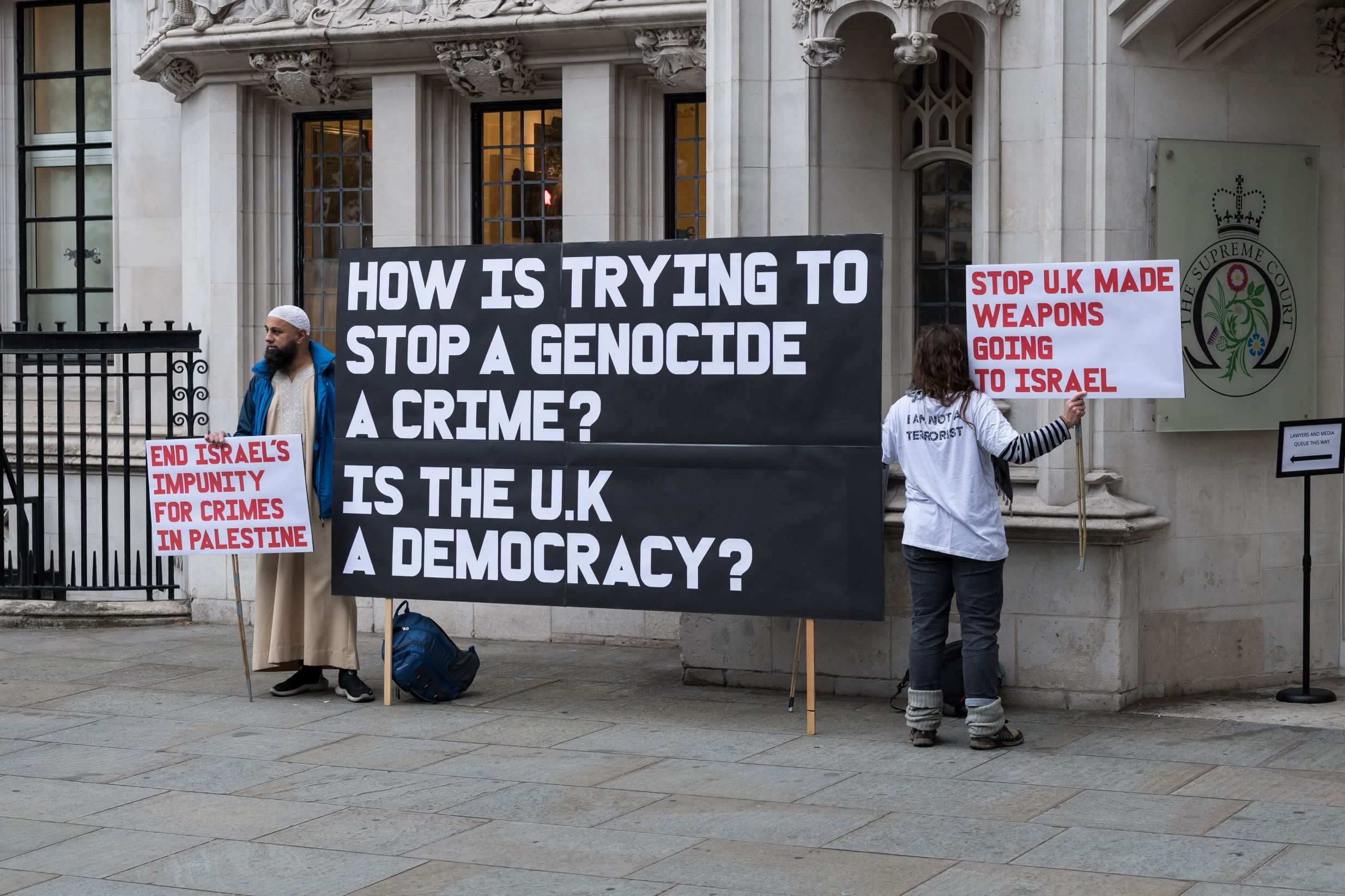
The government has made more than 4,000 arrests since the group was banned, raising alarm about the use of counterterrorism powers against political protesters.MANCHESTER, England (CN) — A co-founder of Palestine Action challenged the British government’s decision to ban the campaign group as a terrorist organization Wednesday as police arrested dozens of protesters outside the U.K. Supreme Court.The five Supreme Court justices will consider whether banning Palestine Action is compatible with the European Convention on Human Rights, which protects freedom of expression and association.Huda Ammori brought the challenge against the government’s decision to proscribe the group under the Terrorism Act 2000.Founded in 2020, Palestine Action carried out hundreds of direct actions, including occupying premises, obstructing businesses, spraying graffiti and breaking windows at companies it said were connected to supplying weapons to Israel.The U.K.’s highest court is hearing the appeal over two days, with arguments due to continue Thursday.Arrests put protest rights in focusThe decision may have implications for the right to protest in Britain, where more than 4,000 arrests have been made in connection with the group since the ban took effect in July 2025.The arrests have included large numbers of older protesters. During one demonstration in August 2025, 532 people were arrested, including 259 aged 60 or older and almost 100 in their 70s.Proscription criminalizes membership of a banned organization and certain forms of expressing or inviting support for it, with some offenses carrying prison sentences up to 14 years.The Metropolitan Police said Wednesday that 25 people were arrested outside the court on suspicion of expressing support for a proscribed organization.Demonstrators held placards bearing wording similar to an October social media post by journalist and author Sarah Helm: “God help us authors who support Palestine and Palestine Action.”Helm is married to Jonathan Powell, who has served as the government’s National Security Adviser since 2024.Amnesty International UK criticized the arrests, saying protesters had been detained for using language similar to Helm’s without her facing arrest.The organization said the case illustrated the “chaos wrought by the government’s grave misuse of terrorism powers,” and shows “how dangerously vague our terrorism laws are.”More than 300 people were also arrested during a demonstration outside the U.S. Embassy in London this past Saturday.The Metropolitan Police said 325 people were arrested, 320 of them for expressing support for a proscribed organization.Government defends terrorism banAmmori’s lawyers argue the government went too far in using counterterrorism powers against the group.They say government officials had assessed that only three of 385 actions carried out over five years met the legal definition of terrorism.Her lawyer Raza Husain told the justices that historical protest movements, including the suffragettes campaigning for women’s voting rights, had used tactics similar to or more extreme than those associated with Palestine Action.He cited the suffragettes’ early 20th-century bombing campaign.The government maintains that the group’s escalating activities justified the ban. The Home Office points to serious property damage, including a 2024 raid on the Bristol premises of Israeli defense contractor Elbit Systems that caused an estimated 1 million pounds (about $1.35 million) in damage.In June 2025, activists broke into Royal Air Force Brize Norton and damaged two military aircraft with spray paint, shortly before the government confirmed its decision to proscribe the group.The Home Office said the decision followed a rigorous, evidence-based process approved by Parliament, insisting the ban did not prevent lawful demonstrations in support of Palestinians or opposition to Israel’s actions in Gaza.In February, Britain’s High Court found the ban unlawful because the government’s decisionmaking was inconsistent with its own policy and disproportionately interfered with freedom of expression and assembly.Then in June, the Court of Appeal upheld the ban, finding it was a proportionate response to the risks posed by Palestine Action.It pointed to three incidents involving serious property damage at facilities belonging to defense companies and said the Home Secretary was entitled to consider the threat of future attacks.The Supreme Court granted Ammori permission to appeal in July, but only on the question of whether the ban was compatible with the European Convention on Human Rights.The case has also drawn intervention from Amnesty International UK, the civil liberties organization Liberty and the United Nations special rapporteur on counterterrorism, Ben Saul.Saul argued the proscription was “out of step with comparable liberal democracies, including in Europe and various common law states.”Liberty’s director, Akiko Hart, said the government’s definition of terrorism was so broad that “it captures behavior most people would never consider terrorism.”“This case has already had a chilling effect on protest and free speech — leaving many too afraid to protest or say the wrong thing,” Hart said.The hearing continues Thursday.Courthouse News reporter James Francis Whitehead is based in England.Subscribe to our free newslettersOur weekly newsletter Closing Arguments offers the latest about ongoing trials, major litigation and rulings in courthouses around the U.S. and the world, while the monthly Under the Lights dishes the legal dirt from Hollywood, sports, Big Tech and the arts.Additional Reads
Palestine Action co-founder challenges UK terror ban at Supreme Court
Full Article
Original Source
Read the full article at Courthousenews →KhanList aggregates and links to publicly available news content. We do not host full articles from third-party sources. Always verify important information with original sources.