
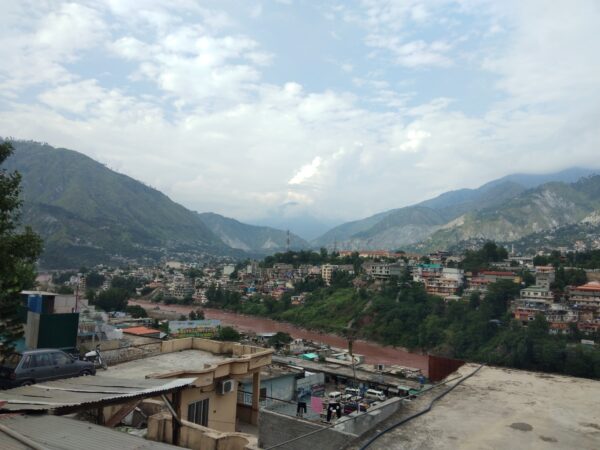
The Madina Market of Muzaffarabad, a major regional commercial hub, has finally reopened to economic activity following weeks of turmoil. Muzaffarabad – the capital of Pakistan-administered Kashmir, housing the Prime Minister’s Secretariat, the Legislative Assembly, and other government buildings emblematic of its on-paper autonomy – is showing signs of a return to daily life. Likewise, Mirpur, the region’s second largest city, has now resumed intracity public transportation, allowing locals to move between Pakistan and the territory Islamabad dubs as Azad, or Free Jammu and Kashmir. Nevertheless, Pakistan-administered Kashmir still has a visibly heightened deployment of security personnel. Over the past three months, at least 80 people have been killed across the region amid the general election in Pakistan-administered Kashmir, which was held from July 27 to August 10. The election, which was widely deemed contentious owing to allegations of polling day irregularities, in addition to pre-election machinations alleged to benefit status quo parties, saw the Pakistan Muslim League-Nawaz (PML-N) and Pakistan People’s Party (PPP) – which are also leading the ruling alliance in Islamabad – emerge victorious. “The elections were a sham. No one who actually wants any betterment for the locals participated in the election. It is not an election when all the votes go to one party: the Pakistan army,” Tariq Rehman, a schoolteacher in Kotli, told The Diplomat. Pakistan’s omnipotent military establishment has maintained arbitrary control over the region since the 1947 partition of the Indian subcontinent divided the erstwhile state of Jammu and Kashmir between India and Pakistan. Both states administer part of Jammu and Kashmir but claim the territory in its entirety, and they have fought multiple wars over it. In August 2019, India revoked Article 370 of its constitution, which undid the special status of Indian-administered Kashmir. Since then, multiple Pakistani government sources, including military officials, have told The Diplomat that there have been plans to mainstream the Pakistani-administered Kashmir, effectively upholding the Line of Control dividing the territory as an international border. Calls to divide Pakistan’s existing provinces have also gathered pace in recent months. While the Pakistani state makes up its mind over the status of its controlled section of Kashmir, the locals have been stuck in limbo, unsure of their relationship with the country. Whether they are a distinct autonomous region – as upheld by Pakistan’s longstanding position and internationalization of the Kashmir dispute – or just a part of Pakistan is a question that has manifested in local political, social, and cultural expressions. “They want us to be Pakistanis when they feel like it. They want us to be Kashmiris when they feel like it. But the recent bloodshed shows that they want us to remain captives to their power games. Who kills people for demanding that we should have a say in deciding our own future?” said Mir Hamza, a Muzaffarabad-based artisan, who had participated in recent protests and was witness to security personnel firing on protestors. “My brother [cousin] is still in Rawalakot. We want to continue the movement until we can achieve our fundamental human rights.” As the sit-in continues in Rawalakot, local authorities have made the city inaccessible, with media barred from reporting in the region. Internet blackouts have been in place to limit social media coverage, and laws have been passed requiring a No Objection Certificate (NOC) for coverage of any news. Many international and local publications have been blocked in Pakistan. One of them is the Urdu publication Daily Jeddojehad, which has documented the deaths in Pakistan-administered Kashmir amid the recent state crackdown. “Security agencies raided my home. In my absence, three of my family members were picked up. They told my family that my articles on Kashmir were anti-national and the raid was aimed at arresting me,” Jeddojehad editor Farooq Sulehria told The Diplomat. “I was in London, hence I was lucky to escape. However, I am not able to return to Pakistan,” he added. Many journalists and activists have been summoned over dissent in Pakistan-administered Kashmir in order to enforce complete censorship. “This is unprecedented. The state wants to deny the people of Jammu and Kashmir the possibility to voice their protest on social media against the violent repression. It wants to disseminate one-dimensional information and propaganda,” Sulehria said. These measures have been put in place as part of the crackdown on the local protesters, who have been galvanized in recent years by the Joint Awami Action Committee (JAAC). Since September 2023, the JAAC has rallied for the locals’ right to have control over their own resources, with the committee emphasizing issues ranging from power and commodity prices to governance reforms. As part of its list of demands, a major political reform sought by the JAAC was the undoing of seat reservations for muhajirs, or immigrants from Indian-administered Kashmir. As things stand, 12 of the 53 seats in the legislature of Pakistan-administered Kashmir are allocated to such individuals – who could be residing outside the territory. JAAC members and critics told The Diplomat that this arrangement not only reduces local representation, but also allows the military establishment to maintain its political stranglehold. “Azad Jammu & Kashmir should only be ruled by the people of Azad Jammu & Kashmir. Not those in uniform, nor their selected parties, nor those being picked for the reserved seats to toe the lines of the powers that be,” JAAC core leader Shaukat Nawaz Mir had told The Diplomat when the latest protests erupted in June. Mir, among other JAAC members, has since been detained. The government slapped sedition charges on them following the announcement of “head money” over information pertaining to these individuals. The JAAC has been declared a terrorist organization by the Pakistani state, with many of its activists either being detained or voluntarily going underground. While the JAAC enjoys significant support among the people of Pakistan-administered Kashmir, it has its skeptics as well. “I don’t know who they are, and whom they are fighting for. Some say they are Indian agents. All I know is that because of the violence and the internet shutdown I have lost significant business and customers,” said Mohammed Iqbal, a Chakswari-based restaurant owner. According to Madina Market Traders Association President Raja Abrar Mustafa, most of the traders had supported the JAAC initially, but gradually the committee’s position hardened on some issues. “We have supported them over issues related to the public and economic issues. But traders shouldn’t get involved in constitutional matters,” he said. Many of the JAAC’s critics, new and old – including those who are a part of the government machinery – nonetheless concede that most of the demands the committee had brought to the table reflected the sentiments of the majority of the local population, even if some matters might have been contentious. “All of the committee’s demands were accepted. But they continued to fixate over one [on seat reservation], causing so much turmoil. What did all this achieve for the locals?” asked Mirpur-based PML-N leader Chaudhary Muhammad Saeed while talking to The Diplomat. Saeed, who lost his Mirpur seat in the recent elections, said while the voter turnout was lower – around 50 percent compared to the usual 60 percent – it wasn’t different enough to suggest a widespread clash between the locals and the state. “Yes, some people are unhappy over certain issues, and yes, some political reforms are needed in Azad Kashmir. But what is more pertinent are economic reforms. There would be no need for such protests where there is financial stability,” he said. Even so, many of the people who are “unhappy” are unable to participate in these conversations, or respond to the ubiquitous state-sponsored criticism against them. Many of the state’s critics are in jail, in exile, or have disappeared. *Some names have been changed to protect the identities of sources.
Pakistan’s Kashmir Crackdown
Full Article
Original Source
Read the full article at Thediplomat →KhanList aggregates and links to publicly available news content. We do not host full articles from third-party sources. Always verify important information with original sources.