
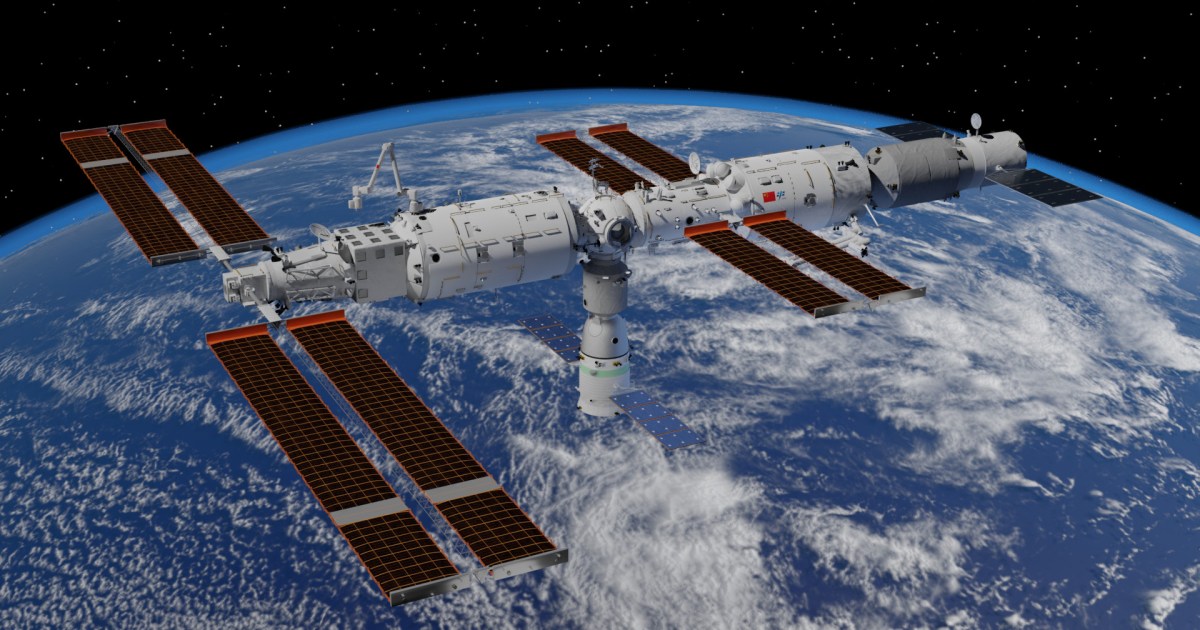
An artist's rendering shows China's Tiangong space station orbiting Earth. This week, Shenzhou-24 is set to carry the station's first foreign visitor, an astronaut from Pakistan. Credit: Shujianyang, via Wikimedia Commons, CC BY-SA 4.0 Rocket launches this week On Tuesday, Nov. 24, Roscosmos is targeting 5:13 a.m. EST to launch the Progress MS-36 cargo ship to the International Space Station (ISS) on a Soyuz-2.1b from the Baikonur Cosmodrome in Kazakhstan, according to Next Spaceflight. NASA still lists the flight only as no earlier than fall 2026 and has not given a date. At 5:45 a.m. EST, Arianespace will try again to launch an Ariane 64 from the Guiana Space Centre in French Guiana with 36 Amazon Leo satellites. A problem with the rocket’s ground support systems halted Monday’s countdown. It is Amazon’s first launch since last week’s Vulcan failure. Later that morning, at 10:55 a.m. EST, SpaceX will launch the classified USSF-266 mission for the U.S. Space Force from Space Launch Complex 4E (SLC-4E) at Vandenberg Space Force Base in California. Neither SpaceX nor the Space Force has said what the rocket carries. The booster will land on the droneship Of Course I Still Love You in the Pacific Ocean. That evening, at 7:18 p.m. EST, a Long March 2F is slated to launch Shenzhou-24, carrying three astronauts, from the Jiuquan Satellite Launch Center in northwestern China to the Tiangong space station, per Next Spaceflight. One seat makes history. A Pakistani astronaut will fly as a payload specialist, becoming the first foreign visitor to Tiangong and Pakistan’s first astronaut. Pakistan’s space agency, the Space and Upper Atmosphere Research Commission (SUPARCO), has shortlisted two pilots, Muhammad Zeeshan Ali and Khurram Daud. One will fly and the other will serve as backup. The astronaut is expected to spend about a week on Tiangong and return to Earth aboard the Shenzhou-23 spacecraft. On Thursday, Nov. 26, the state-owned China Aerospace Science and Technology Corporation (CASC) is targeting 4:35 a.m. EST for a Long March 2D launch from the Xichang Satellite Launch Center in southwestern China, according to Next Spaceflight. The payload has not been announced. Later Thursday, at 7:05 p.m. EST, Rocket Lab will launch Night Owls Never Sleep on an Electron from Launch Complex 1 on New Zealand’s Māhia Peninsula.The payload is a StriX satellite for the Japanese company Synspective. StriX satellites use synthetic aperture radar to image the ground through clouds and darkness. On Friday, Nov. 27, CASC is targeting 8:00 a.m. EST for a Long March 6A launch from the Taiyuan Satellite Launch Center in Shanxi province, according to Next Spaceflight. The payload has not been announced. On Saturday, Nov. 28, CAS Space, a commercial launch company backed by the Chinese Academy of Sciences, plans to launch a Kinetica 1 at 8:00 p.m. EST from a sea platform in the South China Sea, supported by the Haiyang Oriental Spaceport, per Next Spaceflight. The payload has not been announced. Later Saturday, at 10:50 p.m. EST, a Long March 6C is slated to lift off from Taiyuan, according to Next Spaceflight. Its payload is also undisclosed. Finally, at 11:39 p.m. EST on Saturday, SpaceX returns to SLC-4E for USSF-380, another classified Space Force mission. The booster is again slated to land on Of Course I Still Love You. Closing out the week on Sunday, Nov. 29, NASA and Northrop Grumman are targeting 10:47 a.m. EST to launch the NG-25 Cygnus XL cargo spacecraft on a Falcon 9 from Space Launch Complex 40 at Cape Canaveral Space Force Station in Florida. Named the S.S. James A. Lovell after the late Apollo 13 commander, the spacecraft will haul several tons of science and supplies to the ISS. Rocket launches last week Last week opened on Wednesday, Nov. 18, at 5:51 p.m. EST, when a Long March 2D lifted off from Taiyuan carrying Shijian-24. China has not said what the satellite does; CGTN reported only that it reached its planned orbit. On Friday, Nov. 20, at 6:59 a.m. EST, a Long March 8A launched from the commercial launch site at Wenchang with the 30th batch of satellites for Guowang, China’s state-backed broadband megaconstellation. That night, at 11:20 p.m. EST, SpaceX launched the classified USSF-317 mission from Vandenberg, two days later than planned. The booster landed on Of Course I Still Love You. The week closed on Sunday, Nov. 22, at 7:23 a.m. EST, when a Falcon 9 lifted off from the same pad with the National Reconnaissance Office’s NROL-136, a day later than planned. The launch came 32 hours after USSF-317, SpaceX’s fastest turnaround between launches from the same pad. The booster flew back to Landing Zone 4. Upcoming rocket launches South Korea’s Agency for Defense Development (ADD), the military research arm of its defense ministry, is still preparing the first full demonstration flight of its solid-fueled Mir rocket from an offshore platform near Jeju Island. After canceling a June 30 attempt over safety concerns, the ministry has said only that it aims to launch by the end of the year. ExPace, a subsidiary of the state-owned China Aerospace Science and Industry Corporation (CASIC), also has a Kuaizhou 11 launch from Jiuquan on the books no earlier than November 2026. Its payload has not been announced. Brooks Mendenhall is a staff writer at Astronomy, based in Chattanooga, Tennessee, fueled by an unending curiosity about the universe. A former classroom teacher, he has a knack for breaking down complex concepts for a wide audience.
Pakistan’s first astronaut heads for China’s space station
Full Article
Original Source
Read the full article at Astronomy →KhanList aggregates and links to publicly available news content. We do not host full articles from third-party sources. Always verify important information with original sources.