
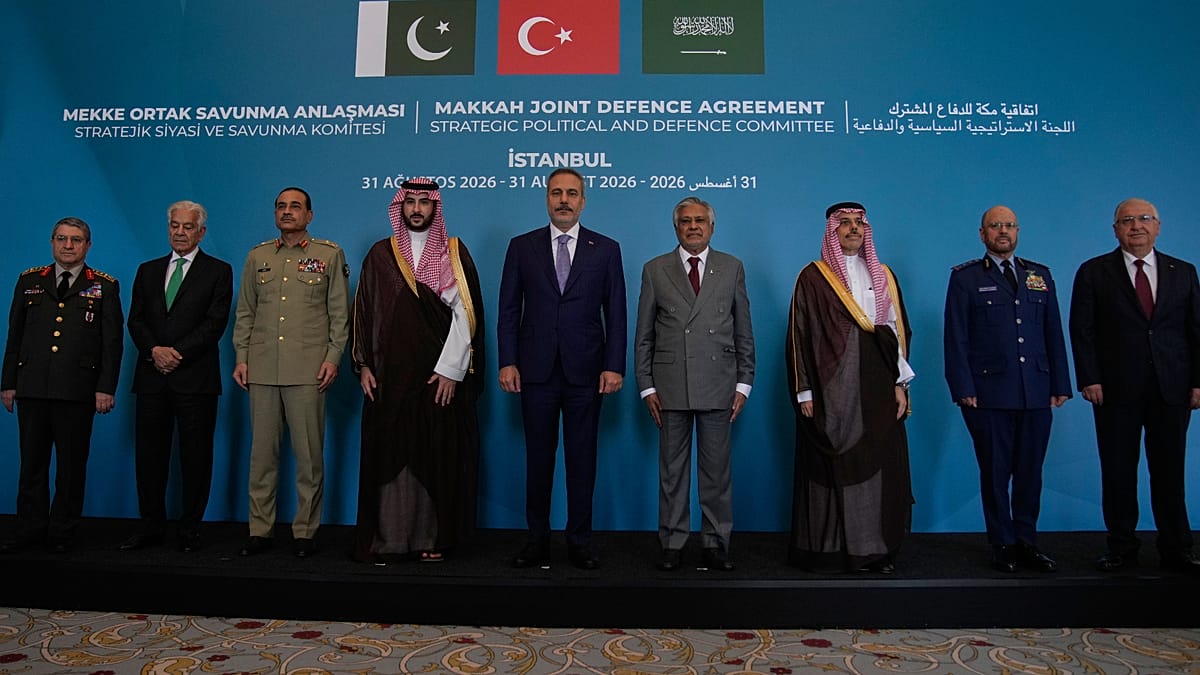
The Saudi-led coalition said that its air defence systems had shot down multiple missiles between Saturday and Sunday, while Yemen’s Iran-backed Houthi rebels claimed they had successfully launched five attacks on King Khalid International Airport and other energy and military sites across Saudi Arabia as the Houthis maintain their pressure on the kingdom. ADVERTISEMENT ADVERTISEMENT The Houthi attacks came amid Pakistan’s rare announcement that it is now deploying its troops to help defend Saudi Arabia, based on its “steadfast resolve to stand by the Kingdom in safeguarding its sovereignty and territorial integrity.” Saudi authorities sent emergency phone alerts urging residents to shelter in parts of the country as the coalition reported missile interceptions, saying no civilians had been injured by falling debris. The Houthis claimed they had launched multiple attacks on Saudi Arabia’s defence, transport and energy sectors, including King Khalid International Airport in Riyadh, radar installations in Abha and Khamis Mushait as well as Saudi Aramco’s Jazan refinery, Aramco’s major Hawiyah gas plant and the Al-Shuqaiq and Jazan southern power stations. The full extent of the claimed attacks has not been independently verified, but videos posted from locals on social media showed smoke and fire around certain energy targets. The Saudi-led coalition said debris from an intercepted missile fell in southern Saudi Arabia without causing civilian injuries. Saudi Aramco’s Jazan refinery was struck on Thursday, killing a Nepalese worker and injuring several others. Some operations were temporarily disrupted, Saudi authorities said, adding that a ballistic missile fired toward Al-Shuqaiq power station was intercepted. Meanwhile, the Saudi-led coalition announced that it had conducted what it called “a military response operation” to destroy “vital” assets used by Houthis to conduct their attacks on Saudi Arabia and Yemen “and to threaten maritime navigation in the Red Sea and Bab el-Mandeb.” The spokesperson for the so-called Coalition to Restore Legitimacy in Yemen said that it “will respond immediately to any further attacks, in accordance with international humanitarian law.” Meanwhile, The Washington-based Institute for the Study of War (ISW) and the Critical Threats Project (CTP) said the attacks were aimed at pressuring Riyadh to “surrender to Houthi demands and cease its military operations in Yemen”, while Saudi Arabia is fighting back striking Houthi command-and-control hubs “in anticipation of further Houthi offensive efforts in the area.” Pakistan to deploy troops to bolster Saudi Arabia’s defences in major development In a major development for the regional security architecture, Pakistan announced it is deploying its troops to help strengthen Saudi Arabia’s defences under the recently signed Mecca mutual defence pact, amid the relentless Houthi attacks. Pakistan’s army said that “the military deployment reflects Pakistan’s unwavering commitment to the security, sovereignty and territorial integrity of the Kingdom of Saudi Arabia,” and that “Pakistan remains steadfast in its commitment to safeguarding the Kingdom’s security and the sanctity of Haramain Sharifain.” Pakistan held a send-off ceremony for its forces going to Saudi Arabia saying that the troops would carry out their duties within Saudi territory under existing defence cooperation arrangements. Islamabad did not disclose the number of troops, their specific duties or the timing and duration of their deployment but said that the deployment would enhance Saudi Arabia’s defences amid “emerging security concerns” and that it was dedicated to protecting Saudi Arabia’s sovereignty and territorial integrity. Pakistan’s decision comes after a trilateral meeting between Pakistan, Saudi Arabia and Turkey in Islamabad on Friday where, in a joint statement, the three countries condemned the ongoing Houthi attacks on Saudi Arabia and reaffirmed their collective defence commitments. Pakistan, Saudi Arabia and Turkey signed the Mecca Joint Defence Agreement on 7 August, agreeing that an armed attack against any one of the three states is considered an attack against all three and committing to defend each other. Whilst stressing that the agreement was for defensive purposes, Pakistan has also been collaborating with Qatar to help broker the peace talks between Washington and Tehran. Pakistan’s announcement also came just over a month after Egypt said it would provide military support to Saudi Arabia, without giving details. A regional official, briefed on the matter, said at the time that Egypt would deploy air defence systems and aircraft to help repel missiles and drones fired at Saudi Arabia. The Egyptian support is defensive in nature and won’t include any ground troops in Yemen, the official said on condition of anonymity because he wasn’t authorized to speak to reporters. In a statement late Saturday, a senior Houthi official lashed out at Pakistan and Turkey over their alliance with Saudi Arabia. Mohamed Ali al-Houthi, member of the Supreme Political Council, said Ankara and Islamabad, which joined Riyadh in the Mecca Joint Defense Agreement, have ignored “the (Saudi) aggression, the blockade, the killings, and the ongoing crimes” in Yemen. “Just as the previous coalition against our country … ended in failure, any future coalition will likewise fail,” he said. Saudi Arabia, a major US ally in the region, has been facing mounting pressure after the Iran war erupted in February, turning to its regional allies, including Turkey, Pakistan, Egypt and Syria, to strengthen its defences in the face of Houthi missile and drone strikes. The kingdom has been countering the Houthis over the past decade in Yemen’s civil war, backing the internationally recognized government in the south. However, the Houthis control Yemen’s most populous areas, including Sanaa. Fighting escalated this summer in Yemen between the Houthi rebels and the government’s Saudi-backed forces. The Houthis have also launched direct and deadly attacks on Saudi Arabia and imposed a blockade on its shipping in what has been viewed as an extension of the US-Iran war. In recent months, the rebels performed their biggest land grab in years, capturing Yemen’s Red Sea coast from pro-government forces. This, along with the closure of a key Saudi pipeline, strengthened their ability to choke off Saudi oil exports, pushing up global fuel prices and giving Iran greater leverage.
Pakistan sends its troops to help defend Saudi Arabia as Houthis ramp up attacks
Full Article
Original Source
Read the full article at Euronews →KhanList aggregates and links to publicly available news content. We do not host full articles from third-party sources. Always verify important information with original sources.