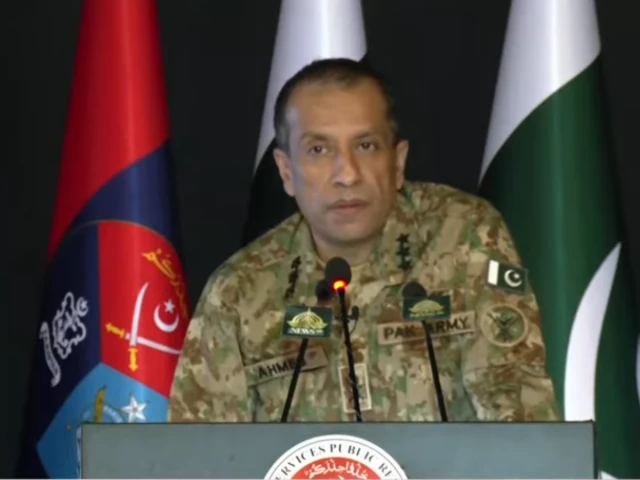
Military spox says security forces conducted 40,348 IBOs across country this year so far, killing 2,084 terrorists Web Desk July 31, 2026 9 min read DG ISPR Lt Gen Ahmed Sharif Chaudhry addresses press conference. Photo: Screengrab Inter-Services Public Relations (ISPR) Director General Lieutenant General Ahmed Sharif Chaudhry on Friday said Pakistan was "not a hard state", as he outlined the country's security situation and said security forces had killed an average of 10 terrorists every day so far this year. Addressing a live press conference focused on Balochistan, the military spokesperson said the briefing would examine three questions: "What is the problem? What is happening? What is being done?" "We will focus on Balochistan because there is a perception that the condition in Balochistan is very bad," he said. The DG ISPR said the first issue was not specific to Balochistan but related to Pakistan's overall security environment. "Are we a hard state? Unfortunately not," he said. Explaining the term, he said a hard state did not mean "a military-run state or an armed forces-dominated state." "When we say a hard state, it means a state in which the law is equal for all, all issues are dealt with through the law, there is no elitism and everyone is equal before the law," he said. The DG ISPR then spoke about what he described as "obligations versus rights." "We are all talking about our rights. We are taking up grievances, taking up arms and raising slogans based on rights. But before these rights, we have some obligations," he said. Citing Article 5 of the Constitution, he said: "Loyalty to the state is the basic duty of every citizen. Obedience to the Constitution and the law is the obligation of every citizen." "The law is clear that we all have a basic responsibility. We need to be loyal to the state. Then you can talk about your rights. We first have to speak about our obligations," he added. Referring to Chief of Defence Forces and Chief of Army Staff Field Marshal Syed Asim Munir's address at the National Workshop on Balochistan, the DG ISPR said the army chief had also stressed the importance of obligations. "Asim Munir, at the National Workshop on Balochistan, said yes, we talk about rights, but why don't we talk about obligations? What are they?" he said. The DG ISPR said every citizen's "first and last identity" should be Pakistani. "Isn't it every citizen's obligation that our first and last identity is Pakistani, not that we talk about our provincial identity? Because our identity is that we are citizens of the state," he said. "Our obligation is that we must acknowledge the fundamental and central position of the State of Pakistan," he added. Turning to the security situation, the military spokesperson said security forces had conducted 40,348 intelligence-based operations (IBOs) across the country so far this year, with the majority taking place in Balochistan. "Nearly 194 intelligence-based operations are being conducted every day," he said. The DG ISPR said 3,145 terrorist incidents had been recorded during the period, while security forces had killed 2,084 terrorists, averaging about 10 terrorists being killed every day. He said 819 people had embraced martyrdom this year, including 303 personnel from the Pakistan Army, 194 law enforcement agencies and 322 civilians. The DG ISPR said there had been 28 suicide bombing incidents this year, adding that the majority of the suicide bombers were Afghan nationals. "The majority of them are Afghanis. The Afghan national involved in the Tank attack was also an Afghani. Afghan nationals and people associated with their security forces are among the terrorists killed and captured," he said. Comparing the figures with previous years, he said security forces had killed 2,597 terrorists during the whole of 2025, while 2,084 had already been killed so far in 2026. "If you look at 2023, our martyr ratio was higher and we were killing fewer terrorists. In 2024, the tide started turning. By 2025, for each martyr we were taking out two terrorists," he said. Responding to a question about the rise in terrorist incidents, the DG ISPR said: "You must ask why incidents are increasing. It has to do with the agenda of terrorists affiliated with the Taliban and with the clarity that Pakistan has. These terrorists have come to understand that there is no room for appeasement now." "Once they know that the state is very clearly telling them, 'Submit in front of the state, otherwise we are here, we are standing here and fighting,' it changes the dynamic," he said. The DG ISPR added that the increase in incidents was also linked to more proactive intelligence-based operations. "Once we get more proactive and engage, once we are doing more effective intelligence-based operations, there will be engagement and incidents increase," he said. 'Elitism', external actors and propaganda DG ISPR said "elitism and sardarism", a desire to maintain the status quo, external actors and propaganda were among the factors behind the security situation in Balochistan. The military spokesperson said these were the "fundamental" issues specific to Balochistan. "This is the fundamental thing, specific to Balochistan," he said. The DG ISPR said "elitism and sardarism and the desire to maintain the status quo" were among the root causes. "We have to get to the root cause today. This is the part of society that thinks it has no obligation but only rights — the elites, part of them," he said. "They think that this status quo must be maintained, a status quo where a normal citizen should not study, should not progress, should do nothing, so he can be my slave, be my driver, walk around like my guard because I'm special." The DG ISPR said they were "prime movers of terrorism." "They are afraid that times are changing. The more afraid they are, the more anxious they become, the more kinetic they get," he said. The military spokesperson also spoke about what he described as a "desire for appeasement." "They think, 'We will do terrorism and then talk. Talk with us. Appease us like you used to.' We don't want to talk to you. We will talk to the real people of Balochistan. You are not a stakeholder," he said. The DG ISPR said some people believed the Balochistan Levies were "our personal army." "They have a habit that this Levies force is our personal army. Half of the guy's salary is mine, the other half will be my personal guard," he said. He added that the Levies force was being turned into a police force. The DG ISPR also said some people were accustomed to, "in the name of trade", carrying out smuggling. "They are used to, in the name of trade, doing smuggling, bringing narcotics and diesel and selling it at six times the price," he said. "If you try to stop them, then they will do terrorism and raise slogans that Balochistan is out of our hands. They say, 'Open my permits. Give me my share from the Rs1,000 billion budget.'" The military spokesperson also referred to what he described as an "external power play." "They know that Balochistan is blessed not only with vibrant human resources but also natural resources. Allah has given it all blessings. They know the potential of this," he said. "They get physically involved with these terrorists and they find ready partners in these sardars. They want the same slaves and private jails. They want to see the system they saw during their grandfathers' time." Referring to Afghanistan, the DG ISPR said: "It's not Afghanistan, it's the Afghan Taliban regime." "Their business is terrorism, and through terrorism they sustain their economy and diplomacy," he said. He also said there was "no difference" between "Fitna al Hindustan" and "Khawarij." Turning to what he described as propaganda, the DG ISPR said it had four "verticals": "the sense of deprivation, lack of representation, the missing persons narrative, and terrorism propaganda." Addressing what he described as the "sense of deprivation," the DG ISPR cited development projects and budget allocations in Balochistan. He said Gwadar had three universities, four colleges, the Pak-China Hospital, five child dispensaries, an international airport, a seaport, an expressway, industrial free zones, tax-free zones and a cricket stadium. "In all of Pakistan, tell me another city with a population of 300,000 that has all this," he said. The DG ISPR said Turbat, with a population of around 500,000, had two universities, colleges, an international airport and road connectivity. "Tell me another city of such a population with all this," he said. He added that Balochistan had 13 major hospitals and 650 dispensaries. The DG ISPR also referred to the province's per capita budget allocation. "Look at the budget per capita. Per capita is Rs75,000-plus, more than any other province. What deprivation is rooted in?" he said. He said development projects were being targeted. "That's why they kill labourers, attack roads. Whoever wants to work in schools or teach, we will kill them, so that the sardars' army stays ready," he said. Speaking about political representation, the DG ISPR said the same families continued to dominate electoral politics. "Take out the lists of the assemblies. The same families, the same parties. They win, then their father or brother wins. If they win, it's democracy; if not, then it's rigging. What representation is this?" he said. Addressing the issue of missing persons, the military spokesperson referred to the Commission of Inquiry on Enforced Disappearances. "They say thousands have been picked up. The government made a commission so that if there is someone missing, there would be a name," he said. The DG ISPR said the commission had received a total of 10,901 cases since the early 2010s. "More than 9,000 cases have been disposed of. Of those, around 5,000 people have gone back home, others are in custody, 308 were found to have died, and around 2,400 were found not to be cases of missing persons," he said. He added that around 2,700 cases remained pending. The DG ISPR said there were more pending cases in Sindh than in Khyber Pakhtunkhwa. He also said some people included in lists of missing persons had later been killed while carrying out terrorist activities. "Some are in Turbat, do terrorism, are killed and then are included in the missing persons list," he said. Turning to what he described as terrorism propaganda, the DG ISPR said attacks were sometimes filmed to generate content. "A guy attacking a police station is being filmed because we have to give content to show that there is a problem in Balochistan, so people can say, 'Look, this has happened,'" he said. This story is being updated.
Pakistan 'not a hard state': DG ISPR on Balochistan security situation
Full Article
Original Source
Read the full article at Tribune →KhanList aggregates and links to publicly available news content. We do not host full articles from third-party sources. Always verify important information with original sources.