
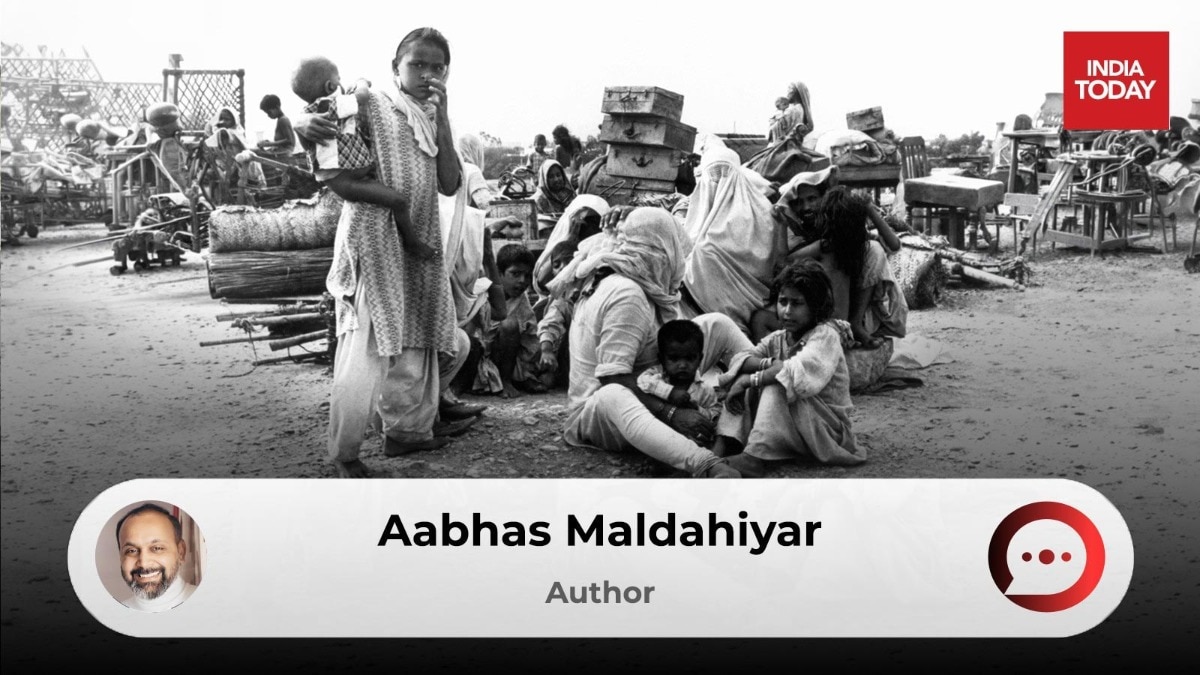
Seventy-nine years after Pakistan was born, we continue to tell its story as though its first chapter was written in the British Parliament. It is a neat explanation, emotionally satisfying and politically convenient: the British practised "divide and rule", poisoned Hindu-Muslim relations, institutionalised communal identities and eventually sliced India in two.There is truth in it. But truth is not the same as the whole truth.The British exploited divisions, deepened them through censuses, separate electorates and constitutional reforms, and transformed communities into competing political constituencies. But to begin the story with British policy is to erase the centuries that preceded it. It also sustains another comforting fiction: that Hindus and Muslims lived in perfect harmony until the British arrived with their political scalpel.History is rarely that merciful. Pakistan could not have been imagined in the 16th century. The modern nation-state itself did not exist. Sheikh Ahmad Sirhindi and Shah Waliullah were certainly not planning Pakistan.But the questions that would eventually feed the Two-Nation Theory were already being debated: What was the political place of Muslims in India? Could Islam preserve its distinct identity under non-Muslim rule? Was faith merely personal, or did it demand a political order? And what happened when former rulers became a permanent minority? These questions did not begin with the Muslim League's Muhammad Ali Jinnah, and they had been simmering for centuries.By the late 16th century, the Timurid Empire dominated northern India, while Akbar's later religious policies marked a sharp departure from orthodox Islamic thought. One of their fiercest critics was Sheikh Ahmad Sirhindi, the Naqshbandi scholar hailed as Mujaddid Alf-i-Sani, the renewer of the second millennium. He was no prophet of Pakistan; his age knew neither nationalism nor nation-states.Yet Sirhindi gave an influential political dimension to Islamic distinctiveness, insisting that faith was inseparable from questions of power and public order. He writes:'The abolition of jizyah in Hindustan is a result of friendship which (Hindus) have acquired with the rulers of this land. What right have the rulers to stop exacting jizyah? Allah himself has commanded imposition of jizyah for their (infidels') humiliation and degradation. What is required is their disgrace, and the prestige and power of Muslims. The slaughter of non-Muslims means gain for Islam. To consult them (the kafirs) and then act according to their advice means honouring the enemies (of Islam), which is strictly forbidden.The prayer of these enemies of Islam is false and fruitless. It should never be called for because it can only add to their numbers. If the infidels pray, they will surely seek the intercession of their idols, which is taking things too far. A wise man has said that unless you become a maniac (diwanah) you cannot attain Islam. The state of this mania means going beyond considerations of profit and loss. Whatever one gains in the service of Islam should suffice'A century later, the political order had dramatically shifted. The Timurid Empire was weakening, while Marathas, Sikhs and Jats were rising, and Islamic authority had all but collapsed. For sections of the Muslim elite, this was not merely dynastic decline but the erosion of Muslim political power. Shah Waliullah Dehlavi's writings captured this anxiety, most famously in his correspondence with Ahmad Shah Abdali. He writes:'In short the Moslem community is in a pitiable condition. All control of the machinery of the government is in the hands of the Hindus because they are the only people who are capable and industrious. Wealth and prosperity are concentrated in their hands, while the share of Moslems is nothing but poverty and misery. At this time, you are the only king who is powerful, farsighted and capable of defeating the enemy forces. Certainly it is incumbent upon you to march to India, destroy Maratha domination and rescue weak and old Moslems from the clutches of non-Moslems. If, Allah forbid, domination by infidels continues, Moslems will forget Islam and, within a short time, become such a nation that there will be nothing left to distinguish them from non-Moslems.'The anxiety was no longer merely religious; it had become profoundly political and civilisational. The 19th century marked another decisive turning point. Muslim elites who had once wielded imperial authority now found themselves subjects of a colonial state. The movement led by Sayyid Ahmad Barelvi and Shah Ismail Dehlavi fused religious revival with political mobilisation, seeking to restore an Islamic political order.Then British constitutional reforms transformed the debate altogether. Under earlier empires, a Muslim dynasty could govern a Hindu-majority population. The representative government overturned that logic.Elections made numbers the ultimate source of political power, and Muslims confronted an uncomfortable reality — they were a substantial community, but not the majority. The central question therefore shifted from Who rules India? To who will rule India when the British leave? Beneath it lay a deeper fear: What becomes of a permanent minority when majority rule determines political destiny? Sir Syed Ahmad Khan recognised this dilemma long before Partition entered political vocabulary. In 1888, he warned:'Oh! my brother Musalmans! I again remind you that you have ruled nations, and have for centuries held different countries in your grasp. For seven hundred years in India you have had Imperial sway. You know what it is to rule. Our nation is of the blood of those who made not only Arabia, but Asia and Europe, to tremble. It is our nation which conquered with its sword the whole of India, although its peoples were all of one religion.''Is it possible that under these circumstances two nations — the Mahomedans and the Hindus — could sit on the same throne and remain equal in power? Most certainly not. It is necessary that one of them should conquer the other and thrust it down. To hope that both could remain equal is to desire the impossible and the inconceivable.'He returns to the same fear and says:'This thing — who, after the departure of the English, would be conquerors — would rest on the will of God. But until one nation had conquered the other and made it obedient, peace could not reign in the land. This conclusion is based on proofs so absolute that no one can deny it.'The political vocabulary was changing, but the anxiety that animated it was centuries old. Long before Pakistan was imagined as a state, Muslim thinkers had been wrestling with a more fundamental question: what would become of Islam's political position once Muslim rule gave way to the rule of others?The Khilafat Movement leaders echoed this concern when they appealed to the Amir of Afghanistan to invade India, recalling Shah Waliullah Dehlavi's earlier appeal to Ahmad Shah Abdali. The circumstances had changed, but the underlying fear remained remarkably similar.Muhammad Iqbal gave this inherited anxiety a modern political language. In his Allahabad Address of 1930, he argued for the consolidation of Muslim-majority provinces in northwestern India into a single political unit. It marked a decisive shift. A religious community was no longer presented merely as a body of believers; it was being defined as a political nation. And once a community claimed nationhood, the demand for political self-determination naturally followed. Muhammad Ali Jinnah converted that intellectual proposition into a constitutional programme.As relations between the Indian National Congress and the Muslim League steadily deteriorated, repeated constitutional negotiations ended in failure. Separate electorates had already institutionalised communal politics, while the political experiences of the 1930s convinced many within the Muslim League that constitutional safeguards alone would not adequately protect Muslim interests in a future democratic India.Jinnah insisted that Muslims were not merely a minority seeking constitutional safeguards from the majority; they constituted a nation.The Lahore Resolution of March 1940 reflected this transformation. It called for Muslim-majority regions in the northwestern and eastern parts of India to be constituted into independent political units. Significantly, the resolution never even mentioned the word "Pakistan". Yet within seven years, Pakistan had become a sovereign state.Its swift birth, however, must not obscure its long ideological ancestry.Pakistan emerged from centuries of debate over Muslim political identity, religious authority, historical memory and the distribution of power. The British undoubtedly intensified communal divisions through censuses, separate electorates and constitutional reforms.But exploiting a division is not the same as creating it. They did not invent the Muslim political identity, nor the fear that once the rulers of the nation, Muslims might become permanently subordinate in a Hindu-majority democracy.Pakistan, therefore, cannot be understood simply through Jinnah, Iqbal or British policy. Its intellectual lineage stretches from Sirhindi's defence of Islamic distinctiveness and Waliullah's anxiety over the decline of Muslim political power, through Sir Syed Ahmad Khan's apprehensions about representative government, to Iqbal's conception of Muslim nationhood and Jinnah's demand for sovereignty. In 1947, that centuries-old argument finally acquired territory, borders and a flag.Partition was the culmination of that journey; not its beginning.(Aabhas Maldahiyar is the author of Babur: The Quest for Hindustan. This is the first in a three-part series.)- Ends(Views expressed in the piece are those of the author)Published By: Avinash KateelPublished On: Aug 14, 2026 14:25 IST
Pakistan: A 300-year-old project that Jinnah completed with Partition
Full Article
Original Source
Read the full article at Indiatoday →KhanList aggregates and links to publicly available news content. We do not host full articles from third-party sources. Always verify important information with original sources.