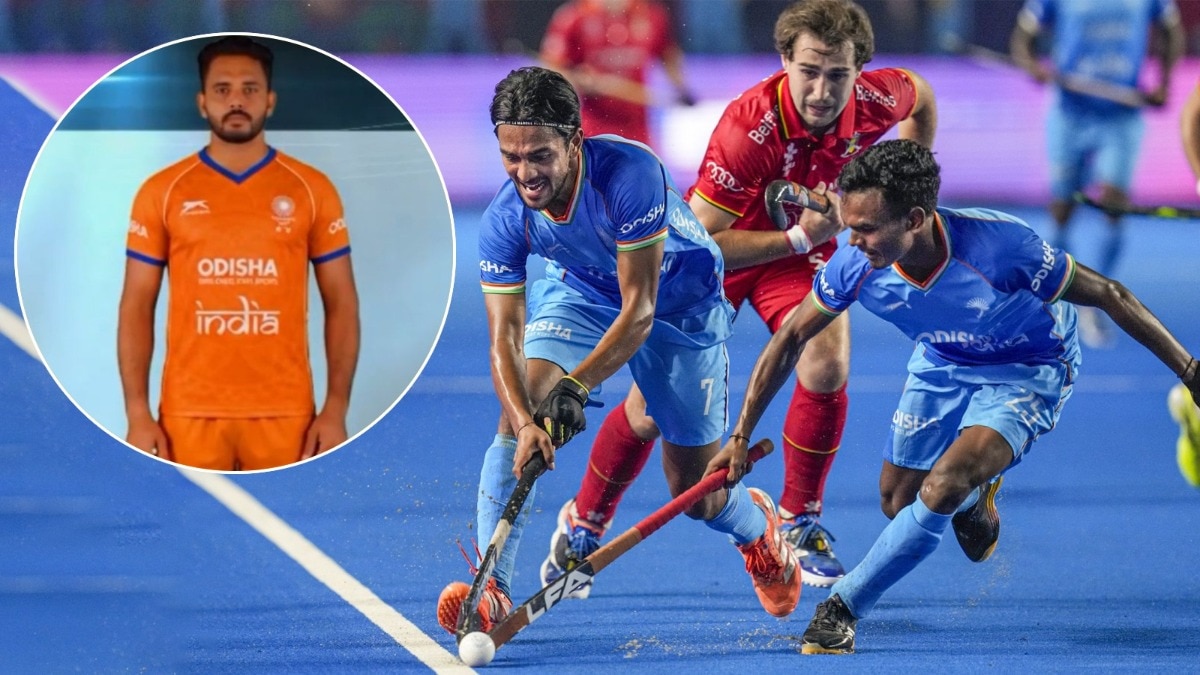
For nearly a century, India's hockey jersey has been synonymous with blue. The national team, sporting that blue, has witnessed eight Olympic gold medals, an iconic World Cup triumph, heartbreaking defeats and, in recent years, the revival of a fallen giant. Now, weeks before the FIH Hockey World Cup 2026 is held in the Netherlands and Belgium, Hockey India's decision to replace the team's traditional blue jersey with a saffron kit has triggered a political controversy.Former players have questioned the need to abandon a jersey that had become part of Indian hockey's identity. While Hockey India insists the decision was taken on purely technical grounds to improve player visibility on blue synthetic turfs, critics have cited the example of Pakistan, which won two World Cups in green kits playing on green fields.The controversy intensified further after former Odisha Chief Minister Naveen Patnaik, widely regarded as the modern patron of Indian hockey because of Odisha's financial rescue of the sport, accused the BJP government in the state of politicising a national symbol.Critics have alleged that Hockey India was "saffronising" even the jerseys of players. That BJP-led governments try to "saffronise" policy and institutions is an allegation that is often hurled their way. The controversy has now become a debate over sporting identity, legacy and whether a colour that has represented Indian hockey for decades should be replaced in the name of functionality.FORMER INDIAN CAPTAIN RAISED FIRST VOICE OF DISSENTThe criticism of the jersey colour switch began soon after Hockey India unveiled the new saffron primary team uniform for the World Cup in Belgium and the Netherlands, which starts from August 15. Hockey India is the federation that manages the national team and regulates the sport in India. Former India captain Viren Rasquinha, who led the national side in 2003-04, was among the first to publicly oppose the move."... This is embarrassing. The legacy and identity of the Indian team has always been blue. I wore the blue jersey with pride for many years. Fans want to see our Indian team in blue. What is the logic of orange?" he wrote on X on July 29.As the debate snowballed and political opposition emerged, Rasquinha clarified that his objection had nothing to do with politics."I'm seeing many unnecessary political comments on this. I don't want to get into any of that. My simple and humble point is pride, identity and legacy. India is to hockey what Argentina is to football. Will we ever see Argentina wearing orange and white stripes as their 1st jersey?"INDIAN TEAM'S JERSEY CHANGED DUE TO VISIBILITY ISSUEFacing mounting criticism, Hockey India issued an official statement on Thursday defending the decision to change the team uniform's colour.According to the federation, the change was recommended after consultations with support staff and players."The decision to change the uniform colour was based on support staff and players' recommendations and detailed consultations with them. The primary consideration was technical. It was observed that the blue playing uniform tended to blend/merge with the blue synthetic playing surface, which is now the standard colour of international hockey pitches. This visual similarity affected on-field clarity and visibility for the players," Hockey India said in the statement.The federation maintained that the decision had no political motivation and was purely intended to improve on-field performance. However, that explanation itself became the subject of fresh scrutiny.Even before the debate was settled by the federation's statement, questions emerged over the claim that the decision followed player consultations.According to The Indian Express newspaper, five current members of the men's and women's national teams denied being consulted during the process. "I wasn't asked or consulted. It is not true," one player told the newspaper anonymously.NAVEEN PATNAIK JOINS THE HOCKEY DEBATE, SLAMS BJPThe debate took a political turn after former Odisha Chief Minister Naveen Patnaik posted a strongly worded statement on X.Patnaik's intervention on Thursday carried particular significance. When Indian hockey struggled to attract sponsors in 2018, the Odisha government stepped in with a landmark sponsorship agreement worth Rs 150 crore, becoming the first state government to sponsor both the men's and women's national teams. That partnership has since been extended through 2036.Beyond financial backing, Odisha built world-class infrastructure including the Kalinga Stadium in Bhubaneswar and the Birsa Munda Hockey Stadium in Rourkela, hosted consecutive FIH Men's Hockey World Cups in 2018 and 2023, and invested heavily in grassroots development through high-performance academies. Odisha has also produced several international stars, including Dilip Tirkey, Birendra Lakra and Amit Rohidas.Because of that sustained investment, Patnaik is widely credited with helping revive Indian hockey during one of its most difficult phases.In his post, Patnaik described the colour change as an attack on Indian hockey's legacy."The iconic shade of blue of the Indian hockey team is not just a colour. It is an emotion associated with the nation's sporting heritage," Patnaik said.He argued that generations of Indians had celebrated Olympic medals while watching the team in blue and alleged that the change had been made under pressure from the BJP government in Odisha, accusing it of attempting to alter symbols associated with the previous administration."Our blue jersey is to us what the iconic stripes are to Argentina, and the yellow jersey is to Brazil. Just because the government changed in Odisha, it should not change our national team colours. This is petty politics of the worst kind," the former CM of Odisha wrote.Journalist Anand Vasu accused that the "real target of saffronisation" is cricket and hockey is just a medium to test the initiative."... You can be sure that those who favour the change to saffron, and even likely initiated it, leaving Hockey India to bear the brunt, are watching the reaction closely.The real target? The much more visible Indian cricket team. Only when they take the field in these colours will the saffronisation of this country be complete," Anand Vasu wrote on X.WHY AND WHEN HOCKEY MOVED TO BLUE TURFThe blue turf itself was introduced not because of player visibility, but primarily for television audiences. The International Hockey Federation first used the blue playing surface during the 2012 London Olympics alongside a fluorescent yellow ball. Inspired partly by the famous blue football field at Boise State University in the United States, the move was designed to make hockey more visually distinctive.The deep blue surface creates stronger contrast with the bright yellow ball, making it easier for players, spectators and television viewers to track one of the fastest-moving balls in world sport.Initially controversial, the blue turf has since become the global standard and is now widely accepted across international hockey.SPORTING COMMUNITY MOCKS HOCKEY INDIA'S MOVEHockey India's explanation attracted mockery from within the sporting community. Sundeep Misra, founder and editor of Athletics India, responded with a satirical post questioning Hockey India's reasoning.Mockingly suggesting that years of poor performances had perhaps been caused by players being unable to distinguish teammates from the blue turf, Misra wrote on X, "All the while our forwards were looking down the pitch, mistaking their own centre-halves for a patch of artificial grass."Misra sarcastically apologised to former national coaches, including Michael Nobbs, Terry Walsh, Roelant Oltmans, Graham Reid and others, for wrongly analysing tactical failures over the past decade.Referring to Hockey India's statement, Misra added that the "blue-on-blue blend was compromising on-field clarity and visibility".He also pointed out that Pakistan, historically known as the "Green Shirts", won major tournaments including the 1982 Asian Games, the 1984 Los Angeles Olympics and the 1994 World Cup while wearing green jerseys on green playing surfaces."So, bring on the Saffron. If the 2026 World Cup campaign goes south, at least nobody can claim we couldn't see it coming," Misra sarcastically wrote.Since India's first Olympic appearance in 1928, the national hockey team has almost always worn blue or white in major tournaments. The blue jersey became inseparable from some of Indian sport's greatest moments. The backlash over the jersey colour change has shown that for many former players, fans and administrators, the debate is not merely about improving visibility on blue turf. It is about whether sporting identities built over generations can be changed without losing a part of the history they represent.- EndsPublished By: Avinash KateelPublished On: Jul 31, 2026 15:12 IST
Pak won with green, India with blue: Saffron hockey jersey comes under fire
Full Article
Original Source
Read the full article at Indiatoday →KhanList aggregates and links to publicly available news content. We do not host full articles from third-party sources. Always verify important information with original sources.