
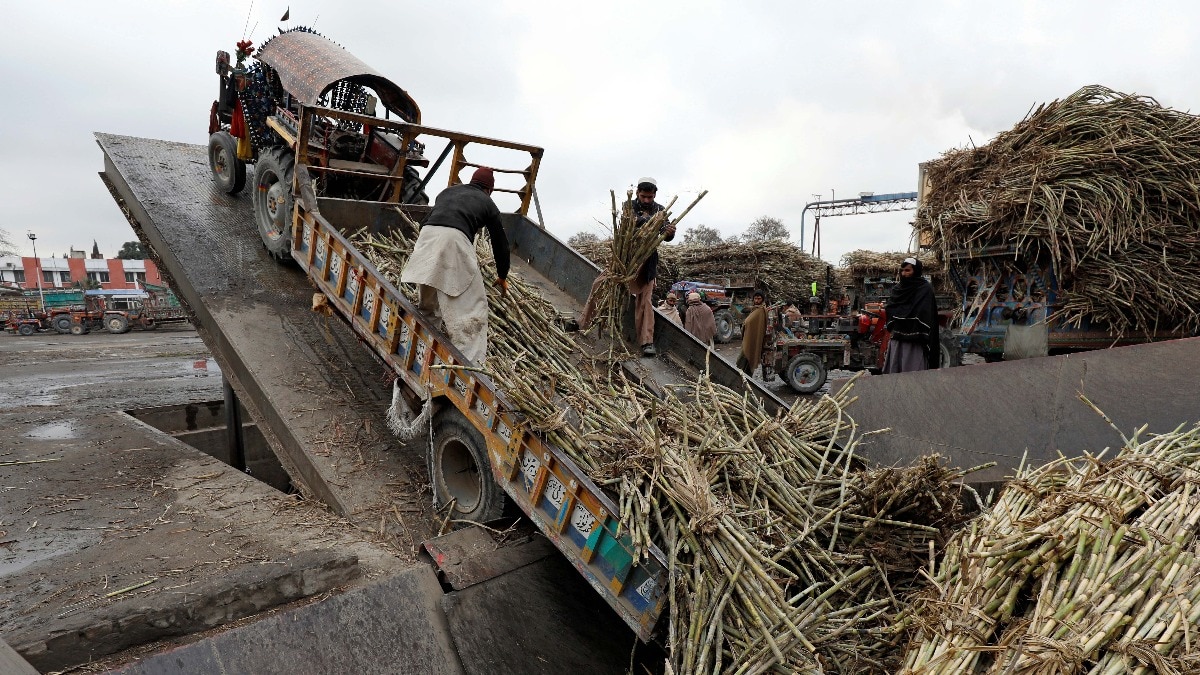
Pakistan's sugar industry has urged the government to explore ways to export sugar to India after the Centre allowed duty-free imports of the commodity. With sugar prices surging in India amid tightening domestic supplies, Pakistan sees an opportunity to tap the Indian market and offload its surplus stocks.Pakistan is currently witnessing a surplus stocks of sugar and estimates suggests more addition to stocks in coming months. (Image: Reuters) Pakistan's sugar industry is looking towards India as a potential market for its surplus stocks of sugar, hours after the Government of India opened the door to duty-free sugar imports amid a surge in domestic prices.The development comes at a strained moment in India-Pakistan relations.Pakistan-based daily, The News International, reported on Thursday that Pakistan's sugar industry has urged the government to explore exporting surplus sugar to India, citing a senior member of the Pakistan Sugar Mills Association (PSMA).Direct bilateral trade between India and Pakistan is at a standstill following heightened political and security tensions, with the Attari-Wagah border and air routes closed. Yet, Pakistan's sugar millers now see India's import decision as an opportunity to clear their mounting stocks and improve their finances. The Centre on Thursday (August 20), allowed duty-free imports of 10 lakh metric tonnes of raw sugar under a Tariff Rate Quota (TRQ) until October 31, 2026. The Directorate General of Foreign Trade (DGFT) said the move was aimed at improving domestic availability and containing rising prices.The decision marks a significant shift for India's sugar market, which has largely remained protected from imports for years. Pakistan's sugar industry is now pushing its government to explore whether some of its surplus can be shipped across the border, according to Pakistan-based The News International newspaper.PAKISTANI SUGAR MILLS SEE AN OPENING IN INDIA The News International in its report on Thursday said that Ch Muhammad Waheed, a senior member of the Pakistan Sugar Mills Association (PSMA) representing Hunza Sugar Mills Ltd, has urged the Pakistan government to allow the export of surplus sugar to India.Waheed said Pakistan's sugar industry is carrying more than "1.2 million tonnes of surplus stocks", creating pressure on mills ahead of the next crushing season. The industry fears that another bumper crop could further swell inventories and make it difficult for mills to purchase the next sugarcane crop from farmers."India's proximity gives Pakistan a potential freight advantage over distant export destinations. Exporting sugar to India could bring in foreign exchange, improve mill liquidity, reduce storage costs and allow sugar mills to make timely payments to sugarcane farmers," Waheed was quoted as saying by the Pakistan-based newspaper.He also suggested that bilateral sugar trade could have a wider benefit by reviving at least one avenue of economic engagement between the two neighbours.But there is an important catch amid all this. Pakistan is not currently preparing to send sugar to India under an existing bilateral trade arrangement. Rather, its sugar industry is asking Islamabad to permit such exports. Any actual shipment would require the necessary government approvals and a mechanism for trade between the two countries.That makes the Indian import decision an opening rather than an immediate trade deal.THE RISING CRISIS OF SUGAR IN INDIAThe Centre's move to cut import duties comes as sugar prices have climbed sharply. The all-India average ex-mill sugar price rose to around Rs 4,000–5,500 per quintal (100 kg) on August 18, compared with about Rs 3,900 a year earlier, according to industry data.The government has also introduced stock holding restrictions to prevent hoarding and speculative activity. In July, the Centre said rising ex-mill prices were not fully supported by demand-supply fundamentals and pointed to hoarding and speculative transactions as factors behind price volatility.The latest decision to allow 10 lakh tonnes of duty-free raw sugar imports is therefore aimed at increasing supplies and preventing prices from rising further. The DGFT has also issued some rules for the allocation of the 10-lakh-tonne TRQ.For Pakistan's sugar industry, the Indian shortage presents a rare potential export opportunity.INDIA'S SUGAR CRUNCH AND THE ETHANOL ANGLEBehind India's sugar-price spike is a broader debate over how much sugarcane should go towards producing sugar and how much should be diverted towards ethanol.India has rapidly expanded its ethanol programme as part of its effort to reduce crude-oil imports and achieve its 20% ethanol-blending (E20) target. The government has encouraged sugar mills to divert excess sugarcane and sugar products towards ethanol, particularly as the country sought to rapidly scale up its biofuel programme.According to the Department of Food and Public Distribution, around 30–40 lakh tonnes of sugar has been diverted towards ethanol in recent sugar seasons. Ethanol production capacity had risen to 1,953 crore litres as of October 2025, up sharply from less than 200 crore litres of molasses-based capacity in 2014.The All India Distillers' Association puts the country's ethanol production capacity at around 1,822 crore litres a year across 499 sites by mid-2025. The sector has increasingly shifted towards grain-based feedstocks, particularly maize, although sugarcane remains an important source.Ethanol blended into petrol helps India reduce its dependence on imported crude oil, while also creating another revenue stream for farmers and sugar mills.But the diversion becomes more visible when sugar supplies tighten. When sugarcane or its derivatives are diverted towards ethanol, less of the crop is ultimately available for producing table sugar. In a year when opening stocks are low or production expectations weaken, that diversion can contribute to tighter availability and put upward pressure on prices.The government has a different explanation for the current price pressure of sugar. It has said there is adequate sugar in the country to meet domestic consumption requirements and has specifically blamed hoarding, speculative transactions and abnormal stock holding by some market participants for part of the recent price volatility.That means India's sugar problem cannot be attributed to ethanol alone.PAKISTAN'S JITTERY ON ITS SURPLUS SUGAR STOCKSPakistan's sugar industry says it has more than enough stock to supply additional markets and is facing a cash-flow problem of its own. Mills are reportedly struggling with unsold inventory, rising input costs and the need to prepare for the next crushing season, according to The News International.Waheed warned that if existing stocks are not cleared, mills could struggle to finance procurement of the new sugarcane crop when crushing begins in November.Pakistan's sugar industry expects another strong sugarcane crop next season, with production estimated at around 8 million tonnes of sugar. If existing stocks remain unsold, the additional output could intensify the pressure on mills, Waheed highlighted while speaking to the Pakistan-based newspaper.However, India-Pakistan trade has been severely restricted following the deterioration in bilateral relations. With conventional trade channels largely frozen, a Pakistani sugar shipment to India would require a significant policy decision from both sides.For now, Pakistan is not exporting sugar to India. Its sugar industry is asking Islamabad to explore the possibility.Yet the fact that Pakistani millers are looking towards India immediately after the Indian government opened a 10-lakh-tonne import window highlights the unusual economics created by the sugar shortage.- EndsPublished By: Avinash KateelPublished On: Aug 21, 2026 15:03 IST
Pak sugar in India? Millers hopeful despite trade ban as Delhi removes import duty
Full Article
Original Source
Read the full article at Indiatoday →KhanList aggregates and links to publicly available news content. We do not host full articles from third-party sources. Always verify important information with original sources.