
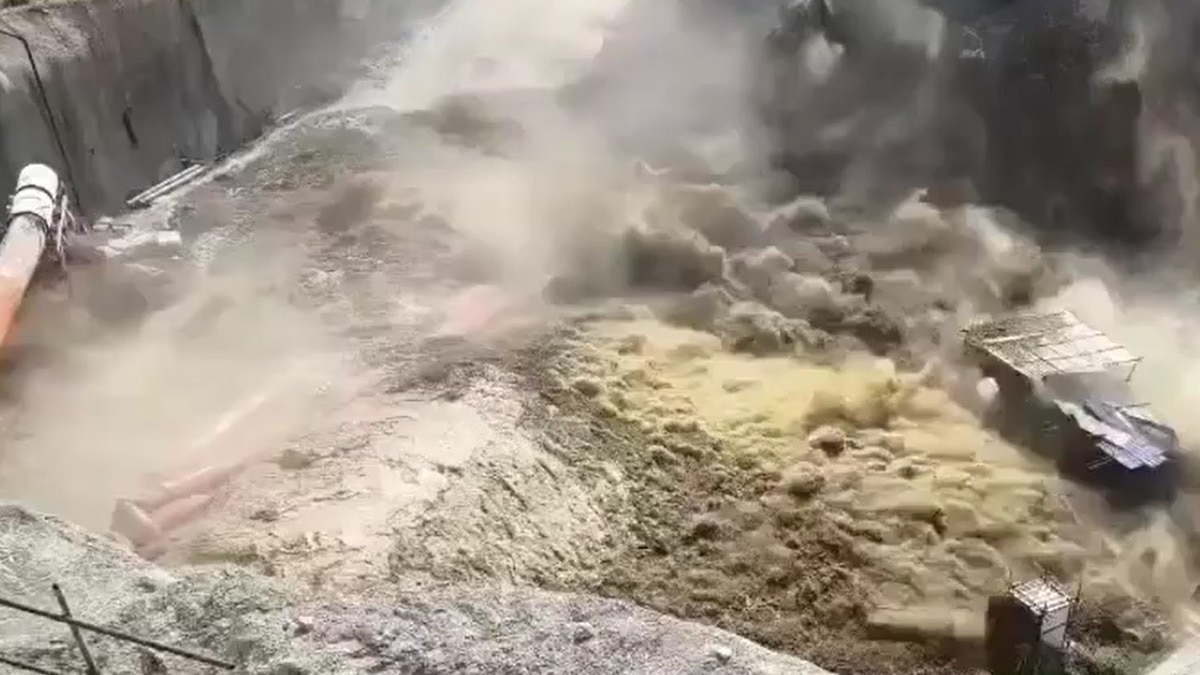
A protective bund at the under-construction Tunnel-5 of Pakistan's 1,530MW Tarbela Dam 5th Extension Hydropower Project, whose civil works contract was awarded to China's Power Construction Corporation of China Limited (PCCCL), collapsed on Monday, triggering a sudden surge of water from the dam's reservoir. An emergency was declared, construction work was suspended and workers were directed to move to safer areas.This is the second major incident at the Tarbela-5 project since 2025. In July this year, a Pakistan Water and Power Development Authority (WAPDA) responsible for an earlier cofferdam collapse at the project.According to a 15-page report accessed by Pakistani newspaper Dawn, the three-member independent inquiry committee identified unauthorised changes to the cofferdam design after the contract was awarded as a major cause of the collapse.The committee said the incident followed several steps outside the contract and contractual breaches involving all three stakeholders. It found that the contractor had proposed a cofferdam design alteration that was not permitted under the contract, while the engineer conditionally accepted a design deficiency without ensuring technical compliance. WAPDA subsequently approved the change when construction was nearing completion, without examining its contractual validity or technical shortcomings.The report said the parties had disregarded their respective rights and responsibilities under the civil works and consultancy contracts. This resulted in the construction of a vulnerable cofferdam, whose structural failure caused flooding, delays and financial losses to the project. The stakeholders sought to link the collapse to flooding. However, the committee found that water flows were within annual levels, were not unusual and should have been taken into account in the original design.According to the report, PCCCL had proposed replacing the cofferdam design with a rock-filled structure, described as a weaker alternative, across the project, including the channel. The revised structure subsequently collapsed. WAPDA approved the alteration without examining whether it was contractually valid.Although WAPDA blamed flooding for the incident, the committee said the flows remained within Tarbela's historical record and were considerably below the cofferdam's designed capacity. It attributed the failure to inadequate protective layers and filter arrangements.The committee also found that WAPDA had asked the consultant in July 2023 to submit an assessment of the cofferdam's performance. Instead of conducting an independent examination, the consultant forwarded the request to the contractor, which submitted a monitoring report in October 2024, more than a year later.The inquiry further found that irregular payments had been made for temporary work in place of permanent work. This weakened the government's right to seek compensation from the contractor following the collapse.The earlier collapse contributed to a delay of at least two years and a cost escalation of more than 285 per cent, with the project's estimated cost rising from 82.36 billion Pakistani rupees (PKR) to PKR 317 billion.According to the Planning Commission, the project's levelised generation cost over 30 years could reach PKR 27-28 per unit, the highest in the country so far for renewable energy, making it economically unviable and unsustainable. Its completion deadline has been moved from 2026 to the end of June 2028.The project includes loans totalling USD 700 million from the World Bank and the Asian Infrastructure Investment Bank.The contractors involved in the project included China's Power Construction Corporation of China Limited (PCCCL), Harbin Electric International Company Limited (HEI) and Harbin Electric Machinery Company Limited (HEC). The consultant was a joint venture involving Pakistan's MM Pakistan and China's BIDR, while the Water and Power Development Authority (WAPDA) was the employer.WAPDA later ended the consultancy agreement with MML-UK, alleging that the company had failed to provide a suitable and adequately qualified project manager and that staffing problems had continued throughout the contract period. MML had also issued a termination notice in May 2025 and withdrawn its staff from the project site unilaterally, contrary to the contractual requirement of 30 days' notice.The inquiry concluded that contractual breaches and technical failures involving the contractor, consultant and WAPDA had resulted in the cofferdam collapse, disrupting work, increasing costs and pushing the expected completion of the Tarbela-5 project to June 2028.- Ends
Pak dam project involving Chinese firms hit by fresh collapse, work halted
Full Article
Original Source
Read the full article at Indiatoday →KhanList aggregates and links to publicly available news content. We do not host full articles from third-party sources. Always verify important information with original sources.