
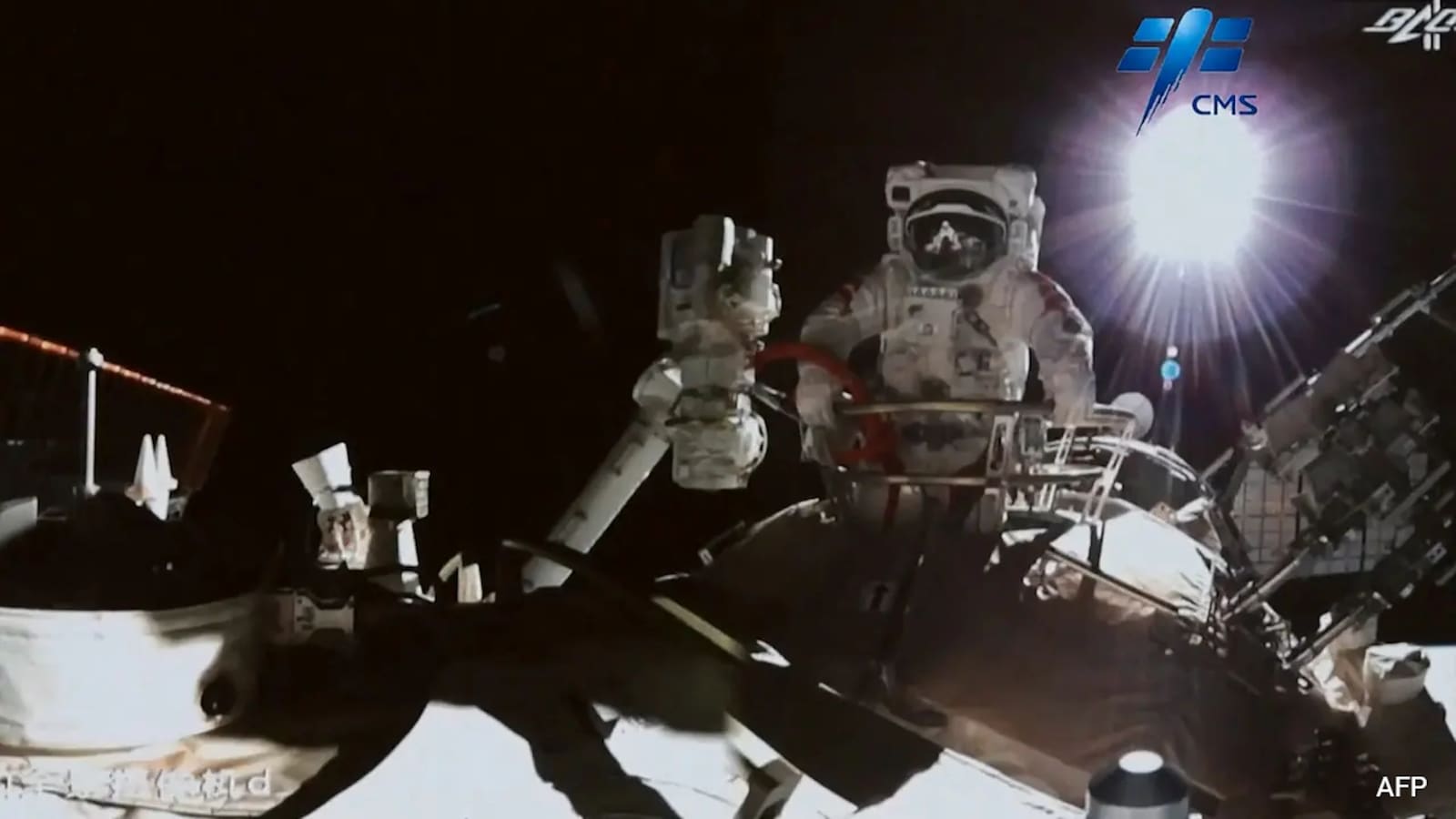
Shillong: Pakistan's astronaut Muhammad Zeeshan Ali is now living and working in the Chinese space station, Tiangong, as Beijing opened its doors of its modern space station to foreigners.Ali flew to China's Tiangong space station aboard the Shenzhou-24 mission on Wednesday, becoming only the second Pakistani to reach space and the first Pakistani to live and work aboard an orbiting space station.The flight represents far more than a symbolic achievement. It places Pakistan inside one of the world's most advanced orbital laboratories at a time when the future of human activity in low Earth orbit is undergoing a profound transition.The Pakistani astronaut entered a space station that did not even exist five years ago. Today, Tiangong, meaning "Heavenly Palace," stands as China's permanent foothold in space and is widely viewed as a major rival, and in some respects a successor, to the International Space Station (ISS).School students watch a live image of a lesson by Chinese astronauts from China's Tiangong space stationPhoto Credit: AFPFor Pakistan, the mission marks a dramatic evolution from the country's first spaceflight milestone.In October 2023, entrepreneur and adventurer Namira Salim became the first Pakistani to travel to space aboard a Virgin Galactic suborbital flight. Her journey lasted only minutes beyond the edge of space. By contrast, a mission to Tiangong involves reaching orbital velocity, docking with the space station nearly 400 kilometres above Earth, and spending days conducting scientific work in microgravity.The mission is also another sign of deepening strategic cooperation between China and Pakistan. Beijing has increasingly opened elements of its space programme to international partners, and Pakistan has emerged as one of its closest collaborators. China routinely gives out calls to international scientists to propose and conduct experiments in its space station.What makes the mission particularly significant is the destination itself.Tiangong is currently one of only two permanently crewed space stations orbiting Earth, the other being the ISS. Yet the two orbital outposts represent different eras of space exploration. The ISS is a multinational engineering marvel built by the United States, Russia, Europe, Japan and Canada, among others. The first ISS modules were launched in 1998, and the station has hosted continuous human occupation since 2000. NASA says more than 265 people from 20 countries have visited the orbiting laboratory.Add image caption hereTiangong, in contrast, is a product of the twenty-first century. Construction began only in April 2021 with the launch of the Tianhe core module. Two laboratory modules, Wentian and Mengtian, followed in 2022, creating a fully operational T-shaped station. China achieved in less than two years what took the ISS partnership more than a decade to assemble.On paper, the ISS remains much larger. It weighs roughly 420 tonnes and contains 16 pressurised modules. The old and ailing ISS is supposed to be very mouldy, as its many crevices are full of fungus, so much so that at least two new species of microbes have been discovered on the ISS, and in fact one of them is named after India's former President, APJ Abdul Kalam, named 'Solibacillus kalamii' in 2017. To be accurate, this is not extraterrestrial (ET) life but a microbe that evolved as a unique species after it was inadvertently carried to the ISS through human spaceflights. Tiangong has a mass of about 100 tonnes and consists of three primary modules. The ISS normally houses seven astronauts, while Tiangong generally hosts three, rising to six during crew handovers.Yet size is only part of the story.Since Tiangong was designed decades later, many experts regard it as technologically more modern. The station incorporates newer life support systems, advanced digital controls, highly automated operations, modern experiment racks, sophisticated robotic arms and efficient recycling technologies that were developed long after many ISS systems had already been designed.The comparison is akin to placing a newly built smart building alongside a larger but older structure. The ISS remains the larger and more capable scientific complex in absolute terms, but Tiangong benefits from modern engineering choices, contemporary electronics and lessons learned from decades of international space station operations.China has also moved rapidly in building a track record aboard Tiangong. Since permanent occupation began, Chinese crews have conducted hundreds of scientific investigations ranging from life sciences and biotechnology to fluid physics, materials research and astronomy. The station has become the centrepiece of China's ambitions in human spaceflight.Human traffic through Tiangong has risen steadily. Available mission records indicate that about 31 Chinese astronauts and spaceflight participants have now visited the station through successive Shenzhou crew rotation missions.Photo Credit: AFPThe Shenzhou-24 mission carrying a Pakistani astronaut therefore represents one of the first major international presences aboard the station.For Pakistan's astronaut, daily life aboard Tiangong includes scientific experiments, maintenance activities, and physical exercise to counter the effects of weightlessness, educational outreach and observation of Earth. The station circles the planet approximately every 92 minutes, completing about 16 orbits each day.The broader significance of the mission extends beyond Pakistan and China.The ISS is approaching the end of its planned operational life. NASA and its international partners currently intend to operate the station through 2030 before conducting a controlled deorbit. The station is expected to be retired around 2030 to 2031 after more than three decades in orbit.That looming retirement raises a striking possibility.When the ISS leaves orbit, Tiangong could become the only government-operated, permanently crewed space station remaining in space.Several commercial stations are being developed in the United States, including projects led by Axiom Space, Space Hab, Voyager's Starlab consortium and others. India also has long-term ambitions for its own space station called Bhartiya Antariksha Station by 2035. However, none is yet operational. As a result, Tiangong may find itself as the world's sole active crewed orbital outpost for at least a period after ISS retirement.For Pakistan, joining Tiangong now therefore means joining what may become the most important destination in low Earth orbit during the next decade.Chinese astronauts Tang Hongbo, Wu Yi and Pakistani astronaut Muhammad Zeeshan Ali take part in a see-off ceremony before taking part in the Shenzhou-24 spaceflight mission to China's Tiangong space station, at Jiuquan Satellite Launch Center, near Jiuquan, Gansu province, China, November 25, 2026Photo Credit: REUTERSThe symbolism is difficult to miss. In 1984, Indian Air Force pilot Wing Commander Rakesh Sharma became South Asia's first astronaut when he flew to the Soviet Salyut 7 space station.
Pak Astronaut At Chinese Space Station: How Good Is Tiangong Compared To International Space Station
Full Article
Original Source
Read the full article at Ndtv →KhanList aggregates and links to publicly available news content. We do not host full articles from third-party sources. Always verify important information with original sources.