
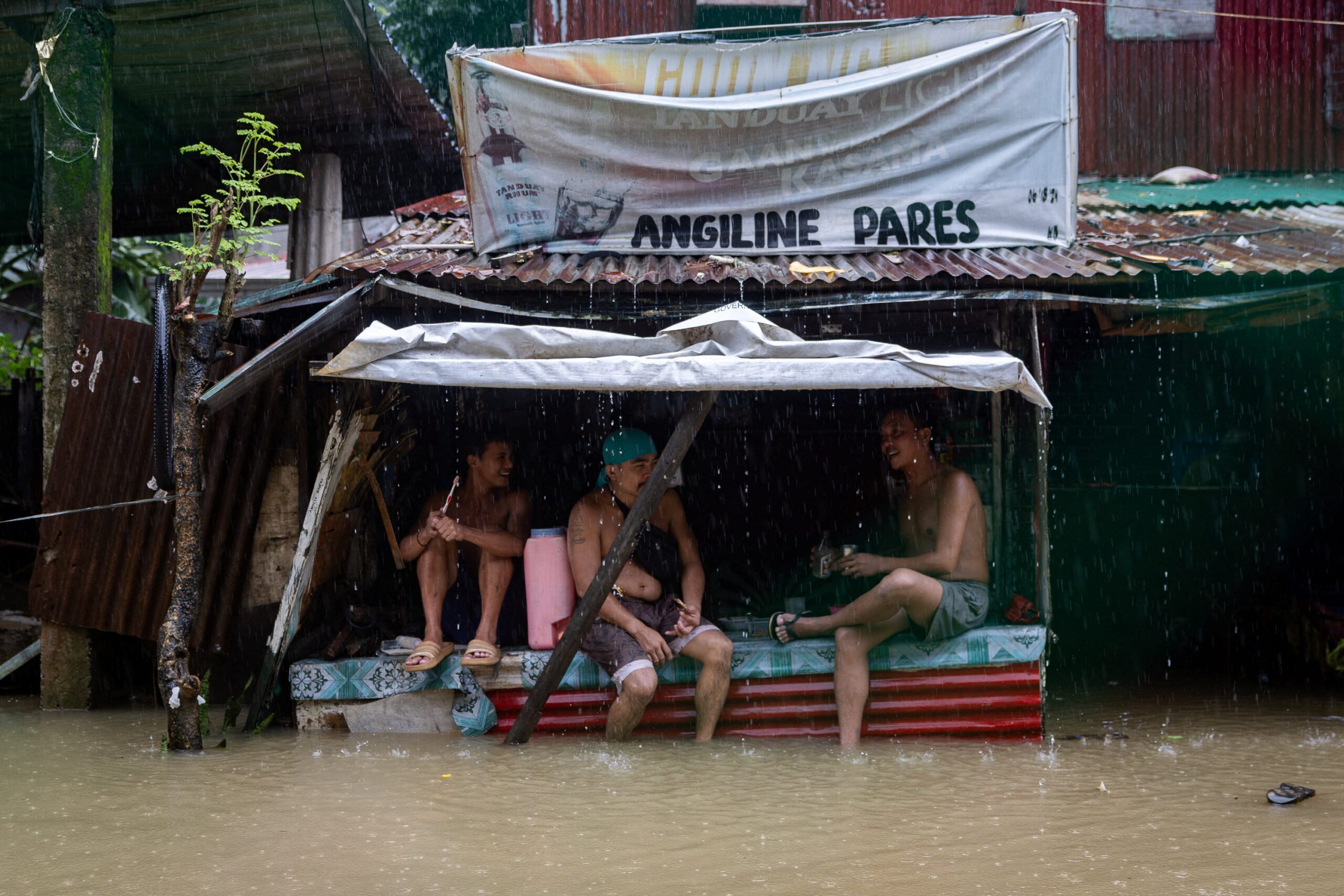
FLOOD. Residents socialize at an inundated village, amid southwest monsoon rains in Bagong Silangan, Quezon City, on August 10, 2026. Eloisa Lopez/Reuters 'We can mainstream the science, the knowledge into the plans of the community,' says disaster risk management expert Mahar Lagmay Project Noah has received a P1-billion funding boost from the 2026 national budget to enhance its hazard monitoring capabilities with advanced technology and equipment. Managed by the University of the Philippines Resilience Institute, the program aims to improve hazard mapping and promote nature-based solutions for disaster risk management, while facing challenges in reaching local governments. Despite past setbacks, including a reduction in expertise after its 2017 termination, Project Noah continues to collaborate with local governments to develop effective flood mitigation strategies. This is AI-generated. Read the article for full context. Report any errors. MANILA, Philippines – Project Noah has been revitalized with a P1-billion fund release from the 2026 national budget, half of which will go to up-to-date equipment such as LiDAR drones and the rest to operations and its researchers. Despite this newfound support to this long-running program, there remains the problem of reaching more local governments with knowledge and maps that scientists generate. Project Noah is a hazard monitoring program launched in 2012, considered a landmark project in the Philippines’ disaster risk reduction and management. The Rodrigo Duterte administration pulled the plug on the program in 2017, which was then under the Department of Science and Technology. Project Noah did not completely disappear but with its termination, the program lost most of its experts and reach. Currently, the University of the Philippines Resilience Institute (UPRI) manages Project Noah. With the new funds, UPRI intends to prioritize using cutting-edge technology. This would allow it to generate higher resolution maps of major river basins, a huge improvement from the maps generated when Project Noah was launched 14 years ago. It will also continue promoting nature-based solutions to disaster risk reduction and management. MAPPING. Comparison of old (left) and newer (right) hazard mapping of Project Noah. Screenshot from Dr. Mahar Lagmay’s presentation on August 28, 2026. Mahar Lagmay, the institute’s executive director, listed down their priority areas in budget allocation such as: simulation of major detention basins, LiDAR drone surveys with educational institutions, native tree-mapping and inventory. Higher resolution is not just a quality issue; with it, UPRI researchers will be able to see where exactly flooding happens in a particular street. Lagmay said they need help in disseminating information, including reaching more local governments so they can apply science to disaster risk management. “We can mainstream the science, the knowledge into the plans of the community,” Lagmay said in a press conference on Thursday, August 27. “We want the plans of the community to be in accordance with the vision of the stakeholders.” Lagmay said Project Noah will continue to prioritize support for the government’s flagship flood mitigation program Oplan Kontra Baha. “The business of hazards mapping is not just to identify the hazards but more importantly to identify the safest places in the community for development and for citing evacuation centers,” Lagmay said. Mainstreaming remains hard According to Lagmay, UPRI has worked with at least 20 local governments on hazard and risk mapping in a span of eight years. A notable partnership of UPRI was with the Quezon City local government. The result was a city-wide drainage master plan that relied on “science and nature-based solutions to mitigate flooding.” All local governments UPRI has worked with “were really aggressive” and “wanted to change the system,” said Lagmay. Working with a local government to find ways to mitigate flooding and other hazards takes one to two years. University of the Philippines President Angelo Jimenez said the university is “not an implementing arm” but only provides the knowledge and resource. “It’s our mandate to offer this resource to the people,” Jimenez said in the same press briefing. “I believe that because of recent events, there is more appreciation of our work.” He referred to the P1-billion funding as some sort of recognition, but it will need to be replenished if the government wants to continue Project NOAH. – Rappler.com Quotes translated to English for brevity. How does this make you feel? Loading
P1-billion fund revitalizes Project Noah. But they need more help reaching LGUs.
Full Article
Original Source
Read the full article at Rappler →KhanList aggregates and links to publicly available news content. We do not host full articles from third-party sources. Always verify important information with original sources.