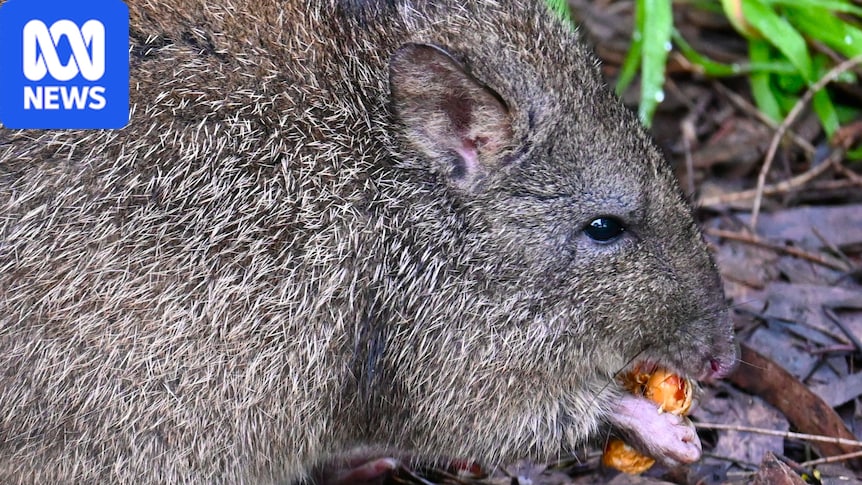
Ozzy, the long-nosed potoroo, is living his best life in the eco-sanctuary of Tatachilla Lutheran College in the famous wine-growing region of McLaren Vale, just south of Adelaide.In January, his life was in the balance after his mother became ill with a bacterial infection and had to be euthanised.Still in the pouch, weighing 96 grams and having only just grown his first covering of fur, a team of staff, students and volunteers pulled together to help raise him.Ozzy, the long-nosed potoroo, having one of his two-early feeds in the early days of his care when he weighed less than 100 grams. (Supplied: Tatachilla Lutheran College)They included long-standing staff member Dolores Amos, who prefers to be known as Ranger Dee, who took on the two-hourly night feeds and resultant sleep deprivation needed to keep him alive.During the day, other staff and volunteers kept up with his feeds, and students helped by crocheting pouches to keep little Ozzy feeling warm and safe.Ozzy was orphaned after his mother developed a bacterial infection. (Supplied: Tatachilla Lutheran College)Now Ozzy is a healthy one-kilogram juvenile.Tom Hurley, the coordinator of the college's EcoSanctuary, said Ozzy's development was a testament to Ranger Dee's skills and knowledge."He's grown into a very robust young male."Ozzy is now one of 20 long-nosed potoroos living in the eco-sanctuary and now weighs one kilogram. (ABC South East SA: Caroline Horn)Growing independenceNow, in what could be called his teenage phase, Ozzy has moved out of the care centre and is becoming an independent resident of the school's 4.3ha eco-sanctuary.While he is learning "how to be a proper potoroo", he still has an appetite for a peanut treat.Ranger Dee and the other staff have to resist the urge to give Ozzy too many peanut treats. (ABC South East SA: Caroline Horn)He still comes when called in the early morning, but it takes him a while to rouse after spending much of the night foraging for roots, fungi, grubs, and insects.Recently, Ozzy has started making a nest for himself under a bus, a sign that he's starting to have female potoroos on his mind.Hopefully he will find one amongst the nine other potoroos that live with him, in addition to the brush-tailed bettongs, tammar wallabies, and birds that can flourish away from the threat of cats and foxes.Students at the college crocheted pouches to keep Ozzy warm and secure. (ABC South East SA: Caroline Horn)The college's eco-sanctuary is more than 20 years old and is on land that was once used to grow grapes and run sheep in the famous wine-growing region of McLaren Vale.It's been revegetated with plants native to the local area and fenced to keep out cats, foxes and other predators, which is just as well for Ozzy and the other potoroos that call the sanctuary home, as Mr Hurley said they tended to be "incredibly naive" to these threats.Ranger Dee, Tom Hurley and Tatachilla Lutheran College Principal Alison Thacker with Ozzy. (ABC South East SA: Caroline Horn)The sanctuary is used as a teaching resource and as a place for students who want to learn about the environment, providing a contrast between what the area was once like and the vineyards that surround the school."This is as close to what it used to be like, as we can create," Mr Hurley said.Lost to the wild in South AustraliaRob Brewster from the Invasive Species Council said he believed long-nosed potoroos were extinct in the wild in South Australia, due to land clearing and the introduction of feral predators.Rob Brewster said long-nosed potoroos were believed to be extinct in the wild in South Australia. (ABC News: Lani Oataway)While they were able to cope with native predators such as quolls, the potoroos had not been able to withstand cats and foxes, as well as the loss of complex vegetation.He said that while the school's population of potoroos was only small, it meant a lot to keep the species "on the radar" and show how they could be returned to South Australia "one day".Letting goThe time will come soon when Ranger Dee calls for Ozzy, but he'll no longer respond as he gets on with his life, safe within the sanctuary, and she's not fazed.Ozzy has graduated from two-hourly feeds to foraging for himself. (ABC South East SA: Caroline Horn)"That's the way it should be," she said.Holding the pouch she had made for Ozzy when he was smaller, Year 11 student Marlee felt the same way."To see him now, out with the rest of the animals, is so sweet."
Ozzy the orphaned long-nosed potoroo loves his peanuts
Full Article
Original Source
Read the full article at Abc →KhanList aggregates and links to publicly available news content. We do not host full articles from third-party sources. Always verify important information with original sources.