
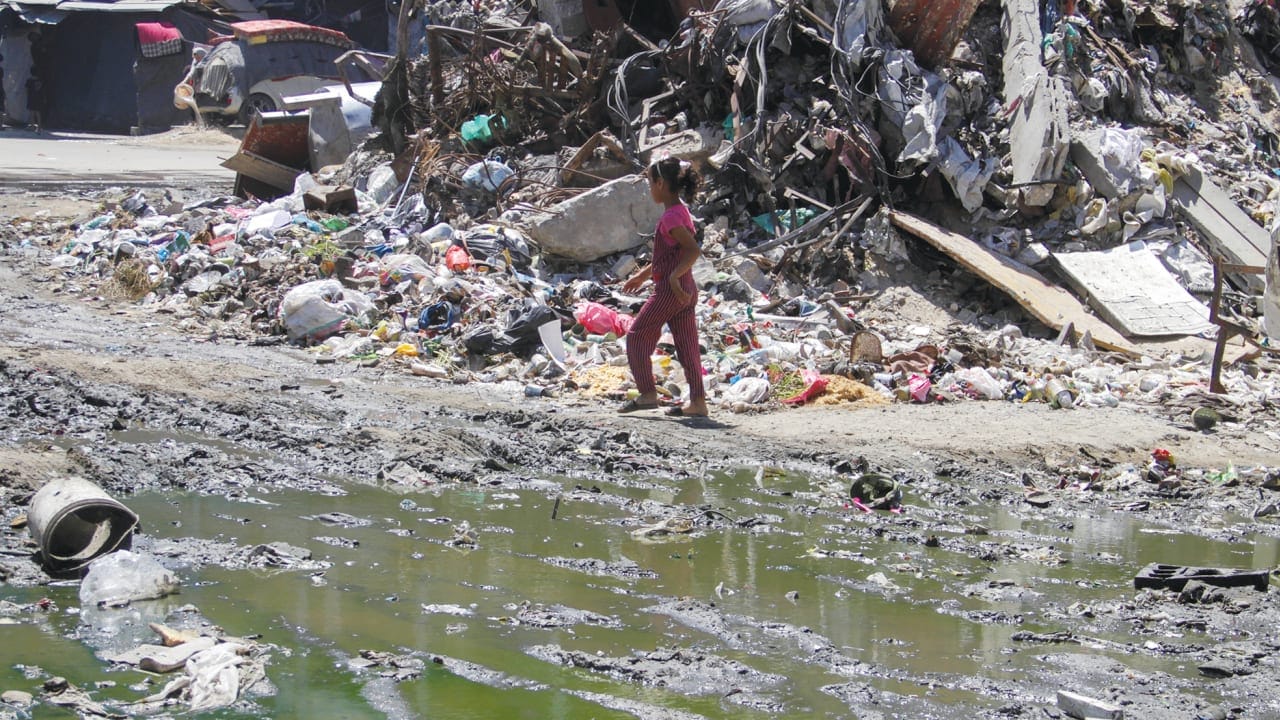
NOVEMBER 27, 2026 13:47Oxfam’s new report accuses Israel of “environmental war crimes,” and says its military assault has turned Gaza into “a toxic wasteland, threatening human survival.”Yet a closer examination of the report reveals significant gaps in its methodology, inconsistencies in its treatment of evidence, and legal conclusions that its environmental research cannot independently substantiate.Across 125 pages, the report explores Gaza’s environmental devastation primarily through the lens of what Oxfam has already concluded constitutes genocide.The research claims to document how, since October 2023, Israel’s military actions have “wreaked havoc on environmental systems, dismantling the basic conditions necessary for life,” at a scale and intensity that has “fundamentally altered Gaza’s environment.”Oxfam, the anti-poverty charity, does acknowledge its methodological limitations, noting that there has been no independent, field-based post-conflict environmental assessment of Gaza, meaning it cannot establish site-specific contamination levels, and its assessment relies primarily on secondary research, spatial analysis, and satellite imagery.AN OPEN-AIR pool filled with wastewater in Gaza City’s Sheikh Radwan neighborhood. While the war has severely damaged Gaza’s wastewater infrastructure, substantial sewage pollution and inadequate treatment capacity predated the conflict. (credit: OMAR AL-QATTAA/AFP via Getty Images)Yet this distinction between what can reasonably be inferred and what has been empirically established becomes increasingly blurred throughout the report.Israeli environmental scholar Prof. Alon Tal, who reviewed the report at the request of The Jerusalem Post, described Gaza’s environmental situation as “intolerable and in urgent need of attention,” but questioned the evidentiary basis for Oxfam’s accusations against Israel.“The environmental devastation is real, and its consequences are potentially catastrophic. But establishing the extent of environmental damage is not the same as establishing the intentions of those responsible for it,” he told the Post.What does the 99% contamination figure actually mean?Perhaps the most striking finding in the report, and the one that will likely be quoted the most, appears on page 9, where Oxfam claims its “spatial analysis identified at least one potential contamination across more than 99% of Gaza’s territory.”Oxfam divided Gaza into 1,821 hexagonal grid cells, using a 500-meter grid. It then identified potential contamination sources within each cell across 12 sectors, ranging from agriculture and residential buildings to military activity and wastewater infrastructure.The severity score is constructed from expert-assigned numerical weightings. These are relative hazard weightings, not measured concentrations of pollutants.The model uses a binary indicator: essentially, if a relevant contamination source is identified within a grid cell, that sector is counted as present.Consequently, a damaged facility can be treated as a potential pollution source without necessarily establishing whether hazardous materials were released.This is a qualitative assessment of contamination risk rather than a quantitative measurement of pollution: Oxfam has mapped potential contamination sources across approximately 99% of Gaza, not demonstrated that 99% of Gaza’s land is contaminated with hazardous concentrations of toxic substances.While the distinction is acknowledged in the report’s methodological annex, it is less apparent in its broader conclusions throughout.Munitions and atmospheric pollutionOxfam maps Israel’s munitions usage throughout the war, as it deems each strike “a potential point source of contamination, introducing hazardous materials into soils, groundwater, surface water, and the built environment.”The report says that these contaminants – such as heavy metals, asbestos, or explosive residues – are not limited to isolated impact sites but can become widely dispersed across soils, groundwater, surface water, and the land surface, creating multiple and overlapping risks of human exposure.While the dispersal of such contaminants is a well-established phenomenon, the recurring methodological issue is Oxfam’s failure to distinguish potential sources of contamination from demonstrated hazardous contamination. Oxfam does not have sufficient physical sampling to quantify the latter.To demonstrate the transboundary effects of conflict-related air pollution, Oxfam cites the 1999 Kosovo conflict, when hazardous pollutants released by strikes on Serbian industrial facilities were subsequently detected in northern Greece, and the war in Ukraine, where smoke-containing air masses from conflict-related fires crossed into multiple European countries.Oxfam does acknowledge here that while the United Nations Environment Program’s (UNEP’s) assessment of Gaza has recognized the potential for transboundary environmental consequences, systematic air-quality monitoring and field sampling has not been possible.These two examples raise the question of whether comparable conflict-related pollution has been detected inside Israel, given that Israeli communities are located within a few kilometers of Gaza, and prevailing Mediterranean winds frequently blow from west to east.Three Israeli air-quality monitoring stations (Erez, Karmiya, and Sderot) did record higher average PM2.5 concentrations between October 10, 2023, and January 12, 2024, compared with the equivalent period a year earlier, but UNEP acknowledged that the increases could have resulted from factors unrelated to the war.Likewise, later in the report, Oxfam says Israel’s military assault in Gaza has generated a substantial greenhouse gas emissions burden, citing a 2026 study that estimated that direct emissions from open conflict had exceeded 1.3 million metric tons of carbon dioxide equivalent (CO2) by January 2025, rising to 33.2 million metric tons CO2 when including emissions associated with pre-conflict military infrastructure and post-conflict reconstruction.Israel’s emissions did increase by 2% in 2024 compared with 2023, but the Environmental Protection Ministry attributed increases primarily to fluorinated gases, electricity production, and transportation.More strikingly, approximately 95% of the estimated emissions have been attributed to reconstruction rather than the fighting itself. In other words, the 33.2 million metric tons should not be reported as emissions that have already occurred.Water infrastructure and preexisting pollutionOxfam then discusses water, claiming that Israel’s military assault had destroyed all six of Gaza’s wastewater treatment plants by April 2024, rendering them nonoperational, while as of April 2026, only 19% of sewage pumping stations remain functional, and approximately 30% of the wastewater network retains some operational capacity. It says this has resulted in the uncontrolled discharge of approximately 40,000 cubic meters of raw sewage per day into the Mediterranean Sea.If taken to be true, the volume of sewage reportedly being discharged into the Mediterranean is considerably lower than some prewar estimates.The UN’s 2020 environmental assessment reported that approximately 110,000 cubic meters of untreated or partially treated wastewater were discharged into the Mediterranean daily in 2018. Even in 2012, the UN reported 90,000 cubic meters.The World Bank also documented that before October 7, the north Gaza wastewater treatment plant was operating beyond capacity, with approximately 10,000 cubic meters of wastewater diverted daily into makeshift sewage lakes and 13,000 cubic meters of raw sewage discharged into the sea daily from late August until the war began.In September 2023, just weeks before the war, a wastewater treatment plant in northern Gaza collapsed, prompting Israel’s Health Ministry to close Zikim Beach.This doesn’t mean that water pollution was worse before the war, as lower sewage discharge volumes could reflect reduced water consumption, collapsed water supplies, and sewage accumulating in residential areas instead of reaching the sea. Moreover, the historical figures include partially treated wastewater, whereas Oxfam’s estimate refers specifically to raw sewage.Nevertheless, Oxfam’s figures need to be contextualized against the substantial preexisting contamination.Palestinians gather at the site of a deadly collapse of a sandbank at a tent camp for displaced people in Deir Al-Balah, central Gaza Strip, November 9, 2026 (credit: REUTERS/Mahmoud Issa)The absence of HamasRegarding water infrastructure in Gaza, it is also relevant to discuss how Hamas has previously repurposed Gazan water pipes for rocket production.This is well documented: a September 2020 Al Jazeera documentary showed Hamas operatives excavating and repurposing water and irrigation pipes left behind following Israel’s 2005 Disengagement from Gaza. In May 2021, Reuters reported that Palestinian Islamic Jihad leader Ziad al-Nakhala publicly boasted that his organization manufactured rockets from water pipes. And in October 2024, The Washington Post documented Hamas’s extensive use of water pipes in its weapons manufacturing industry.While the extent to which pipe repurposing contributed to the degradation of Gaza’s water infrastructure is unclear, Oxfam does not examine this potential factor. In fact, Hamas is never once mentioned by name across the report’s 125 pages.The report does acknowledge on page 35 that “tunneling and earthworks” can affect groundwater recharge and the movement of contaminants, but does not separately quantify the environmental consequences of Hamas’s tunnel network. Nor does it present a separately quantified assessment of the environmental effects of Hamas’s and other terror groups’ activities.Methodologically, this is problematic. An environmental assessment focused on one belligerent can identify hazards associated with that belligerent. It cannot, without additional source-attribution analysis, establish its exclusive responsibility for every hazard identified.Indeed, the conflict incident data used in Figure 3 of the report were explicitly filtered to include Israeli military forces as the primary actor. The resulting map is therefore not a comprehensive representation of all conflict-related military activity in Gaza.The Foreign Ministry told the Post that Oxfam has “traded its credibility for campaigning,” and that this “shameful and slanderous report, which does not name Hamas or other Palestinian terrorist organizations, is the latest proof.“The scale of destruction in Gaza reflects the scale of the terror network Hamas built there, including a 500+ kilometer tunnel system and weapons depots, inside and beneath civilian areas. Hamas has also admitted to cannibalizing Gaza’s civilian infrastructure for terror, for example turning dedicated water pipes into rockets. No serious account of the damage can ignore that,” the ministry added.Health risks versus health outcomesOxfam warns that repeated bombardment, hazardous debris, and the destruction of water and wastewater infrastructure have created conditions for acute and sustained toxic exposure across Gaza’s civilian population, with health consequences that could persist long after hostilities cease.Nevertheless, while the report discusses the potential for cancer, neurological impairment, reproductive harm, cardiovascular disease, kidney damage, and other long-term conditions, public health risks are not equivalent to observed disease outcomes.Even where hazardous materials are present and environmental contamination occurs, the extent of human exposure, the doses received, and the resulting adverse health effects require separate assessment.The evidence for the first two (hazardous material and contamination) can justify precautionary action before the latter stages are conclusively established. But extrapolating from potential contamination to specific future diseases cannot establish how many people will develop those diseases, their severity, or their precise causes.The distinction is particularly important when assessing the report’s claims concerning the long-term health of Gaza’s entire population.Does the legal analysis hold up under international law?While Oxfam identifies genuine provisions of international law, its environmental evidence does not independently establish all the elements necessary to demonstrate violations.Under Article 8(2)(b)(iv) of the Rome Statute, the environmental damage provision cited by Oxfam, damage must be widespread, long-term, and severe: three cumulative requirements. It must also be clearly excessive in relation to the concrete and direct overall military advantage anticipated, and the requisite knowledge on the part of the perpetrator must be established.Oxfam’s mapping of potential contamination sources cannot independently satisfy these requirements.There is also a fundamental legal distinction between damaged civilian infrastructure and unlawfully targeted civilian infrastructure.An object ordinarily used for civilian purposes may qualify as a military objective in specific circumstances, although obligations regarding proportionality and precautions continue to apply.A satellite image can show that a warehouse, agricultural structure, or industrial facility has been destroyed. It cannot necessarily establish how the facility was being used, what military information was available, or whether the anticipated civilian harm was excessive.The scale of the destruction is relevant evidence, but it is not a substitute for an assessment of the circumstances in which it occurred.Genocide as a premise rather than a conclusionThe most significant legal weakness is the genocide allegation found throughout.Oxfam relies particularly on Article II(c) of the Genocide Convention, concerning the deliberate imposition of conditions of life calculated to bring about the physical destruction of a protected group, in whole or in part.The report is correct that genocide does not require the immediate killing of members of a population. It can be committed through deprivation of food, water, shelter, and other resources essential to survival. This means that environmental destruction could therefore constitute part of the factual basis of a genocide case.However, the decisive legal requirement remains the specific intent to destroy a protected group, in whole or in substantial part, as such. Foreseeable environmental harm, even on an extensive scale, does not independently establish that intent.In its November 19 judgment in The Gambia v. Myanmar, the International Court of Justice reaffirmed that where genocidal intent is inferred from a pattern of conduct, it must be the only reasonable inference that can be drawn from that conduct.But Oxfam has not carried out a systematic examination of competing explanations for the environmental destruction it documents, and its findings do not independently establish genocide under the applicable evidentiary threshold.Oxfam describes Israel’s military campaign as amounting to genocide, without qualification, and its recommendations demand that Israel end its genocide.Yet no international court has issued a final judgment establishing that Israel has committed genocide in Gaza.Prof. Tal similarly raised this issue: “I am deeply troubled by Oxfam’s apparent determination to interpret Gaza’s environmental devastation primarily through the lens of genocide,” he said.“I believe this framing goes well beyond what the environmental evidence itself can establish. It also risks lending credibility to sweeping accusations against Israel rather than encouraging the cooperation needed to address the crisis.”Why Gaza?The Post could not identify a directly comparable Oxfam report dedicated to mapping toxic environmental contamination caused by military operations in another conflict.While Oxfam has published extensively on the humanitarian consequences of other wars, including destruction of water infrastructure, sanitation systems, and agricultural land, those reports have generally had a different focus from its new Gaza report.For example, in Iraq, in 2016, Oxfam documented the environmental and health consequences of ISIS deliberately setting oil wells ablaze near Mosul. This was a press release rather than a dedicated scientific contamination report.As mentioned, Oxfam explicitly acknowledges the Kosovo/Serbia and Ukraine wars as precedents for conflict-related transboundary pollution in its own Gaza report. Yet the Post could not find comparable Oxfam environmental research reports on either conflict.Additionally, while drawing on field studies from Lebanon, Iraq, Syria, and Ukraine to identify contaminants likely to be present in Gaza is a reasonable starting point for developing an environmental testing program, the existence of contamination in one conflict does not establish equivalent concentrations in another.Comparative research can help identify what should be tested for in Gaza, but cannot substitute for the testing itself.Tal questioned the absence of a comparable Oxfam environmental assessment of the destruction in Khartoum, where Sudan’s civil war has devastated water infrastructure, industrial facilities, and entire urban neighborhoods.“The environmental consequences of warfare deserve rigorous and consistent scrutiny, regardless of the parties involved,” he said.Tal strongly endorsed Oxfam’s recommendation for an independent, field-based environmental assessment. In a forthcoming paper coauthored with former Environmental Protection Ministry director-general Galit Cohen, he argues that Gaza’s environmental rehabilitation is both a humanitarian imperative and an Israeli national interest.Gaza’s environmental devastation can warrant a serious scientific investigation in its own right without needing to be framed as genocide.But evidence of environmental destruction is not necessarily evidence of toxic contamination, just as evidence of contamination is not necessarily evidence of a war crime.In presenting a qualitative environmental risk assessment alongside categorical conclusions about Israel’s alleged criminal responsibility, Oxfam repeatedly blurs these distinctions.“There is more than enough environmental destruction in Gaza to warrant urgent action,” Tal concluded. “We do not need to attribute motives that have not been convincingly established to recognize the magnitude of the disaster, or our shared responsibility to address it.”The Environment and Climate Change portal is produced in cooperation with the Goldman Sonnenfeldt School of Sustainability and Climate Change at Ben-Gurion University of the Negev. The Jerusalem Post maintains all editorial decisions related to the content.Follow us on Google
Oxfam accuses Israel of turning Gaza into a 'toxic wasteland' - but does the evidence hold up?
Full Article
Original Source
Read the full article at Jpost →KhanList aggregates and links to publicly available news content. We do not host full articles from third-party sources. Always verify important information with original sources.