
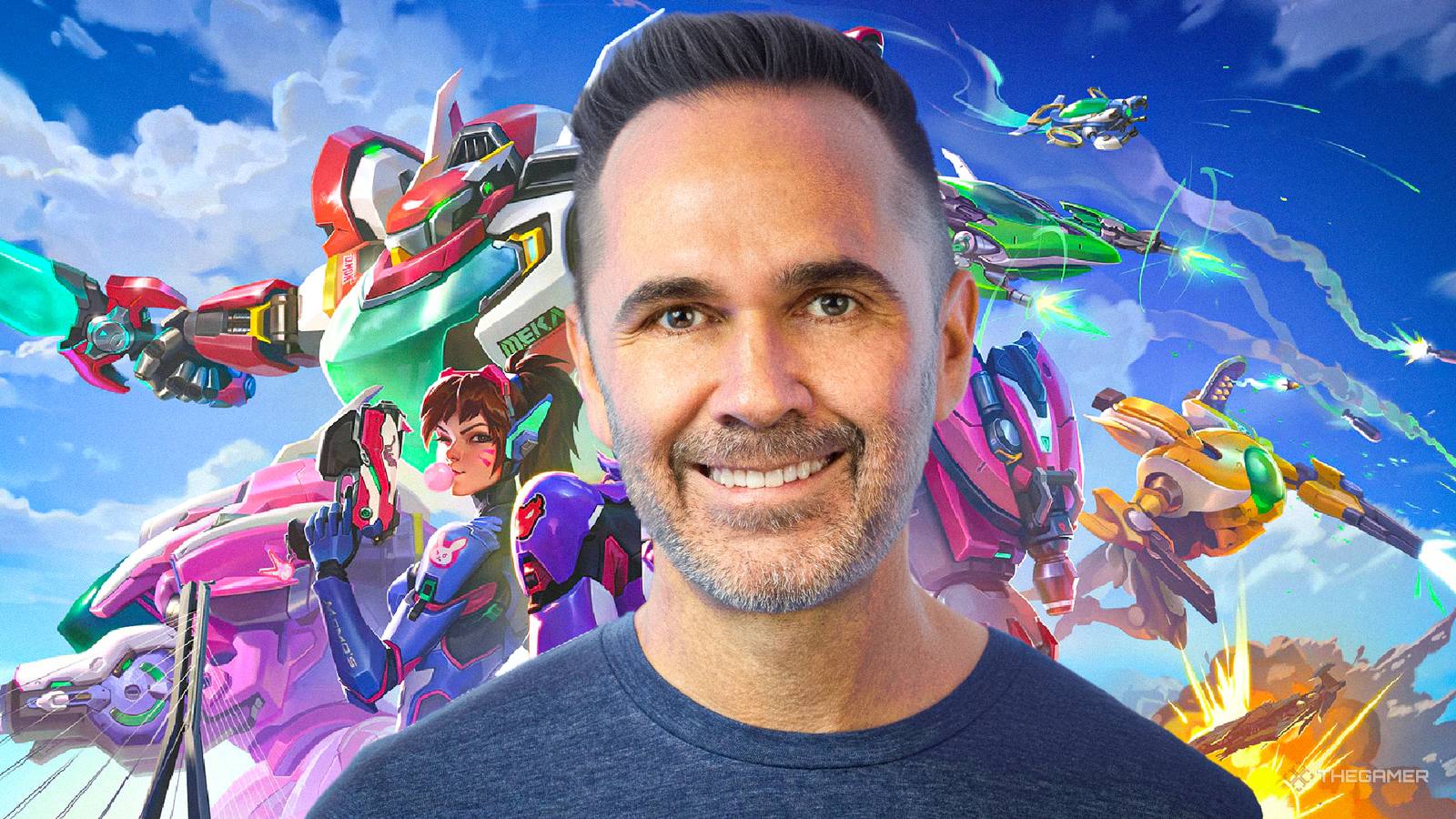
Published Aug 20, 2026, 10:00 AM EDT Overwatch director Aaron Keller talks BlizzCon rumors, the game's comeback, and why we're supposed to expect surprises. I Asked Overwatch’s Director About The Wildest BlizzCon Rumors, Here’s What He Said For a game that has been around for a decade, Overwatch is having a surprisingly busy midlife crisis, or, depending on who you ask, a comeback tour. After some very public stumbles, Blizzard has spent 2026 trying to make the game feel ambitious again, with a new annual story, a hero every season, new modes, and a focus on the players who never left. Season 4 keeps that momentum going with D.Mon, an overhauled Battle Pass, competitive changes, and experimentation that suggests Blizzard isn't done tinkering. I recently sat down with Overwatch's game director, Aaron Keller, to talk about where the game goes from here. We discussed the sometimes messy business of listening to players without simply handing them the steering wheel, why the Battle Pass needed to become more flexible, what Blizzard still thinks Overwatch needs to improve, and what Keller is willing to tease about BlizzCon. The conversation was, fittingly, not about declaring victory, but figuring out what comes next. Listening Without Letting The Crowd Drive Keller describes the development process as a three-way conversation. “One is player feedback. Another is player data, and it's two different things,” he told me. “And then a third is kind of like our own experience, not just as players, but as game developers and designers.” Sometimes those things point in the same direction. Other times, it sounds like three roommates trying to agree on where to order dinner. Sombra is one example. Players frequently complain about playing against her, and she is often banned, yet her overall win rate doesn't necessarily reflect the frustration surrounding her. “It’s up for the developer to take a look at that and make an interpretation,” Keller said. In other words, the loudest complaint isn't automatically the correct diagnosis. That distinction has become increasingly important as Blizzard experiments with different ways of changing Overwatch. The team has run experimental formats for years, using them to test everything from faster matches to larger systemic changes. “When we do these experiments, a lot of times it's because we are considering making changes to the game and we want to be able to either validate those changes or give us an idea of a direction to go,” Keller said. Surveys help capture how players feel about an experiment, while data can reveal things sentiment alone cannot: how many people participate, how long they play, and whether a change meaningfully alters the way people engage with the game. It is a useful reminder that “the players are mad” and “the players are playing less” are two different pieces of information, even if the internet tends to file both under SCREAMING. The experiments are not necessarily meant to produce a clean yes-or-no answer. Sometimes they simply point toward the next experiment. Making The Battle Pass Feel Less Like Homework Season 4's Battle Pass is one example of Blizzard responding to what Keller calls a broader player need: agency. The old version essentially asked you to walk down a predetermined hallway and hope the thing you really wanted was waiting at the end. The new one lets you pick a door. The previous Battle Pass worked, Keller said, but was relatively simple. Some completed it every season, while others only made it halfway through and could consequently miss cosmetics they were particularly excited about. The revamped version lets you choose which parts you want to pursue first. “We want to be able to make it so that the Battle Pass is more exciting for a broader set of our players,” he said. Then there is the ‘tier hack’, which allows you to swap out certain Battle Pass rewards for alternatives. When Keller mentioned it during our interview, I had already encountered it myself, and immediately clicked the wrong thing because I am exactly the kind of gamer the feature is meant to save from myself. More seriously, it is an unusually direct acknowledgment that players don't necessarily want to be told which rewards they should care about. That idea extends beyond cosmetics. Keller says the team is increasingly interested in the ways Overwatch recognizes players both inside and outside individual matches. “One of them is just like a player's motivation for playing the game and how they feel that the game recognizes them,” he said. The On-Fire system, for example, is meant to make you feel acknowledged for performing well, but Keller believes there is room for it to do more. Beyond the match, the team is also thinking about long-term progression and goals for those who don't spend their time in competitive modes. “We don't really have a lot of that for the rest of the game if you're a Quickplay player or something like that,” he said. That focus reflects a larger philosophy: serve the core player. “Some of them for a decade,” Keller said of the game's longtime players. The team wants those gamers to feel that Overwatch continues to improve specifically for them, whether through competitive updates or features that reward deeper investment in the game. The Point Of A Season Is To Make a Splash Keller has a simple word for what he wants each season to accomplish: exciting. I asked why that word, specifically, when he could have chosen ‘fun’, ‘competitive’, or any number of more familiar live-service buzzwords. “At the end of the day, when we announce a season, we do want people to sit up and take notice of what we're doing,” he answered. Season 4 attempts that through a combination of things that already have an audience, the Mecha Squad, D.Mon, the continuing story, and newer systems and events. “We're trying to create this package for our players where they can look at it and just get really excited for it,” Keller said. The intention is to make each season feel like a coherent package rather than a single new hero surrounded by filler. That approach is also part of a larger effort to make the game feel bigger. This year, Overwatch is releasing a hero every season and running more events, while continuing to add systems and quality-of-life improvements. The strategy appears to be working. On Steam alone, Overwatch hit a concurrent player record high this year, overtaking Marvel Rivals. Keller says he has personally seen people who weren't playing Overwatch last year, including his children's friends, return to the game. For him, that resurgence represents a kind of redemption after the game's difficult period surrounding the cancellation of its original PvE ambitions. “When we did the big release in Season 1 of this year, it was kind of like when the floodgates opened,” Keller said. “It felt like Overwatch was back.” What’s In Store For Blizzcon? BlizzCon BlizzCon, then, arrives at an interesting time. I asked Keller about the sprawling array of internet predictions I'd found while doing my homework: an animated series, a new mode, an Overwatch 3, even Fortnite-style pets. His reaction was noncommittal. “Oh, wow. I mean, there are a lot of predictions out there,” he said. “I think some of them are probably going to get a little bit closer, and some of them, I think, are pretty far-fetched as well.” He wasn't about to say which was which, but he did promise there will be “a lot of Overwatch” at the show. And when I pushed him for something more concrete, he offered just a little more than the usual executive fog machine: “Some of the things that are coming, I think, are going to be total surprises to players.” Some of it, he says, will be playable. “There'll definitely be feedback from players on the show floor about the way that a few of our heroes will be playing,” Keller said. Keller also confirmed that Blizzard will make announcements about the game's future, though he stopped well short of saying which of the internet's wilder theories are anywhere close. For Keller, that future is the culmination of a longer process rather than a sudden reinvention. The team has spent years rebuilding confidence with its core audience, and BlizzCon will offer a chance to show what that work has been leading toward. After talking with him, the most interesting thing about the next phase of Overwatch is the fact that Blizzard seems increasingly interested in proving that the game can keep surprising the people who have been playing it all along. “We love this game as much as they do,” Keller said. “We want to see it improve.” Overwatch (Formerly Overwatch 2) Released August 10, 2023 ESRB Teen / Violence, Blood, Mild Language, Use of Tobacco, Users Interact, In-Game Purchases (Includes Random Items) Developer(s) Blizzard Publisher(s) Blizzard Engine Proprietary Engine Multiplayer Online Multiplayer, Online Co-Op Cross-Platform Play Full Cross Save yes Prequel(s) Overwatch Franchise Overwatch Number of Players Single-player Steam Deck Compatibility Playable Early Access Release October 4, 2022 PC Release Date August 10, 2023 Xbox Series X|S Release Date August 10, 2023 PS5 Release Date August 10, 2023 Nintendo Switch Release Date August 10, 2023 Nintendo Switch 2 Release Date April 14, 2026 Genre(s) Shooter, FPS, MOBA, Multiplayer Platform(s) PlayStation 5, PlayStation 4, Xbox Series X, Xbox Series S, Xbox One, Nintendo Switch 2, Nintendo Switch, PC OpenCritic Rating Strong How Long To Beat 35 hours X|S Optimized Yes File Size Xbox Series 85.1 GB Platforms That Support Crossplay PC, PS4, PS5, Switch, Xbox One & Xbox Series X|S
Overwatch’s Comeback Is Just Getting Started, Says Game Director
Full Article
Original Source
Read the full article at Thegamer →KhanList aggregates and links to publicly available news content. We do not host full articles from third-party sources. Always verify important information with original sources.