
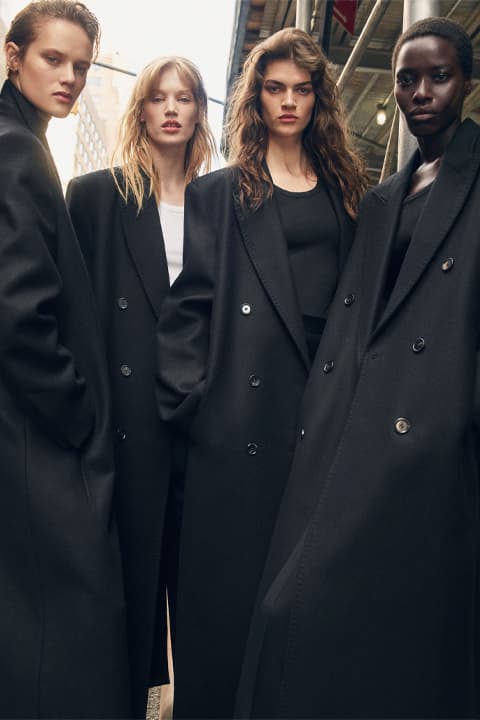
Recently, I met some friends for Sunday lunch. All of us were wearing oversized shirts. In truth, I almost hadn’t changed out of my dog-walking clothes for the occasion. So I was mollified to see that all four of us had dressed as though we were about to paint a bathroom, in an assortment of clothes that a Surrey banker might label as “man-repelling”, despite never having heard of Leandra Medine.The following weekend, I went to a couple of fashion shows. I looked along the front row. All of us were wearing oversized shirts. That is, those of us who weren’t were wearing oversized coats, boxy T-shirts, baggy knits or tops so shapeless that no adjective exists to describe them. While no fashion editor is going to rock up to a show in Look 15 from Dilara Findikoglu, the wilful slouch of it all was something to behold. Breasts? Waists? We didn’t know them.Lockdown ended years ago, but its baggy nonchalance remains. Body-conscious dresses, cantilevered cleavages, high heels, thigh splits and naked shoulders seem to belong to a bygone era whose figureheads were Elizabeth Taylor and Sofia Loren. Now, clothes swallow the body instead of tracing it, and if you turned up at the office dressed like Loren you’d stick out like a very sore (albeit very sexy) thumb.The Row/Cos/Phoebe Philo Somewhere along the way, “sexy” has become a dirty word — and not in the smutty sense. Instead, it’s become the worst of all things: passé. To dress in a traditionally sexy manner is to try too hard, as if your low-cut top is spritzed with Eau de Desperation.The Phoebe Philo effectHow did we get here? Let’s start with Phoebe Philo, whose XXL aesthetic — giant blazers, slouchy trousers — relishes concealment and has been hugely influential since its 2023 launch. Labels like Philo, Toteme and The Row (and more affordable brands like Aligne, Jigsaw and Cos) do a stellar job in wardrobing women who want to look smart and office-appropriate, but in a way that also signals their fashion credentials. So persuasive have these labels been that a trouser-suit is now the default office uniform for women, in the way that it’s always been for men.Whatever happens on the catwalk, I don’t think women will ever go back to the “sexy secretary” look. We now prize comfort and ease, two qualities that were previously only allowed to be enjoyed by men.In some ways, this is the less interesting theory as to why “sexy” is passé. What’s perhaps more seismic is how this message has trickled down to Gen Z. Your teens and early twenties are traditionally when you reach the giddy heights of sexy dressing: you’re young, confident and blissfully unaware of cause and effect. It’s why, as an 18-year-old, I was often asked, “How much?” when I waited for my friends on a street corner en route to the club.But today’s teens are all-too fully versed in the dire consequences of baring too much flesh, thanks to constant messaging that being a woman who “flaunts” her body is less of a vibe and more of a danger. Even the word “flaunt” is negative, as though a pencil skirt or bodycon knit comes with an inherent invitation. It doesn’t, of course — except it’s all too often interpreted that way, sadly.They might not yet work in an office, but my own teenage daughters have already adopted a baggy uniform of their own. Jeans and sweatshirts worn several sizes too big are the best way of avoiding hassle on the street. Given that said hassle started when they were 12, you can see why dressing to look desirable feels more risky than risqué. No wonder Gen Z cycles through character-led microtrends like Tomato Girl and Coastal Grandma. Looking interesting feels safer than looking hot.The backlash against sexyThat is also partly why lingerie has changed on the catwalk. The most progressive designers play with the tension between underwear and outerwear, pairing a bandeau bra with a tailored jacket, or a stocking with a sensible shoe, as at Prada. Any potential sexiness becomes diluted and deliberately jarring.Read MoreTo dress in a traditionally sexy manner is to try too hard, as if your low-cut top is spritzed with Eau de DesperationIt’s yet to be confirmed whether Anthony Vaccarello, creative director of Yves Saint Laurent since 2016, is leaving, as the rumour mill would have us believe. If true, it’s another death knell for sexy. Regardless of what was in fashion, Vaccarello could always be relied upon to serve up a slutty little number or three, be it a leather pencil skirt, satin cami shorts or a lace bodysuit slashed to the navel. That his rumoured successor is Chemana Kamali tells you all you need to know about the backlash against sexy.Kamali, currently at Chloé, is an excellent designer. But her tastes veer towards the whimsical: billowing shapes in saccharine pastel hues. There’s no “let’s take coke and f*** in a toilet” energy at a Chloé show.Vaccarello typically dresses subversively sexy pop stars such as Charli xcx, Madonna, Miley Cyrus and Lily Allen, who reached for the label often during her West End Girl tour when she wanted to look seductive and strong. But this only emphasises the growing disconnect between “showgirl style” and regular style.There was a time when we all walked around dressed like Madonna, channelling her at the little Tesco as well as in the club. Now, it’s mainly influencers who tend to mine this seam: women who are paid to look sexy and have a car booked to drive their bodies home in safety.The rest of us are happily sticking to our barrel-legs and blazers. They might not be sexy, but they’re comfy and safe.Laura Craik is a freelance journalist
Oversized everything: when did sexy become so uncool?
Full Article
Original Source
Read the full article at Standard →KhanList aggregates and links to publicly available news content. We do not host full articles from third-party sources. Always verify important information with original sources.