
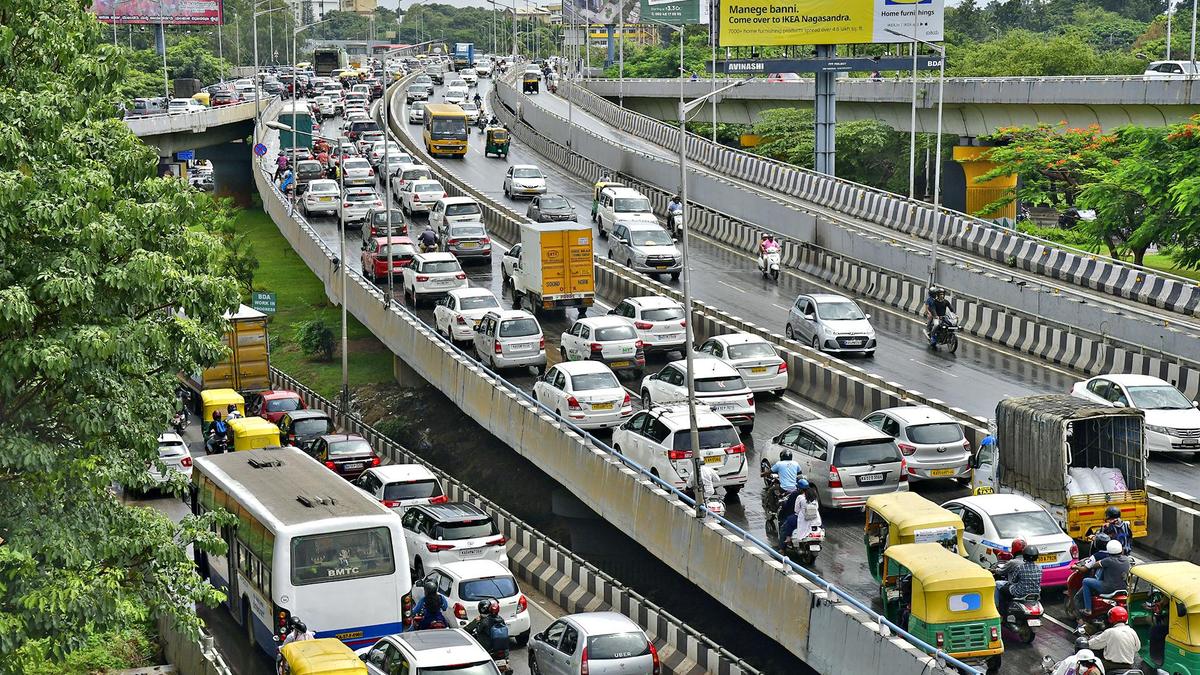
The KIA Road flyover saw five and 10 fatal accidents in 2025 and 2026. | Photo Credit: File photo Over 41 people lost their lives on the Electronics City and Kempegowda International Airport (KIA) Road flyovers in the past 19 months, which became a triggering point for the Bengaluru Traffic Police (BTP) to impose the recently announced restrictions, according to official documents accessed by The Hindu.Now, According to the BTP notification, two-wheelers will be banned on the Electronics City flyover from September 11. Similarly, two-wheelers are restricted on the KIA Road flyover (from Sanjeevininagar Cross to Vidyashilpa Junction) from September 4.A review of the data revealed that the Electronics City flyover witnessed 14 fatal accidents in 2025 and 12 in 2026 (till July-end). On the other hand, the KIA Road flyover saw five and 10 fatal accidents in 2025 and 2026, respectively. An average of 70-85% of accidents on these elevated corridors involved two-wheelers.A senior police officer explained to The Hindu that both elevated corridors have consistently witnessed a high number of accidents for over five years, and there has now been a sharp spike.Alarming trendWhen looked at police station-wise, the Electronics City flyover mainly falls under three stations — E-City, Madiwala, and HSR Layout — whose combined total of fatal accidents in 2025 was 67. So, 21% of the combined total accidents happened on the elevated corridor.Similarly, the approximately 8-km KIA Road flyover is covered by the Hebbal and Yelahanka police stations, which saw a combined 78 fatal accidents in 2025. Of the total fatal accidents, about 6% unfolded on the elevated corridor. When 2026 data is considered, the percentage rises to 12%.It has to be noted that Yelahanka is the station that witnesses the highest number of accidents, while Electronics City station witnesses the fourth-highest number of accidents every year in the city. A senior police officer explained that these two stations are on the fringes of the city, which are naturally accident-prone due to roads and other factors. “When you compare these accident statistics with places within the city, the numbers are alarming,” the officer emphasised.Police stations record lessIn simpler terms, more than 35 police stations in the city recorded fewer fatal accidents than the incidents that occurred on the Electronics City flyover. When it comes to the KIA Road flyover, more than 10 stations recorded fewer fatal accidents than the said elevated corridor.Karthik Reddy, Joint Commissioner of Police (Traffic), told The Hindu that the alarming number of accidents on these corridors, especially those involving two-wheelers, prompted them to conduct a survey and subsequently decide to impose a ban on two-wheelers.Commuters dividedA doctor at a nearby private hospital in southeast Bengaluru explained that victims of accidents on the Electronics City corridor, especially two-wheeler riders, are very frequent. “Many non-fatal accidents go unreported because people often don’t file complaints, but we get multiple cases every month,” he stressed.According to the data, the Electronics City flyover saw 32 non-fatal cases in 2025 and 28 in the seven months of 2026.On the other hand, Suchith, a daily commuter to E-City from Koramangala by two-wheeler, lashed out at the move, stressing that even the Yellow Line Metro is difficult to access, so he used to commute on his bike.“They have banned three-wheelers already, including goods autos, so bikes could have been accommodated on the stretch,” he said. Published - August 31, 2026 07:38 pm IST
Over 41 deaths in 19 months: Reason behind banning two-wheelers on E-City and KIA Road elevated corridors
Full Article
Original Source
Read the full article at Thehindu →KhanList aggregates and links to publicly available news content. We do not host full articles from third-party sources. Always verify important information with original sources.