
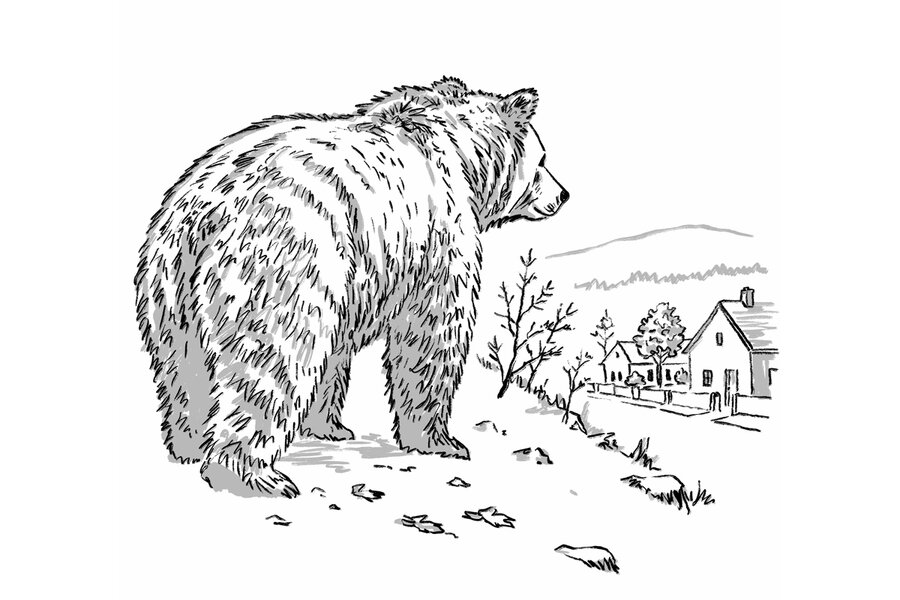
Russia facing a growing threat from bears A combination of rising bear numbers and shrinking natural food sources in the forests has led to an unprecedented wave of dangerous encounters in Russia this past summer between bears and people, including several human fatalities. Russia’s bear population has more than doubled to over 300,000 in about three decades, leading authorities to urgently seek new authority to curtail the bear surge, according to the independent news outlet Meduza. – Fred WeirChina supercharges its goal for electric and hybrid cars China has unveiled a bold target for electric and hybrid vehicles – aiming for the vehicles to make up 70% of new passenger vehicle sales by 2030. Such sales are already at 59% for the first eight months of this year. But commercial vehicles are lagging behind, in part because of the lack of charging and refueling networks on long-haul truck routes. The government’s five-year blueprint calls for 40% of new commercial vehicles to be electric or hybrid by 2030, up from 34% now. It also sets stricter targets for fuel efficiency and promotes automated driving, according to the Caixin Global financial news outlet. – Ann Scott Tyson “We want the police to know that workers are not alone.” That’s what a member of a neighborhood patrol in Buenos Aires told the newspaper El País, describing the rationale for monitoring police operations against street vendors and immigrants. Under Argentina’s President Javier Milei, immigration enforcement has become more visible on the streets. In the capital, a group of neighbors has formed to document arrests of migrants and to protect them from alleged abuse by police. The group was inspired by reports of neighborhood organizing in the United States amid Immigration and Customs Enforcement operations. – Whitney Eulich“The illusion of illusions” That’s the title of a research paper by Oxford mathematician Alain Goriely challenging the long-standing theory of optical corrections. The myth goes back 2,000 years and holds that the Parthenon, which sits on the Acropolis overlooking Athens, was intentionally constructed with curves to correct various visual illusions and thus appear straight to the human eye. But the theory “does not withstand close examination,” Professor Goriely writes in the Royal Society Open Science journal after conducting mathematical modeling. “The proposed illusions are either unsupported by evidence or too small to have a perceptible effect under typical viewing conditions.” – Matthew Bell Deepen your worldviewwith Monitor Highlights.Politics with respectGet political stories with respectful analysis.There‘s a world of new ideas in everyBooks newsletter.There‘s more to life, enrich yours withCulture & Learning weekly.Follow humanity‘s discoveries withScience & Nature stories in your inbox.Gain a spiritual perspectivefrom the stories in your inbox.Want to understand the deeper impact of critical events? Learn the Monitor‘s insight.Already a subscriber? Log in to hide ads. ALREADY A SUBSCRIBER? LoginReal news can be honest, hopeful, credible, constructive.The Christian Science Monitor was founded in 1908 to lift the standard of journalism and uplift humanity. We aim to “speak the truth in love.” Our goal is not to tell you what to think, but to give you the essential knowledge and understanding to come to your own intelligent conclusions. Join us in this mission by subscribing.
Our World: The week of Oct. 5, 2026
Full Article
Original Source
Read the full article at Csmonitor →KhanList aggregates and links to publicly available news content. We do not host full articles from third-party sources. Always verify important information with original sources.