
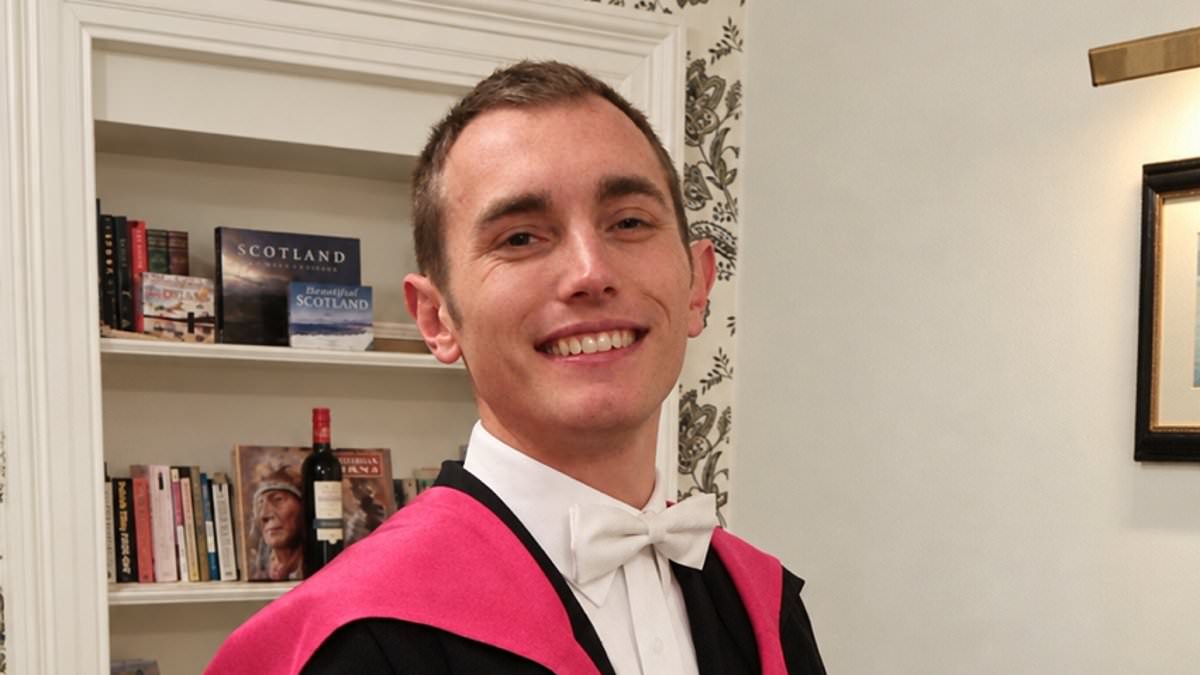
Strange as it may sound, whenever Hugo Flint-Cahan was sectioned, his family felt a sense of relief.It happened several times during the long years in which they watched his mental health deteriorate.Each admission was distressing but it also meant that, for a while at least, they could stop worrying about where he was and what might happen to him.'When we would tell people they would always say, 'Gosh, how awful!' And our response every time was just utter relief that he was safe,' his stepmother Sue says now.Hugo's large and loving family – he was one of five siblings – continued to believe that right up until the moment, in the small hours of January 3, 2023, that they discovered the 34-year-old had been murdered by a fellow patient on the specialist NHS psychiatric ward to which he'd been admitted six months earlier.That a vulnerable man could be strangled inside a secure psychiatric unit is shocking enough.More shocking still is that it happened amid multiple failures by nursing staff at the Newham Centre for Mental Health in east London.A nursing assistant fell asleep while on duty and later falsified observation records to suggest he had been checking on patients every hour.When the attack took place, two nurses were in the staff room with the door shut. Hugo's body was not discovered for almost two hours. Hugo Flint-Cahan, 34, was being treated at Newham Mental Health Centre (NMHC), run by the East London NHS Trust (ELFT), when he was fatally attacked during the early hours of January 3, 2023 Nurses Rosemary Chukwuji-Ohanachum and Raji Olagunju were in a closed-door staff room and healthcare assistant Anthony Onuh was asleep in a therapy roomIt took more than three years for his death to be examined at an inquest, where last month Senior Coroner for East London, Graeme Irvine, ruled that Hugo had been unlawfully killed by Rolando Torres-Peña and that his death was contributed to by neglect.On October 2nd, he sent his Prevention of Future Deaths report to East London NHS Foundation Trust (ELFT), flagging 14 concerns about both men's care and warning further deaths may occur unless staff issues are addressed.Mr Irvine highlighted repeated failures by the Trust, which runs the Newham centre, in a number of patient deaths, describing it as 'Groundhog Day' as he heard evidence of the same errors 'over and over again'.He also condemned what he called a 'culture of dishonesty and impunity' and a 'conspiracy to deceive'.They are excoriating words and it is little wonder that today, a few weeks on, Hugo's family's anger and bewilderment remain palpable.'There's unsafe in the sense of, could an unstable patient hit another patient?' says Hugo's younger brother Jolyon, 33.'But the idea that you're so unsafe that one patient could kill another while staff around them are in dereliction of their duties and breaking their regulatory codes is utterly ghastly.'And this is not just about Hugo. In fact, we know from other cases this isn't isolated. It makes you feel no-one is safe.'It is a devastating statement for a family with close ties to the health service: Jolyon is an anesthetist, while Sue is an NHS radiographer.'I could never have conceived of something like this before it happened,' says Jolyon.Of course, long before Hugo became a psychiatric patient, he was simply a much-loved son and brother.Raised in Hertford, Hugo was the eldest of three sons - there's also Rupert, 36, - born to William, 72, a teacher, and his first wife Gillian.He also had two younger half-siblings, Harry, 26, and Fiona, 23, from William's second marriage to Sue.'Hugo was nearly 12 when Harry was born, but he was very patient, very gentle with him,' Sue recalls. 'All the family were – are – close.'A cheerful little boy who loved cricket and football, Hugo was unusually conscientious say William and Sue.'He used to write very long thank-you letters for birthdays and Christmas. He took that sort of thing quite seriously,' says Sue.He also had a keen sense of justice. Rupert, (dark hair), Hugo (blonde) with parents William and Gillian Raised in Hertford, Hugo was the eldest of three sons - there's also Rupert, 36, - born to William, 72, a teacher, and his first wife Gillian. Hugo Skiing aged 12'He was very caring about a number of societal issues, environmental issues,' says William. 'I always hoped he would make something of himself in those sort of areas.'It was not until Hugo's first year of sixth form that his family discovered he had been badly bullied at Haileybury, the public school where William taught French and English literature until his retirement earlier this year.What began with his schoolbag being thrown in the bin and books defaced had escalated into physical incidents.The bullies were suspended for a fortnight, but after they returned it quickly became clear Hugo could not stay. He moved to a local state school.'He felt it wasn't terribly fair,' says Jolyon. 'He was forced to leave effectively, and for a person keen on things being ordered and by the rules it was particularly hard.'Nonetheless, Hugo appeared to flourish until April 2007 when, in his A-level year, he suffered a psychotic episode. He was sectioned and admitted to the Priory for six weeks.'He hadn't been himself, and while it was very upsetting it was seen as an episode from which, with treatment, he could totally recover,' says William.The following month his mother, to whom he was very close, was diagnosed with pancreatic cancer. She died the following year.Despite this devastating emotional load, Hugo insisted on sitting his A-levels.Having gained a place at St Andrews University to study Italian, at first all seemed well.'He made lasting friends who attended the inquest,' says William.Towards the end, however, Hugo's condition deteriorated. He became convinced people had stolen his books and his family believe he had stopped taking his medication. He had also begun using recreational drugs.After graduating in 2013, Hugo drifted, working in bars and often staying with friends.Increasingly troubling episodes ranging from going awol for weeks and posting odd messages on Facebook to telling people he'd got a gun and then not allowing a flatmate to leave their accommodation because he wanted to keep him safe, eventually brought him back under the care of mental health services and in November 2018 Hugo was sectioned for a second time.During that admission he was diagnosed with schizoaffective disorder, the start of an exhausting and distressing cycle of ever shorter periods of relative wellness punctuated by acute episodes, arrests, police stations and visits to A&E.On one occasion he presented at A&E with stomach pains and said he must have been stabbed - but there was clearly no wound or blood.For the family, those years were characterised by a permanent thrum of anxiety.'Even today, every time I hear my father's ringtone I think, 'Oh God, it's Hugo. Something's happened,' says Jolyon.William's eyes fill with tears as he recalls the rollercoaster of trying to help a son who could be by turns loving, distressed and angry.At times Hugo became paranoid that his family were insisting he was ill when he was perfectly well. He sometimes asked consultants not to share information with them.Then, on July 5, 2022, after another period of erratic behaviour which culminated in him arriving at A&E in an agitated state and claiming he'd taken an overdose of his prescribed medication, Hugo was sectioned for the eighth and final time.He was admitted to Topaz Ward, a 17-bed adult male ward at the Newham Centre for Mental Health.Well-liked on the ward, Hugo enjoyed taking part in art sessions and was known to visit other patients in their rooms.'We think that because he spoke fluent Spanish he was probably trying to make friends with Ronaldo,' says William.He adds: 'We've seen in forums online since that people have posted, 'I was actually in one of the wards with Hugo. He was such a lovely character. That has been very comforting.'He last saw his son on December 22, when he took him a Christmas stocking.'He was very pleased with it, very affectionate. And better than he had been for a while,' he recalls.'He seemed to have an idea that his life was passing him by, and I thought, 'Oh, that's new. Maybe you can still turn your life around.' But twelve days later he was dead.' Hugo in school uniform aged 15 or 16 In fact, the family subsequently learned staff had been considering discharging Hugo on January 6 and hoped to arrange a meeting.They will never know what might have happened. On December 29, Rolando Torres-Peña, a 22-year-old maths student at Queen Mary University, was admitted to the ward.Diagnosed as a teenager with bipolar affective disorder with psychotic symptoms, he had previously presented at hospital asking to be admitted but was simply sent home to his parents with more medication. Only belatedly had he been admitted.'We feel very strongly that two families have been failed,' says Sue.What happened next was laid bare at Hugo's inquest.During the period that Hugo was killed the unit's two supervisory nurses, Rosemary Chukwuji-Ohanachum and Raji Olagunju, were in the staff room with the door shut, while nursing assistant Anthony Onuh was asleep for two hours in the therapy room. He should have been making hourly rounds.He admitted to the coroner that an observation log in which he recorded Hugo as awake in bed at 2am had been filled in without him making the required checks. In fact by then, Hugo was dead in Torres-Pena's room.At around 1am, CCTV cameras showed staff oblivious as Hugo and Torres-Peña interacted in the corridor and visited each other's rooms.The last CCTV image of Hugo alive was at 1.22am, when he was seen walking down the corridor carrying a cup of hot chocolate.While the exact timing of his death is not known, at 1.31am, a patient in the neighbouring room can be seen on CCTV emerging and appearing to watch something out of shot. CCTV footage then shows Torres-Peña walking down the corridor without trousers, his lower half covered by a white towel.Hugo's body was not discovered until 3.19am, almost two hours after the attack. Resuscitation did not begin until 3.45am, and he was pronounced dead by paramedics at 4.41am.An hour and a half later, police arrived at William and Sue's door.'They said that Hugo had died, and they said that somebody had been arrested for his murder. Those two sentences, one next to the other,' Sue recalls. 'And our response was 'But we thought he was in the unit'. And they said 'Yes, he was'. It was so deeply shocking.'Torres-Peña subsequently pleaded guilty to manslaughter by reason of diminished responsibility at the Old Bailey in October 2023 and was given an indefinite hospital order.There was therefore never any uncertainty for the family about who had killed Hugo. Understanding how it has been allowed to happen has proved much harder.'We had conversations with the Trust where they were, to put it bluntly, bland and disinterested,' says Jolyon.They are words they believe underpin the Trust's overall response, including its subsequent 'Serious Incident Review', which the family say contained incorrect dates and times and references to CCTV footage that did not exist.When it was sent to them, it also included 40 pages of another patient's medical notes.For the family, the recent inquest finally provided some of the scrutiny they felt had been lacking.Yet their fear is that Hugo's case does not mean lessons were learned. They point to the fact that Chukwuji-Ohanachum remained employed by the Trust and was on duty when another patient died three years and three months after Hugo.They were also struck that while Trust board members attended the inquest when its director of nursing was giving evidence - apparently to show their support - none returned to hear the coroner deliver his conclusions.'They were not interested to hear first-hand what the coroner had to say about what happened that night,' says Sue. 'They had no interest, and no sense of responsibility.'Hugo's cousin James Cahan, a medical negligence lawyer at Thomson Snell & Passmore who was instructed by the family within days of his death, believes this is what makes the case particularly troubling, pointing out that over the past 12 years, local coroners have sent at least 29 Prevention of Future Deaths (PFD) notices to the Trust.These are sent to an organisation when a coroner identifies problems which, if not dealt with, could lead to further deaths.'Something needs to change because the same issues seem to be arising again and again,' Mr Cahan says.'We have seen falsification of records, poor observations and inadequate risk assessments – issues which have been highlighted to the Trust by coroners before. That is why the coroner himself used the phrase 'Groundhog Day'.'A fully independent Serious Incident Review commissioned by NHS England is meanwhile due to be shared with the family and the Trust. The family fear that unless its lessons are disseminated more widely, another opportunity will be lost.For them, navigating the investigations and inquest alongside their grief has been 'gruelling'.'We have all struggled in our own ways,' says Sue.William adds: 'There's a hole that will never be filled.'And inevitably there are the what-ifs – not least the possibility that, in those final weeks, Hugo really had reached some sort of turning point.'It's horrible,' William says. 'Of course you wonder. What you can't do is bring him back. But what you can do is do your best to try to stop what happened happening to anyone else.'For Sue, what happened to Hugo ultimately returns to the belief the family used to cling to: that however distressing it was to see someone you loved sectioned, at least they were protected.'We use pretty extraordinary legal powers to take people off the street, deny them their liberty and compel them to take strong, powerful drugs,' says Sue.'And the assumption there is that you do it to place them somewhere that is safer than the outside world.'The fact that wasn't the case for Hugo is still something they find almost impossible to comprehend.David Bridle, Chief Medical Officer of the ELFT, told the Daily Mail: 'I express my deepest sympathies to Hugo's family, friends and loved ones. We are deeply sorry for the failings that occurred when he tragically died while in our care.'Hugo's care fell well below the standards we want to provide. The coroner raised serious concerns regarding behaviors and actions of the staff on duty that evening, and how they didn't keep to established procedures for safe care.'We agree this is wholly unacceptable and does not reflect the standards, values or behaviors we expect. One member of staff has been dismissed. Others involved are subject to further investigation.'Since Hugo's sad death in 2023, we have undertaken a significant programme of work to improve our inpatient culture, behaviors and practice. We will ensure the learning from the coroner's findings informs our continuing work to strengthen patient safety and care.'
Our son was murdered by another NHS patient while nurses sat in the staff room with the door closed. Now his devastated family say: 'It makes you feel no-one is safe'
Full Article
Original Source
Read the full article at Dailymail →KhanList aggregates and links to publicly available news content. We do not host full articles from third-party sources. Always verify important information with original sources.