
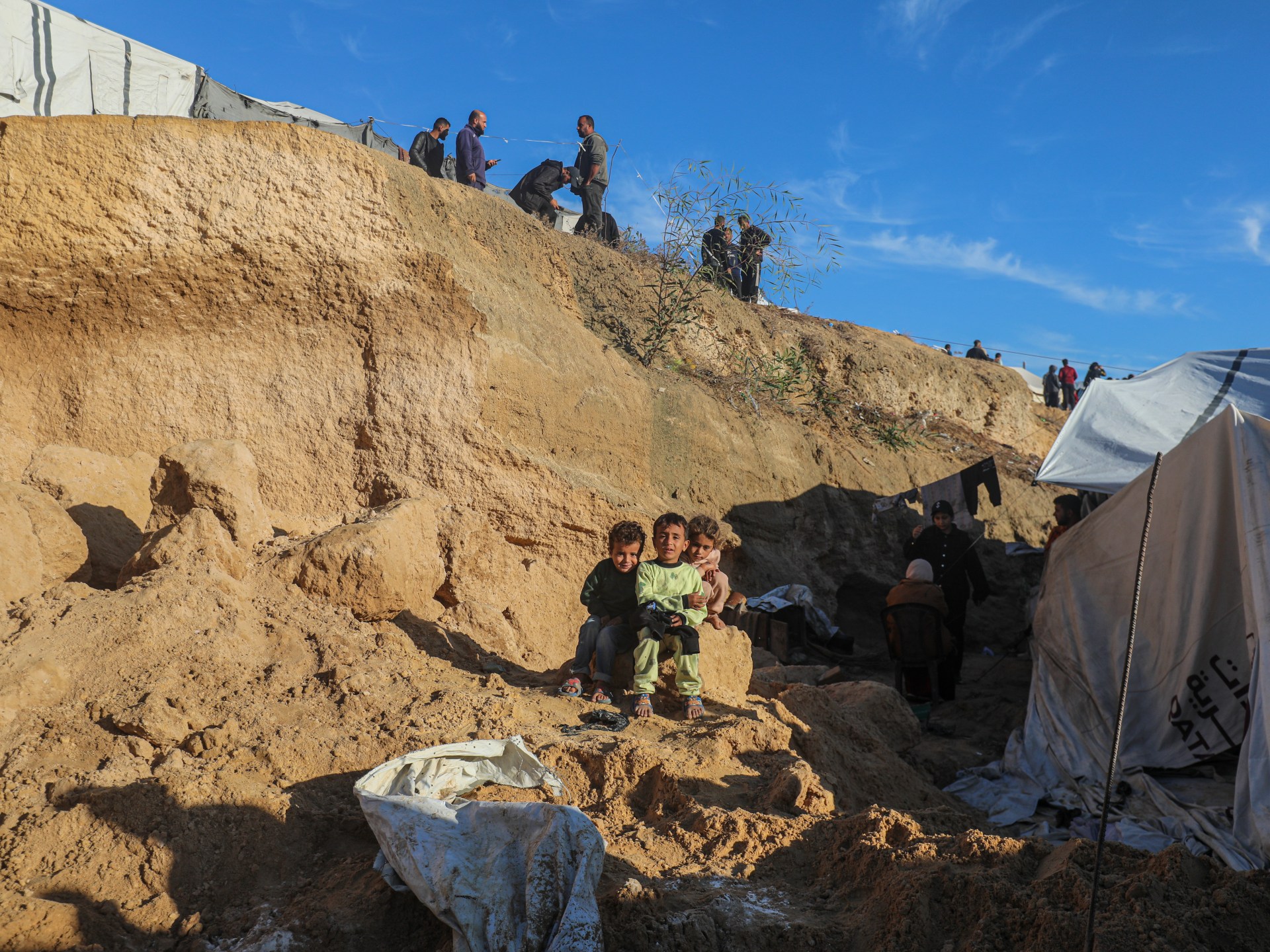
Deir el-Balah, Gaza Strip – Gaza is dealing with the cleanup of catastrophic flooding after storms submerged displacement camps and war-destroyed cities.Heavy rain has directly affected 106,000 people in Gaza, according to UNICEF, with thousands of tents for displaced Palestinians submerged under water and latrines overflowing into camps.Recommended Stories list of 3 itemslist 1 of 3Palestine Weekly: West Bank on fire – and Gaza’s tents under waterlist 2 of 3Father, child among eight Palestinians killed in Israeli attacks on Gazalist 3 of 3Gaza’s infrastructure collapse leaves residents defenceless against floodsend of listThe floods also brought death: a sandbank under pressure from heavy rain collapsed at the Ard al-Ribat displacement camp in Deir el-Balah, central Gaza, on Sunday evening, killing three children and a woman.Without excavation equipment, residents had to dig through the sand with their bare hands to reach people trapped under debris. When darkness came, they used flashlights on their mobile phones to search for survivors.Zahira al-Sahar, 58, was preparing to sleep in her tent in the camp on Sunday when she and her 28-year-old daughter were almost entombed in the collapse.“I was lying in my bedding when something suddenly pushed me and came down on top of me,” al-Sahar told Al Jazeera. “The sand reached up to my neck. My daughter was beside me, and she was almost completely buried.”Her sons came to the rescue. “I told them: ‘Pull your sister out first, then come back for me.’ They pulled her out, then came back and rescued me,” she said.Meanwhile, in a neighbouring tent, members of the al-Nabhan family were also buried in the sandbank’s collapse.“[When I realised] I started screaming and calling for people to come and help,” al-Sahar said. “I told everyone that our neighbours had been buried. We kept shouting: ‘Please, save them. Our neighbours are gone.’”But the family did not respond to the rescuers’ calls. Eight-year-old Salah, his six-year-old sister Maryam, and their mother, Tahrir, 36, who was five months pregnant, were among the dead. Their father, Ahmed, who was only recently released from Israeli detention, is the family’s sole survivor.Zahira al-Sahar, 58, and her daughter were rescued after being buried beneath sand when an embankment collapsed onto their tent [Abdelhakim Abu Riash/ Al Jazeera]“[Ahmed al-Nabhan] and his wife had been very happy after he came out of prison. They were looking forward to having another child in a few months,” said Suhaib Abu Darabi, 32, who was among neighbours who rushed to the site to help save them.Abu Darabi said the collapse sounded like an explosion and was followed by screaming. The site was exposed to the elements and on unstable ground and collapsed after just a few minutes of rain. By the time neighbours reached the area, they found two tents completely buried under debris.Abu Darabi said residents were digging with whatever tools they could find.“We managed to clear some of the rubble, but we could not save the people trapped underneath. The scale of the collapse was far beyond what the residents here could handle, given the lack of resources,” Abu Darabi told Al Jazeera.“The tents that collapsed beneath the embankment are what the world saw. But what people did not see was that all these tents fell to the ground that night. Residents had to repair whatever they could so they could continue living in them.”In the neighbouring al-Zein family’s tent, four-year-old Habiba was killed, while her mother, Reem, and brother Ibrahim remain in intensive care.Suhaib Abu Darabi, 32, joined residents attempting to rescue families buried beneath a collapsed embankment [Abdelhakim Abu Riash/ Al Jazeera]The scale of the damage caused by this winter’s first storm, which began on November 6, was significant and has exposed the dangers faced by families living in tents with little protection from extreme weather.This is the fourth winter since Israel’s genocidal war on Gaza began, in October 2023, and hundreds of thousands of people are living in tattered tents or makeshift shelters that have been exposed to the elements for years.More than 26,000 households had reported damage to their shelters or other belongings by November 8, the United Nations Office for the Coordination of Humanitarian Affairs (OCHA) reported. The UN estimated that about 1.4 million people, or 65 percent of Gaza’s population, were living in tents or makeshift shelters when the storms hit.The danger is only compounded by the extensive destruction of Gaza’s infrastructure from Israeli strikes. Drainage networks have been severely damaged, roads and access routes remain in poor condition, and municipalities lack sufficient equipment to remove accumulated rainwater and respond to emergencies.Gaza’s Government Media Office described the Deir el-Balah sandbank collapse as a humanitarian disaster.It said it held Israel, the United States administration and the international community responsible and the blocking of proper shelters, construction materials, mobile homes, fuel and spare parts was a factor in the deadly floods.The media office also said the failure of the so-called Board of Peace and the National Committee for the Administration of Gaza to act in the crisis also raised “serious questions about the purpose of these bodies”, which have been accused of working with Israel to continue its siege on Gaza.The Board of Peace said in a statement this week that it had urged Israel to allow essential supplies such as temporary shelters and drainage equipment to enter the enclave.Aid organisations have also repeatedly called for the entry of shelter materials and equipment needed to repair damaged tents and infrastructure to avoid a repeat of this past week’s deadly events.Shaima al-Daour, 22, a displaced woman from northern Gaza who works as a nurse in the Ard al-Ribat camp, was also among those who rushed to help the injured.“I tried to resuscitate a young child who was pulled out from under the rubble, but he had internal bleeding. I tried, but there was no response,” she said.Displaced Palestinians struggle to protect their tents from heavy rain and unstable ground during Gaza’s first major winter storm [Abdelhakim Abu Riash/ Al Jazeera]Al-Daour said another boy, aged 15, was brought to her with difficulty breathing. She opened his airway and he began to breathe, but his pulse was weak. With no ambulance readily available, she called on people around her to find any means of transport to get him to the hospital.“I was surrounded by men, shouting at them: ‘Does anyone have a tuk-tuk? A cart? Anything to carry him?’ What I saw was unbearable. I could not save the little child in front of me,” she said.“We need shelter and land where people can live safely. We also need equipment so that, God forbid, if something happens again, there is something available to help us.”Al-Daour said she is still in shock by what she witnessed and is terrified by the prospect of the impending winter.“I still cannot get over what happened,” she said. “Have the people of Gaza not experienced every possible way of dying? Have some compassion for us. Just have some compassion for us, people of the world,” she said.
‘Our neighbours are gone’: Gaza survivors recount horrors of deadly floods
Full Article
Original Source
Read the full article at Aljazeera →KhanList aggregates and links to publicly available news content. We do not host full articles from third-party sources. Always verify important information with original sources.