
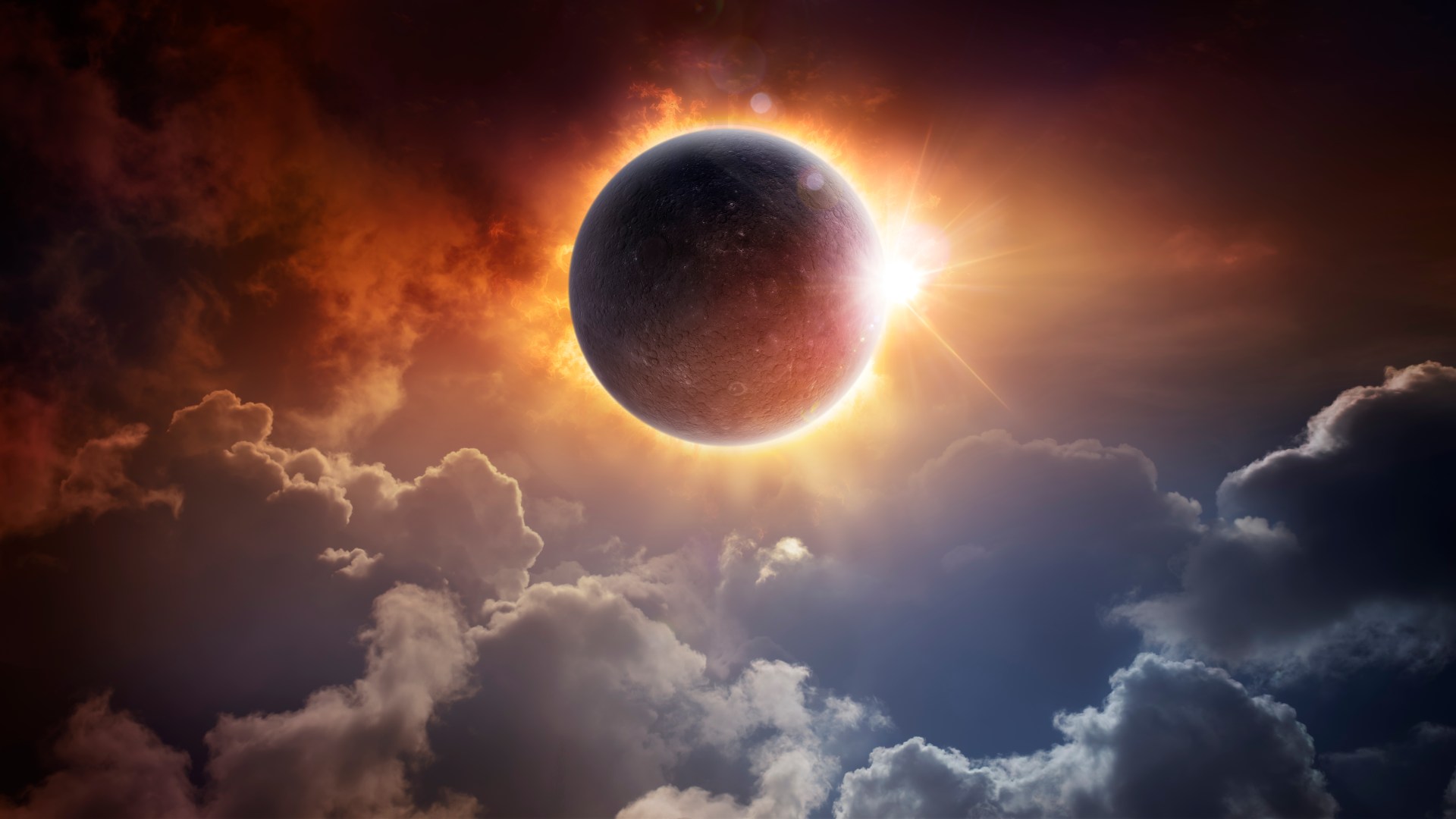
WHATEVER your plans are on Wednesday evening, prepare for them to be overshadowed. At around 7pm, the UK will be treated to its most spectacular solar eclipse since 1999 as the moon passes in front of the sun and blocks out most of its light. The UK is set for its most spectacular solar eclipse since 1999 Credit: Getty The moon will look like it’s taken a ‘bite’ out of the sun Credit: Getty Millions are expected to look skywards for the rare event, which will see more than 90 per cent of the sun disappear from view across much of Britain. Whether you are a night sky novice or an old hand, here astronomer Neill Saunders reveals how to make the most of the moon’s moment with his definitive eclipse guide . . . Sign up for the Tech newsletter Thank you! WHOLE OF THE MOON THE moon will appear to take an enormous “bite” out of the sun as it moves across its face, obscuring more than 90 per cent of it across much of Britain. A solar eclipse happens when the moon passes between the Earth and the sun. READ MORE ON SOLAR ECLIPSE In a remarkable cosmic coincidence, the sun is about 400 times larger than the moon but also roughly 400 times further away, making the two appear almost the same size in our sky. The UK sits just outside the “path of totality”, which means the sun will not fully disappear here — a thin, brilliant crescent will remain — and we will get what is known as a partial solar eclipse as daylight fades and the world around you takes on an eerie appearance. Elsewhere the lights really will go out. Parts of Greenland, Iceland and Spain lie inside the narrow path where the moon will completely cover the sun and briefly turn day into night. But the UK is still in for its deepest eclipse since 1999, when parts of Cornwall and Devon experienced a rare totality. Most read in Tech The next total solar eclipse visible from here is not until 2090. SET YOUR ALARM ‘First contact’ will be when the edge of the moon appears against the sun Credit: Alamy SET a reminder for around 6.15pm, when the first signs of the eclipse will begin appearing across Britain. There are three moments to watch for . . . “First contact” is when the edge of the moon appears against the sun. Over the following hour, it will creep further across until “maximum eclipse”, when the greatest amount of the sun is hidden. Then comes “last contact”, when the moon finally moves clear and the eclipse is over. Exactly when each happens depends on where you live. In Cornwall, the eclipse begins at around 6.18pm and peaks at 7.16pm. Maximum eclipse comes at around 7.13pm in London, Bristol and Cardiff, 7.11pm in the Midlands and 7.10pm in Manchester. For precise local timings, check the Royal Observatory Greenwich, which will also broadcast the eclipse live. LOW AND BEHOLD This eclipse is due to happen near sunset, which is a rare occurrence Credit: Getty WHAT makes this eclipse particularly unusual is that it is happening close to sunset. At its peak, the sun will be hanging just ten to 15 degrees above the western horizon across much of the UK. That means you could see the thin crescent of remaining sun hanging above rooftops, hills or the sea as the evening draws in. The downside is that with the sun so low, a building, tree or hill could block your view completely. So work out where west is and find a spot where nothing is standing between you and the setting sun. BLIND SPOT Proper protection is essential whenever you look towards the sun Credit: Bav Media LOOKING directly at the sun is dangerous and your trusty sunglasses will not cut it, no matter how dark the lenses are. They are designed to take the glare out of everyday daylight, not to protect your eyes while staring directly at the sun. You must use only use certified eclipse glasses. And don’t assume cloud offers protection. The sun can still damage your eyes through thin cloud, so proper protection is essential whenever you look towards it. The warnings are there for a reason. After the 1999 eclipse, around 70 people reported problems with their vision, with 40 per cent of those affected having looked at the eclipse for less than a minute. If you notice blurred vision, unusual patches or any other change to your sight afterwards, seek medical advice. RAID THE KITCHEN Tiny crescents from watching an eclipse through a colander Credit: Getty WITH people scrambling to get their hands on eclipse glasses, shops have been selling out across the country. If you have not managed to find a pair, raid the kitchen instead. Grab a colander, stand with your back to the sun and hold it up so the light shines through the holes on to a pale wall, pavement or piece of white paper. As the eclipse progresses, the normally round spots of light will turn into rows of tiny crescents, each one a miniature projection of the sun above. You can spot the same effect beneath a leafy tree, where the gaps between the leaves can scatter crescent-shaped suns across the ground. Kids can also make a simple pinhole projector by piercing a small hole in a piece of card and projecting the light through it on to another sheet of white card. A small make-up or shaving mirror can give you an even bigger view: cover a flat mirror with paper, leaving a hole around 5mm wide, then use it to reflect the sun on to a pale wall in the shade around five metres away. The further away the wall, the larger the image should appear. Just do not use a magnifying mirror or look directly into the reflection. Whichever method you use, look at the projected image rather than through the holes towards the sun. BEST SEAT IN THE HOUSE The line to buy eclipse glasses near the Royal Observatory in Greenwich Credit: X DO not wait until 7pm to discover there is a tower block or row of trees in the way. Head out early and look for somewhere open with a clear view west. Clifftops, beaches, hilltops, open countryside and elevated parks are all good bets. Not sure which way is west? Open the compass on your phone to point you in the right direction and check there are no buildings, trees or hills blocking the horizon. Even an upstairs window or balcony could do the job if it faces the right way. And you don’t necessarily need to travel miles. If you are staying at home, check beforehand where you can see the setting sun from your garden, window or street. Then all you need is for the clouds to play ball. GET THE SHOT It’s a tricky task to snap an eclipse on your phone Credit: Getty GETTING a decent picture of the eclipse on your phone is harder than you might think. Even when most of the sun is hidden, what remains is incredibly bright, which can leave you with a shot of a white blob instead of the neat crescent you can see with your own protected eyes. On your phone, tap the sun on your screen and turn the exposure down until you can make out its shape. Avoid digital zoom too. It won’t get you any closer and can leave your picture looking grainy. You may actually get a better picture by zooming out. Try getting trees, rooftops, church spires or even friends and family silhouetted against the low sun. Keep your phone still too. A small tripod is ideal, but resting it against something solid can help. Take extra care with other viewing equipment. Never look at the sun through an optical viewfinder, binoculars or a telescope unless the equipment has the correct solar filter fitted to the front. Standard lenses concentrate the sun’s rays and can seriously damage your eyes. Eclipse glasses alone are not enough when looking through magnifying equipment. The Solar Snap app, from the App Store or Google Play, is another option and works with a filter placed over your phone camera. ECLIPSE JACKPOT The South West will have the best view of the eclipse IF you are in the South West, you’ve hit the eclipse jackpot. Cornwall will see around 95 per cent of the sun covered at the peak, leaving just a thin crescent shining above the horizon. Pembrokeshire will get around 94 per cent, while Manchester and Liverpool will see around 91 per cent and London around 90 per cent. But do not be put off if you are nowhere near Cornwall. Across much of the country, more than 90 per cent of the sun will still be covered. And the weather could make a bigger difference than a few percentage points. Someone with clear skies in London could get a far better view than an eclipse-watcher stuck under unwelcome cloud in Cornwall. LAST-MINUTE CHECKS Check your old eclipse glasses carefully before using them Credit: Shutterstock Editorial GOT an old pair of eclipse glasses tucked away in a drawer? Check them carefully for scratches, tiny holes or damage to the filter before using them. If you spot any, don’t risk it. Forget some of the old-fashioned tricks you might remember from childhood too. Smoked glass, photographic film and dark plastic might make the sun look dimmer, but that doesn’t make it safe to stare at. Finally, set an alarm for a few minutes before maximum eclipse. You do not want to be hunting for your glasses or setting up your phone just as it reaches its peak. The eclipse is set to begin from around 6pm in most areas of the UK on Wednesday Comment now
Our guide for the solar eclipse – how to watch it with a kitchen utensil, ‘first contact’ time & getting the best pic
Full Article
Original Source
Read the full article at Thesun →KhanList aggregates and links to publicly available news content. We do not host full articles from third-party sources. Always verify important information with original sources.