
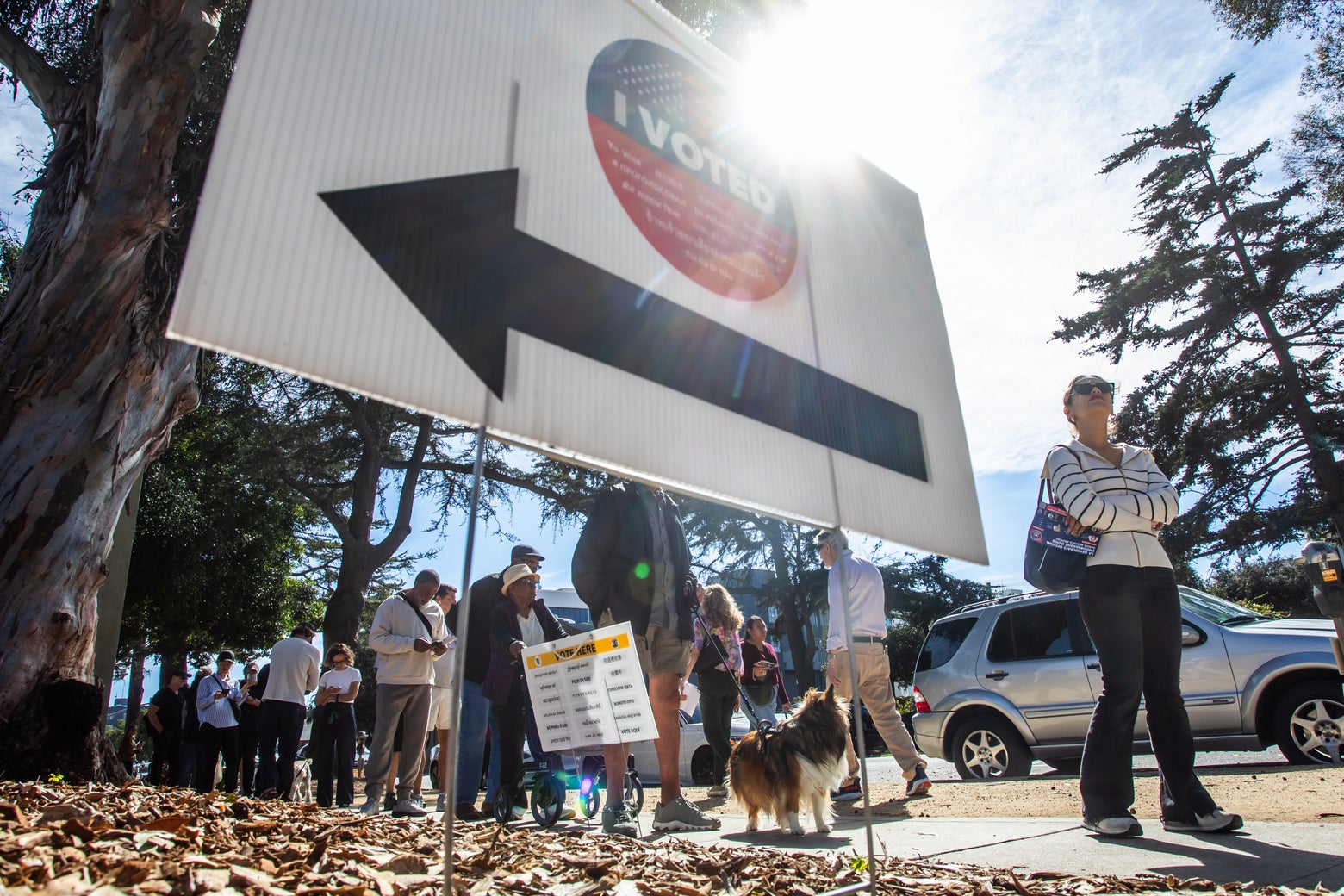
Jurisprudence Voters ready in line to cast their ballots at Marine Park as Californians head to polls on Election Day on November 3, 2026 in Santa Monica, California, United States. (Photo by Apu Gomes/Getty Images) Sign up for Executive Dysfunction, a weekly newsletter that highlights one under-the-radar story about how Trump is changing the law—or how the law is pushing back—and keeps you posted on the latest from Slate’s Jurisprudence team. Despite legitimate fears that the forces behind Jan. 6 would do their utmost to manipulate our elections, it was clear by Tuesday night that the just-concluded U.S. midterm elections survived President Donald Trump’s relentless attacks. Now, the morning after, there is every reason to believe that U.S. Senate and House winners will be able to peaceably assume office in January, with Democrats regaining control of both houses. There were no ICE agents at polls, Department of Justice officials challenging voters, or federal agents forcing state and local election officials to set aside ballots from alleged noncitizens. States were able to mail ballots to voters. Republican House Speaker Mike Johnson, who will no longer be speaker on January 3, won’t try to block the seating of Democratic victors. Late Tuesday night, he acknowledged that Democrats will control the House. We are in decent shape not because Trump’s attacks were weak, or because our election system is strong, or because we were just lucky—although the huge margins did make things “too big to rig.” The risk that Trump would interfere with our democracy in a way that made 2020 look harmless was quite serious, and it took laborious work of thousands of lawyers, election administrators, and key parts of civil society to neutralize the threat from materializing. And yet: We cannot let our guard down against future attacks on American democracy. For now, though, we can be sure that those who would subvert U.S. elections will be in much weaker shape come 2028, with fewer election deniers in office, and fewer state legislatures likely to pass new, restrictive voting laws. Let’s start with how much the goal posts have moved. Before polls closed Election Night, CBS News Senior White House reporter Weija Jiang posted on X that while the president’s advisors were concerned about potentially “razor thin” U.S. Senate margins, “Trump is not planning to push officials not to certify results or declare martial law, but they will be checking for irregularities.” The comment about the president’s “plans” was remarkably matter of fact, unaccompanied by siren emojis. The post did not cause major news outlets to send alerts. It was already baked into Americans’ understanding that the president might contemplate trying to block the results of democratically conducted elections, potentially putting armed troops into the streets. Donald Trump in his second term matched his nonstop attacks on election integrity—he’s made claims of rigged elections on 460 days and counting in his second term, according to a New York Times tally—with real actions. He tried to force a federal agency to change the form voters can use to register in federal elections to require documentary proof of citizenship. He likewise tried to muscle the United States Postal Service into a rush adoption of strict rules governing election mailings that would have stopped USPS from accepting mail ballots from any state in 2026. He tried to shove that change down the Supreme Court’s throat with three separate emergency petitions. His DOJ went 0-for-27 in trying to get states to hand over unredacted voter rolls containing personal information like social security numbers, to make a purported citizenship list that no doubt would have been used to disenfranchise eligible voters. He had DHS agents harass people and arrest some accused of voter fraud, often without reliable evidence. His DOJ threatened California election officials with criminal prosecution if they didn’t break state and federal law by segregating ballots for potential disenfranchisement. There were legitimate concerns Trump would go further, such as by seizing ballots or voting machines while states were tabulating ballots and certifying results. People also worried he would invoke the Insurrection Act or declare a national emergency as a pretext for a federal election takeover. He publicly said he wanted a federal takeover of elections in Democratic states. His administration refused to categorically rule out sending ICE or other agents to the polls, or to abstain from messing with state election certifications. That none of this happened is a testament to the very hard work that has been underway for years. It was not just of one individual or group that saved American democracy. Civil rights lawyers, who have been in the trenches for years fighting for voting rights, pivoted to fighting against attempts to steal elections. Nonprofit election protection organizations mobilized civic, business, and religious leaders to bolster support for threatened election officials. Foundations and voters stepped up to fund this intense work. Democratic and Republican election officials conducted war games considering what to do if DOJ showed up with warrants for ballots or to arrest election administrators. Citizen groups mobilized in case ICE showed up at the polls. Courts decided emergency election cases, often on absurdly compressed timetables, and judges across the legal and political spectrum held the line. Journalists relentlessly explored the weak spots in how elections are run, pressed the Trump administration for answers, and reported fairly about the risks. Voters turned out in droves, and named democracy as one of their primary concerns, along with corruption, for their votes. They rejected election deniers who wanted to run elections in 2028. As the Democrats’ shellacking was clear on Tuesday evening, Trump told the New York Times that “I am absolutely willing to accept those results.” That’s good, but the shenanigans may not be fully over. Trump’s Justice Department signaled Tuesday that it may still push against the certification of the U.S. Senate race in Alaska should results show that incumbent Republican Senator Dan Sullivan narrowly lost the race. It also sent target letters to Democratic lawyers and party officials suggesting they could face possible indictment for allegedly conspiring with candidate Daniel J. Sullivan to run in the Senate race to confuse voters and help Democratic candidate Mary Peltola. That said, even the staunchest election deniers could do nothing but concede defeat. Texas Attorney General Ken Paxton, who on the frontlines of Trump’s legal efforts to overturn the vote in 20202, conceded defeat on Tuesday night, congratulating Senator-elect James Talarico. Paxton’s response was not the outcome one might have predicted up until the very moment it was made, but such was the work of democracy’s many protectors that it was his only choice. As for what’s next, Trump may not try to repeat his election subversion attempts in 2028, when he will have nothing personally on the line. My hope is that he disengages from the issue. But that does not mean the U.S. is out of danger. Trump’s actions in 2020 and 2026 revealed the nation’s vulnerabilities, and the next would-be authoritarian might be more ruthless and more competent. We should not walk away from 2026 feeling like the mobilization against antidemocracy forces was overkill or unnecessary. We should be proud that, thanks to the effort of thousands of people, the system held against a powerful barrage. Democrats Department of Justice Donald Trump Jurisprudence Judiciary Mississippi 2026 Midterms
Our Democracy Was Hanging By a Thread. Here’s the Real Reason It Held.
Full Article
Original Source
Read the full article at Slate →KhanList aggregates and links to publicly available news content. We do not host full articles from third-party sources. Always verify important information with original sources.