
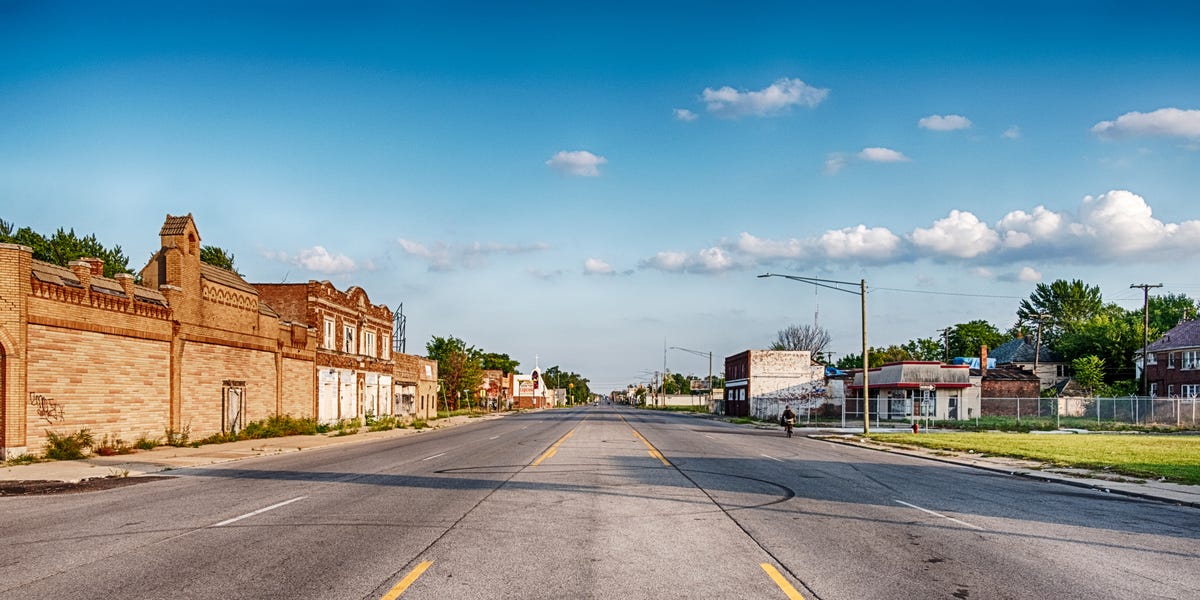
7 min readHere’s what you’ll learn when you read this story:The global population could shrink to just 2 billion people in 300 years—a size last seen in 1927.About 40 percent of nearly 30,000 U.S. cities are already depopulating, and that’s a threat to infrastructure such as roads, water systems, and buildings.The U.S. loses 6 billion gallons of treated drinking water each year through leaking pipes. Replacing the system at the current pace could take 200 years.Two billion individuals. That’s economist and demographer Dean Spears’ forecast for our human population in 300 years. The last time we belonged to that small of a group was 1927. Now there are eight billion of us, and in 2080, we’re expected to hit our peak—around ten billion people. Yet, for the first time in history, demographers estimate that the average dropping birth rate over the past several decades means our species will no longer be able to replenish our numbers.Civil engineers say this will cause major instability worldwide, including to the man-made structures of our world—roadways, buildings, safe water pipelines, and more. All of them will likely deteriorate without city residents who can pay to maintain such structures.But we don’t have to fully reimagine what our infrastructure would look like under extreme population collapse; we can look to a swath of the industrial Midwest, known as the Rust Belt, which saw immense population decline when the steel industry cratered in the 1970s and ’80s. The fallout meant shedding at least 75 percent of the 350,000 jobs lost nationally, and massive population decline in cities from St. Louis, Missouri to Buffalo, New York. For example, in Cleveland, Ohio, 46 percent of the residents exited between 1970 and 2000, a typical scenario.Depopulation on this scale is an unprecedented situation, but also an inevitable one, explains civil and environmental engineer Sybil Derrible, PhD, a professor at the University of Illinois Chicago. He calls himself an urban engineer, because he focuses on studying how population loss will affect multiple urban infrastructure systems over the coming century. “As far as I know, there's no policies about how to deal with depopulating cities,” he says. “No one’s going to give you $2 million to shrink.”The total mass of all infrastructure systems humans have built over the past 200 years is truly mind-boggling; it exceeds all living biomass, which is 545.8 gigatons, according to the World Economic Forum. “So when the population goes down, infrastructure will go from being a thing we really need to being a burden. And it's already happening in many cities where there was a lot of infrastructure investment,” says Derrible.In the 1970s, a massive exodus began in Pittsburgh, Pennsylvania, when the steel industry collapsed. The city of nearly 700,000 residents shrunk to about half its size between 1970 and 2025, and today more than 20,000 housing units sit vacant.The engine that keeps a city running is its infrastructure, a vast, interconnected network of housing construction, roadways, public transit, electrical grids, and safe drinking water. But multiple factors, including job loss and a higher cost of living, have been pushing people—including new migrants—out of thousands of American cities for decades, leaving the infrastructure with little financial support. The problem will only worsen as the population fails to replace itself, Derrible believes.Right now, about 40 percent of the nearly 30,000 U.S. cities are losing their people. In a century, it will be more like 50 percent. The larger ones, like New York City or Chicago, are likely to weather changes in population in the long run. It’s the smaller ones, home to about 10,000 to 20,000 people, that will truly suffer, Derrible says. About 12,000 cities, many of them in the Midwest, are facing infrastructure problems, but at least another 3,000 will be experiencing them by 2100, according to Derrible and his team’s 2024 paper in Nature. While the overall U.S. population is increasing due to immigration, people coming to this country don’t usually move to “small, rural cities,” he says. Instead, they settle in the suburbs.Yet, policies designed to help people living with weakened infrastructure don’t yet exist, Derrible says. “Those people are completely being neglected. So I'm worried about that. I really want to make sure that we have some policies to be able to help them.”But Derrible believes the solutions will come. Policymakers, engineers, scientists, city planners, and residents need to put their heads together and do the work, he says.Here are three core parts of city infrastructure that are already being hit the hardest.~Water~The most dire consequence of a shrinking population is the inability to maintain massive but increasingly derelict water distribution systems, Derrible says. If you don’t have money for upkeep, the result can be crises like Flint, Michigan’s untreated toxic water disaster, which happened after the cash-poor city switched its municipal water source from Detroit’s system to the Flint River to cut costs in 2014. The city has seen a mass departure of people since the 1980s, when the U.S. auto industry closed many plants and downsized operations. By 2010, four years before the water crisis, Flint’s population had dropped to nearly half its former peak.“[The water problem] is especially overlooked because people don’t think about it too much,” Derrible says. Figuring out solutions to the lurking water crises in cities has to happen now, he says, but no easy solutions exist. Questions about how to deal with water contamination or shortages are many, though: “Do you go back to wells? Are there aquifers?” Derrible asks. And if you need to cut off a totally depopulated part of a city, how do you even do that?According to industry organization Empowering Pumps and Equipment, aging water infrastructure is the biggest enemy of water, wastewater, and stormwater professionals who maintain and run these systems. The group cites the 2017 American Society of Civil Engineers (ASCE) Infrastructure Report Card, which says that pipes leak 6 billion gallons of treated drinking water each year, and that about 240,000 water main breaks happen annually. Upgrades and replacements require greater investment—to the tune of $670 billion, the ASCE’s 2025 infrastructure report says—but funding doesn’t come close to meeting need. With two million miles of drinking water pipes across the country, many of which were laid in the early- to mid‐20th century and are now technically at the end of their lifespan, it will take an estimated 200 years to replace the entire system at the current replacement rate of 0.5 percent of pipes per year, according to the 2017 report.//Roads//Underutilized roads are cracking and becoming harder to drive on, but also harder to fix in cities with far fewer people. A 2021 paper by Derrible and his team in the journal Environmental Research: Infrastructure and Sustainability reported that driving on rough roads in New Orleans cost about $685 per person each year. The city has lost half its population since Hurricane Katrina.Instead of stretching thinning budgets to maintain underutilized roads, cities could consider current and future traffic patterns and potentially abandon some roadways. They could even rip out surfaces and turn them back into dirt roads, Derrible says. Each city must look at its individual needs and create its own solution.Japan is implementing a similar kind of solution, where denser patches of houses and services keep their maintained roads and public transit areas, but in areas with few residents, the mostly unused streets are closed or repurposed.Several cities in the U.S. have been choosing to remove the interstate highway sections that slice up their cities, most of which entered urban areas in the 1950s and destroyed and divided neighborhoods. One such city is Detroit, Michigan, which plans to replace the wide gray strips with roomy, walkable neighborhoods, in hopes of reconnecting residential areas.||Buildings||Because fewer people means less tax revenue, cities that are being abandoned have less money to deal with aging or empty infrastructure like buildings. The other side of the coin is that new businesses don’t want to occupy old buildings. “New Costco? They’ll want new land to build it,” Derrible says. “At the same time we have all those abandoned buildings that we're not doing anything with, because it's just cheaper to build on new land than to retrofit an existing building.”The picture of abandoned buildings doesn’t have to look like a post-apocalyptic nightmare of neglect. Existing buildings that are still in good shape could meet housing needs or become community spaces. For example, urban malls could be turned into apartments that are already conveniently located.“At the very least, what I think we could be doing when a building is being abandoned is remove all the hazardous equipment, material, appliances, all of that,” Derrible says. Similar to the cleanup after a natural disaster, all furnaces and power and electrical hardware must come out to prevent fires and toxic materials.Then you could either bulldoze the building and remove the debris, or you could strip the structure for useful parts, such as wood, metal, pipes, and electrical wire. Even skyscrapers could become rich sources of material that the civil engineering industry could mine. “Instead of going to quarries and getting new material, we could go to old skyscrapers or old concrete buildings. We crush them, so we have the aggregates to build new buildings,” Derrible says. The wood could also be reused, or it could become a source of fuel when burned. Derrible foresees abandoned city infrastructure as a potential source of new jobs that mine and process material for reuse. “Isn't that like the core of the American system, to turn any challenge into an opportunity, right?”Download Pop Mech Digital IssuesBefore joining Popular Mechanics in 2022, Manasee Wagh worked as a science journalist, a newspaper reporter, a technical writer, and an engineer. She has a bachelor's degree in computer engineering and a master’s degree in journalism. Her favorite stories are about the discoveries that unearth even deeper mysteries, and she enjoys helping people understand the science behind the remarkable world we live in. She lives in the Northeast with her two favorite people and one curious, feisty feline, but always seeks to combine her love of food, nature, and travel into memorable journeys away from home.
Our Cities Are Shrinking. Does That Mean They’re Doomed to Be Unlivable?
Full Article
Original Source
Read the full article at Popularmechanics →KhanList aggregates and links to publicly available news content. We do not host full articles from third-party sources. Always verify important information with original sources.