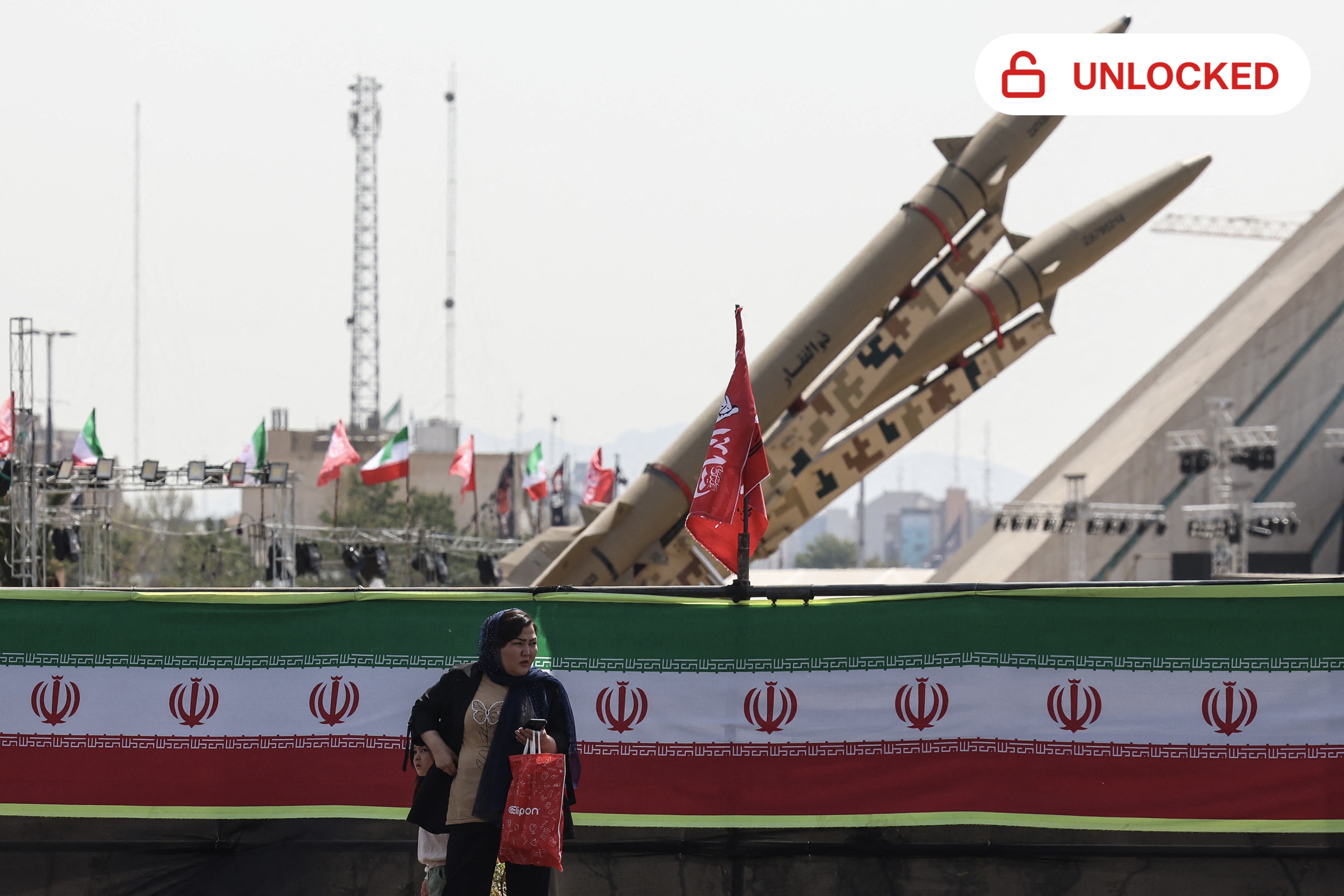
Turn any article into a podcast. Upgrade now to start listening. Members can share articles with friends & family to bypass the paywall. Hello and happy Saturday. The situation in the Middle East added a few layers of complexity this week. As the U.S. and Iran traded strikes, the Yemen-based Houthis said they would impose a naval blockade of Saudi ports. Meanwhile, the Trump administration announced Wednesday it had signed a deal with Saudi Arabia to help it build a civilian nuclear program. That’s a lot to unpack—especially considering that after the nuclear deal was signed, President Donald Trump said Thursday it was contingent on Saudi Arabia normalizing relations with Israel. Saudi Arabia has long insisted it would not do so without a pathway to Palestinian statehood. That puts the deal in doubt, which, given the reviews of the agreement provided by Kevin D. Williamson and Nick Catoggio, might not be the worst thing. Pointing to reporting from the New York Times that the Saudis insisted on terms that limit international inspectors and that the deal could eventually allow the Saudis to enrich uranium, Nick ran through the various reasons Trump might have sought such a deal—the Saudis have been benefactors to various Trump family businesses, he sees them as friends, or maybe oil was involved. He concludes: Wherever you land in all of this, it goes without saying that a U.S. government led by Trump can’t be counted on to stop the Saudis from converting their nuclear energy program into a nuclear weapons program, no matter what sort of formal “black box” guarantees might be built into the relationship. Relying on postliberal America for oversight of Riyadh is like relying on one mafia family to police another with which it’s in business. Kevin, who agrees with Nick that the Saudis are ultimately seeking a nuclear weapon, reminded readers that the Saudis had awfully close ties to the terrorists who carried out the September 11, 2001, terrorist attacks—15 of the hijackers were subjects, Saudi charities and elites supported al-Qaeda financially, etc.—and noted that the Trump administration has sought to stymie litigation brought by families of 9/11 victims against the Saudi government. He writes, “The administration’s credibility here … is not exactly bombproof. And we know that Trump can be bought, or at least rented, by any tinpot Arab potentate with capital sufficient to purchase an airplane.” As of Friday, the U.S. had carried out strikes on targets across Iran for 13 straight nights, with Iran targeting U.S. military installations and civilian infrastructure in the Gulf States. Trump has threatened to strike Iranian bridges and power plants in response. Reuel Marc Gerecht suspects that Trump really wants a nonmilitary solution to the problem, but says that “his ‘art-of-the-deal’ style isn’t helping. The president’s gyrations, the continuing disconnects between word and deed, make him look increasingly unserious.” And he suggests that the president is running out of time: We are probably at Trump’s last chance to show that he still deserves the Islamic Republic’s initial fear of him. If he doesn’t now begin the battle of Hormuz or at least amp up economic warfare through an oil-proof, indefinite blockade, which will certainly guarantee that Iran keeps shooting at Arab Gulf-state energy infrastructure, then it’s not likely he will gird his loins for a more dangerous military campaign after the November elections, as some hope. But Mike Coté, a writer and historian who hosts the Rational Policy podcast, argues that there might be another option: stop shooting. He notes that the endless cycle of “negotiation, ceasefire, fighting, and escalation” has done nothing to temper the conflict and that both diplomacy and combat have their own risks. His solution? “Embrace ambiguity and step back.” Basically, end the strikes, leave the blockade in place, and ramp up sanctions. He writes: This approach avoids many of the traps that could present themselves—and very much already have—in the dealmaking and enforcement process, as well as a potential return to all-out war. Instead of trying to come to an understanding with a counterparty that is uninterested in implementing or following any agreement, America should bank its tangible military victories, continue to apply maximum economic pressure, and maintain its freedom of action to strike kinetically once again if the opportunity arises. Thank you for reading and have a good weekend. One note: There will be no Dispatch Weekly next Saturday as the Ohio bureau is relocating to South Carolina for a little R&R. If you have any recommendations for the Charleston area, I’d love to hear them. Perhaps the most surprising thing about Doug Wilson’s ideas is how much they recycle. When asked about Christian nationalist policies he would focus on today, Wilson replayed a narrow set of issues from the culture wars: abortion, LGBTQ rights, and feminism. Wilson runs his ministry along the tried-and-true template of the megachurch pastor or televangelist, presiding over a conglomerate of churches, schools, and media outlets that also employ his family. … And while Wilson claims the moniker “Reformed” (his college is “New St. Andrews,” echoing the University of St. Andrews), his lack of formal theological training (he has an M.A. in philosophy from the University of Idaho but no theological degrees from seminaries) and penchant for innovation are constitutionally at odds with that tradition. In many ways, Wilson’s approach reflects more of his upbringing as a child of the post-World War II religious revival than the traditionalism he espouses. It’s just before noon on a Saturday, and the blacktop at RFK Stadium’s “festival grounds”—which is just a nicer way of saying “parking lot”—is already reflecting 90-plus degree heat into the crowd. Free Throw is one of my favorite new-ish emo bands, and I’m not one to turn down a good time. But I’m fresh off a midnight drive from Jersey to D.C., and I’m exhausted. The early hours (at least those between, say, 4 and 11:59) aren’t meant for moshing. And yet there’s a pit to jump into. The very first pit of Vans Warped Tour 2026. What began as a ramshackle tour has, 31 years later, grown into a highly choreographed blockbuster festival with stops in five major cities across North America. The Vans Warped Tour is often likened to an emo summer camp for artists and attendees alike. Today the tour is more polished, more corporate, more predictable. But the formula remains the same, and it works. And while the “summer camp” comparison might be cliché, there’s a reason it’s stuck. There’s an old joke that libertarianism is “a shadowy conspiracy to leave you alone,” and while conservatism and liberalism (I mean what we call “classical liberalism,” though I do not much care for that phrasing and do not want to repeat it every time) are distinct from libertarianism, they have a certain libertarian character and share a certain libertarian disability: The practical pursuit of political power is always in tension with philosophies based on restraining political power. Populism is exciting and enjoys a certain built-in political advantage because it is based on an underlying premise of action rather than on an underlying premise of restraint: A populist demagogue, of the right or of the left, can promise a crowd just about anything—there is no limiting principle. Ezra Klein, speaking at the conference, praises the “unbounded” vision of New York’s socialist mayor, Zohran Mamdani. Liberalism is not an unbounded vision of the scope of state action. The hard part of selling liberalism or American conservatism (which seeks to conserve the liberal principles of the American founding) is not how we talk about the philosophy—the trouble is with the philosophy itself. Restraint is (barring some kink) unsexy. There is nothing thrilling about acknowledging the necessity of trade-offs, the role of prudence applied ad hoc to individual cases, or that the best-case scenario we are offering is a series of good-enough second-best settlements and accommodations. Best of the Rest Rachael Larimore is a managing editor of The Dispatch and is based in the Cincinnati area. Prior to joining the company in 2019, she served in similar roles at Slate, The Weekly Standard, and The Bulwark. She and her husband have three sons.
Our Best Stuff From a Big Week in the Middle East
Full Article
Original Source
Read the full article at Thedispatch →KhanList aggregates and links to publicly available news content. We do not host full articles from third-party sources. Always verify important information with original sources.